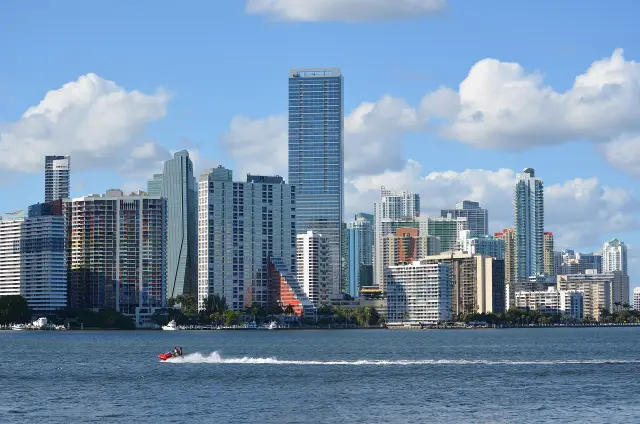
Short answer: Jacksonville grew into one of the great rail centers of the South as lines from Georgia and Florida met at the St. Johns River. The Jacksonville Terminal on Lee Street opened at 12:01 a.m. on November 17, 1919, and served passengers until January 4, 1974, according to its National Register nomination. Today CSX and the Florida East Coast Railway are based in Jacksonville, and JAXPORT counts 40 daily trains on three major railroads.
Last verified: October 18, 2026, against the sources listed at the end of this page.
Why is Jacksonville a rail center?
Jacksonville became a rail center because it was where lines from Georgia and the North met the Florida railroads, a role its 1976 National Register nomination calls one of the great rail centers of the South.
The National Register nomination for the Jacksonville Terminal Complex, prepared by the Florida Department of State in November 1975, says Jacksonville's emergence as a major transportation center began in the mid-nineteenth century and that events of the 1880s insured its future as one of Florida's great rail centers and terminal cities. It closes by calling Jacksonville a major terminal city whose history and development have been closely tied to rail transportation.
The rail role continues at the port and in two corporate offices. JAXPORT lists 3 major railroads, 40 daily trains and 40 rail freight stations in Duval County. CSX Corporation describes itself as based in Jacksonville, and the Florida East Coast Railway says it is based in Jacksonville and connects to the national railway system there.
How did the railroads first reach Jacksonville?
The lines that made Jacksonville a junction came together in the 1880s, when Henry Bradley Plant's system linked the city more directly with Georgia.
The nomination says inland transportation between Florida and Georgia, the link Jacksonville depended on, was firmly established with Plant's 1879 purchase of the Atlantic and Gulf Railroad, which he reorganized as the Savannah, Florida and Western Railway, a forerunner of the Atlantic Coast Line. A Live Oak to Lawton connector had been completed in March 1865 to carry Confederate supplies; its tracks were torn up at the end of the war and relaid by October 1866.
In 1881 Plant built the 75-mile Waycross Short Line between Waycross, Georgia, and Jacksonville, which gave the city more direct access to the North. The depot for that line, called the Waycross Depot or Union Depot because it also served the Jacksonville, Pensacola and Mobile Railroad, stood roughly where the Seaboard Coast Line building stood when the nomination was written.
What came before the 1919 Jacksonville Terminal?
Before the 1919 terminal, Jacksonville's trains used an 1898 Union Station built by the Jacksonville Terminal Company, which was chartered in 1894.
The nomination says the company's officers included Henry Morrison Flagler as president, and that land along McCoy's Creek in Jacksonville was filled for a new station. A September 1894 hurricane destroyed the framing, so only the train shed, one-fifth of a mile long by 520 feet wide, was complete by 1895, when service opened from a temporary two-story brick building that still stood beside the terminal in 1976.
The construction contract for the permanent Union Station, designed by architect W.B.W. Howe, was let in June 1896, and the station opened in 1898. The nomination says it served the rail travelling public of Jacksonville for the next 21 years, until popular agitation for a larger and more presentable depot grew in the 1910s.
What was the Jacksonville Terminal on Lee Street?
The Jacksonville Terminal was the $2.5 million station on the Lee Street site that opened at 12:01 a.m. on November 17, 1919, and carried passengers until January 4, 1974.
| Date | Event | Source |
|---|---|---|
| 1894 | Jacksonville Terminal Company chartered | National Register nomination |
| 1898 | Union Station opens, architect W.B.W. Howe | National Register nomination |
| November 17, 1919 | Jacksonville Terminal opens at 12:01 a.m. | National Register nomination |
| July 1, 1967 | Atlantic Coast Line and Seaboard Air Line merge as the Seaboard Coast Line | National Register nomination |
| January 4, 1974 | Passenger service at the terminal ends | National Register nomination |
| October 22, 1976 | Register record published, NRIS 76000590, 1000 W. Bay St. | NPGallery record |
The nomination records a dispute over the site: the City of Jacksonville had selected Myrtle Avenue, while the terminal company favored the Lee Street site next to the existing depot, which won. Kenneth Murchison of New York submitted the winning design, Irwin and Leighton of Philadelphia built it, and the building cost about $2,500,000. With over twenty stub end and through tracks, it served the Southern Railway, the Atlantic Coast Line, the Seaboard Air Line and the Florida East Coast.
The Jacksonville terminal opened with little celebration or fanfare and was in disuse when the nomination was written. The National Park Service record lists the Jacksonville Terminal Complex in Duval County under NRIS 76000590 with significant years of 1898 and 1919.
How did Jacksonville railroads connect to the port?
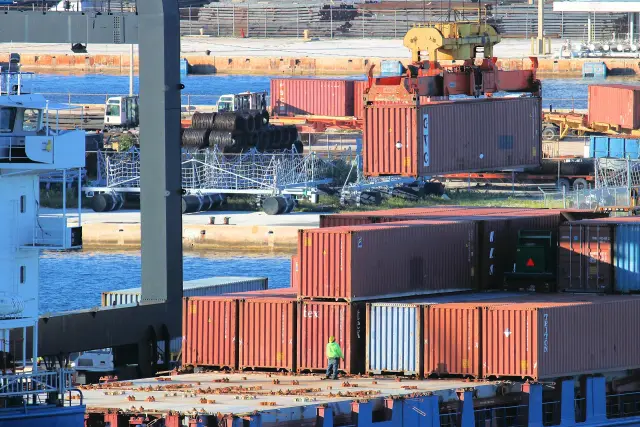
Jacksonville's port has moved cargo between ships and trains since the 1890s, and today JAXPORT runs two intermodal container transfer facilities.
The JAXPORT history says that at the turn of the century downtown Jacksonville harbored 30 private waterfront ship terminals transferring cargo between ship and rail, after a dredging project that cost $1.8 million, including $300,000 from the first bond issue ever sold by Duval County. In 1913 Jacksonville voters approved $1.5 million in construction bonds for municipal docks on about 160 acres in the Talleyrand area.
In 2016, per the same history, JAXPORT's $30 million Intermodal Container Transfer Facility opened to give on-dock rail service to the Blount Island and Dames Point terminals in North Jacksonville. The port's current rail connections page describes the layout a little differently, listing one on-dock transfer facility at the Talleyrand Marine Terminal and one near-dock facility at Dames Point. It also says the Jacksonville port has the highest and widest cargo clearance for port rail access on the CSX national system, 20 feet high and 13 feet wide.
Which railroads and trains serve Jacksonville today?
Freight dominates: JAXPORT counts 40 daily trains in Jacksonville on two Class I railroads, CSX and Norfolk Southern, plus the regional Florida East Coast Railway.
CSX says its CSX Transportation network covers about 20,000 route miles of track in 26 states, the District of Columbia and the Canadian provinces of Ontario and Quebec. The Florida East Coast Railway calls itself a Class II regional railroad that owns all of the 351-mile main line from Jacksonville to Miami and connects in Jacksonville to the national system for traffic to and from Georgia, Tennessee and the Carolinas; intermodal traffic is 78 percent of its business, and it is the exclusive rail provider for PortMiami, Port Everglades and the Port of Palm Beach.
Passenger service runs from the Amtrak station at 3570 Clifford Lane, a brick station that opened in early 1974 between downtown and the airport. Amtrak lists the Floridian and the Silver Meteor there, reports CSX Transportation as owner of the platform and track, and gives annual ridership of 94,783 for fiscal year 2025. It also says the Jacksonville Transportation Authority and the Florida Department of Transportation have discussed since the late 2000s moving Amtrak back to the former Union Station in LaVilla, now the Prime F. Osborn III Convention Center, in a multimodal center estimated at about $180 million with funding sources not yet identified. The Amtrak page carries no date for that estimate.
Last verified: October 18, 2026, using the Jacksonville Terminal Complex National Register nomination and NPGallery record, the JAXPORT port history and rail connections pages, the Amtrak station page, and the CSX and Florida East Coast Railway company pages.
Frequently asked questions
When did the Jacksonville Terminal open?
The National Register nomination says the terminal opened to the public at 12:01 a.m. on November 17, 1919, with little celebration or fanfare.
When did passenger trains stop using the Jacksonville Terminal?
The nomination says the terminal served passenger traffic until January 4, 1974. Amtrak says its Clifford Lane station opened in early 1974.
Where is the Amtrak station in Jacksonville?
Amtrak lists the Jacksonville station at 3570 Clifford Lane, between downtown and the airport, served by the Floridian and the Silver Meteor, with 94,783 riders in fiscal year 2025.
Is CSX headquartered in Jacksonville?
Yes. CSX Corporation describes itself as based in Jacksonville, and its CSX Transportation network covers about 20,000 route miles in 26 states.
How many trains run through Jacksonville each day?
JAXPORT says Jacksonville offers 40 daily trains on two Class I railroads, CSX and Norfolk Southern, plus the regional Florida East Coast Railway.
Sources
- Jacksonville Terminal Complex, National Register of Historic Places Inventory, Nomination Form (National Park Service NPGallery; prepared by the Florida Department of State, 1975) https://npgallery.nps.gov/GetAsset/2d9fb282-18fd-4e51-b684-1c692a825946 Used for: rail history, 1898 and 1919 stations
- Jacksonville Terminal Complex, NRIS 76000590 (National Park Service NPGallery) https://npgallery.nps.gov/AssetDetail/NRIS/76000590 Used for: register record
- Port History, JAXPORT https://www.jaxport.com/about-jaxport/port-history/ Used for: ship to rail terminals, 1913 bonds, 2016 ICTF
- Rail Connections, JAXPORT https://www.jaxport.com/cargo/rail-connections/ Used for: daily trains, ICTFs, clearance
- Jacksonville, FL (JAX), Great American Stations (Amtrak) https://www.greatamericanstations.com/stations/jacksonville-fl-jax/ Used for: its own station, ridership, relocation plan
- About, Florida East Coast Railway https://www.fecrwy.com/about Used for: its own network
- Company Overview, CSX https://www.csx.com/index.cfm/about-us/company-overview/ Used for: its own base and network
How this page was made
Digital Towns uses AI assistance to research and write its guides, and every page is only as good as the sources it cites. Our goal is the most accurate, useful local information possible.
This page was fact-checked twice before publishing.
If you see an error, or anything you can show is false, tell us right away and we will take a third look.
Report an error
Thank you. We'll take a third look and correct the page if it's wrong.