Short answer: Arlington is a Jacksonville neighborhood on the St. Johns River, inside the City's Greater Arlington/Beaches planning district. Its history runs from the French Fort Caroline of 1564 to Norman Studios on Arlington Road and the Mathews Bridge, built in 1953, after which the district saw its greatest growth. The Renew Arlington CRA now targets University Boulevard, Merrill Road and Arlington Road.
Last verified: October 18, 2026, against the sources listed at the end of this page.
What is Arlington, and where is it in Jacksonville?
Arlington is a Jacksonville neighborhood along the St. Johns River, at the heart of the City's Greater Arlington/Beaches planning district.
The City's Greater Arlington/Beaches Vision Plan (2010) describes a district of almost 42,000 acres, about 62 square miles, with more than forty residential neighborhoods. Its predominant physical characteristics are the St. Johns River along the western and northern borders, the Intracoastal Waterway and beach communities to the east, Craig Airport and Naval Station Mayport, and colleges including Jacksonville University, Jones College and Florida State College at Jacksonville.
Jacksonville University, established in 1934, describes its campus as set in Jacksonville's historic Arlington neighborhood, with a half-mile stretch along the St. Johns River. The university's own About page gives two campus sizes: 235 acres in its introduction and 260 acres in its fast facts. Old Arlington is the older riverside core; the City places Norman Studios "in the heart of Old Arlington."
What happened at Fort Caroline?
Fort Caroline was the French colony founded on the St. Johns River in 1564 and attacked by Spanish troops in the fall of 1565.
The National Park Service writes that two centuries of Spanish and French colonial rivalry in North America began there in 1564, when Admiral Gaspard de Coligny envisioned Fort Caroline as a French challenge to Spanish colonies, a potential commercial venture and a shelter for Huguenots. Rene de Goulaine de Laudonniere led the attempt, and the group of 200 named the area La Caroline after King Charles IX. The local Timucua initially helped the French build the fort.
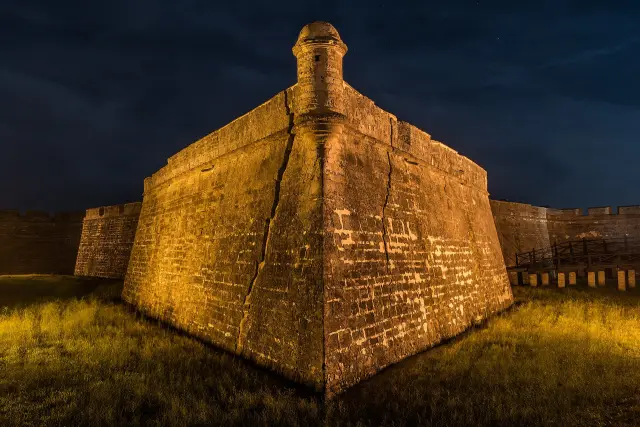
Spain answered quickly. King Philip II sent an armada under Don Pedro Menendez de Aviles, whose troops attacked the fort in the fall of 1565, killing most of the settlers they found. In April 1568 the French sent Dominique de Gourgues, who landed at Fort San Mateo (Fort Caroline) and captured and burned the fort. The NPS notes that the exact site of the fort is unknown and that visitors see a large-scale model based on contemporary drawings.
Today Fort Caroline National Memorial memorializes the short-lived French presence in sixteenth century Florida and hosts the visitor center for the entire Timucuan Preserve, at 12713 Fort Caroline Road. Current NPS operating hours for the Fort Caroline grounds are 9:00 a.m. to 5:00 p.m., Wednesday through Sunday, closed on Thanksgiving, Christmas Day and New Year's Day. The City's Vision Plan adds that, rivaled only by St. Augustine, Fort Caroline is a monument to one of the oldest colonies in Florida and the United States.
What are the key dates in Arlington history?
The key dates run from the 1564 French colony to the 2015 creation of the Renew Arlington Community Redevelopment Area.
| Year | Event | Source |
|---|---|---|
| 1564 | Laudonniere's colony founds Fort Caroline on the St. Johns | NPS |
| 1565 | Menendez's troops attack the fort in the fall | NPS |
| 1915 or 1916 | Eagle Film studio complex developed (NPS says 1915; the City and Department of State say 1916) | NPS, City |
| 1922 | Richard Norman buys the Eagle Film studio in Arlington | NPS |
| 1953 | Mathews Bridge, a toll-financed steel through truss, is built | FDOT |
| 1988 | Tolls removed from the Mathews Bridge and four other facilities | JTA |
| 1989 | Dames Point Bridge opens to the general public | JTA |
| December 19, 2002 | City of Jacksonville buys Norman Studios | City |
| 2009 | First JTA Community Shuttle begins service in Arlington | JTA |
| 2015 | Renew Arlington CRA enabled by legislation 2015-0738 | City |
| 2016 | Norman Studios designated a National Historic Landmark | Florida Department of State |
Why is there a film studio on Arlington Road?
Arlington Road holds the Norman Studios complex, built for the Eagle Film company and bought by Richard Norman in 1922.
The National Park Service lists Norman Film Studios at 6337 Arlington Road in the National Register (reference number 14001084), managed by the City of Jacksonville. It says the complex was originally developed in 1915 by the Eagle Film Company on the site of a cigar factory and served as the headquarters of the Norman Film Manufacturing Company from 1922 to 1928. Norman's early westerns encouraged him to purchase the old Eagle Film studio in Arlington in 1922; later films were shot on location in Jacksonville, many Arlington residents appeared in scenes, and all post production work was done at the Arlington studio.
The Florida Department of State announced on December 5, 2016 that the studios had been designated a National Historic Landmark, calling them the last remaining complex of buildings from a time when Jacksonville was a leader in the silent film industry, and the only preserved film studio in the nation that once specialized in silent films starring African Americans. The release gives the founding as 1916, as Eagle Film City, and says Jacksonville boasted more than 30 movie studios in 1916.
The City of Jacksonville bought the studio on December 19, 2002. Its JaxParks page lists a production building, a generator building, a small cottage for visiting actors and a prop shed, and notes that The Flying Ace (1926) is the only Norman film to have survived. The Department of State says the City has worked since 2002 to partially restore the site with three historic preservation grants from the Florida Division of Historical Resources and city matching funds, while the nonprofit Norman Studios Silent Film Museum works to reopen it.
How did Arlington become a postwar suburb?
Arlington grew fastest in the 1950s, 1960s and 1970s, after the Mathews Bridge and the Arlington Expressway tied it to downtown Jacksonville.
The Florida Department of Transportation historic bridge survey describes the Mathews Bridge as a steel through truss bridge built in 1953 and lists it among the Duval County bridges originally financed by tolls. The Jacksonville Transportation Authority timeline records that tolls at the Mathews Bridge, Fuller Warren Bridge, Hart Bridge, Trout River Bridge and J. Turner Butler Boulevard were removed in 1988, and that the Dames Point Bridge, officially the Napoleon Bonaparte Broward Bridge, opened to the general public in 1989.
The City's Vision Plan sums up the effect: the Greater Arlington/Beaches district experienced its greatest growth during the 1950s, 1960s and 1970s, following the construction of the bridge and the Arlington Expressway. Growth tapered off in the 1980s and accelerated again in the 1990s. Using decennial census counts, the plan reports a district population of 186,072 in 2000, up 26 percent from 147,927 in 1990, which made it the second most populous of Jacksonville's six planning districts. Those figures cover the whole district, beaches included, not Arlington alone.
Transit followed the growth. JTA lists 2009 as the year its first Community Shuttle began service in Arlington, and the community comments recorded in the Vision Plan call for landscaping the foot of the Mathews Bridge as an entry point into Arlington and for studying the Arlington Expressway.
What is Renew Arlington, and what is changing now?
Renew Arlington is a City of Jacksonville Community Redevelopment Area covering three commercial corridors: University Boulevard, Merrill Road and Arlington Road.
The City of Jacksonville says the CRA Redevelopment Plan is the result of a decade of community efforts and is intended as a framework for guiding development of the area over the next 20 years. The City lists the 2007 Old Arlington Neighborhood Action Plan, the 2010 Greater Arlington/Beaches Vision Plan and a 2015 Finding of Necessity Study as its background, and enabling legislation 2015-0738. All 19 members of the Jacksonville City Council serve as the Renew Arlington CRA Board, and the City posts performance measures for FY 24-25.
Historic sites are part of the picture. The Vision Plan names Fort Caroline, the Timucuan Preserve, the Ribault Monument, Norman Studios and historic homes and cemeteries as resources that can guide renewal, and lists Old Arlington homes such as the John S. Sammis House and the Charles P. Judson Residence, along with Arlington Elementary School.
Green space sits inside the neighborhood as well. Tree Hill Nature Center, a nonprofit at 7152 Lone Star Road, describes more than 50 acres of trails, a Florida Natural History Museum, butterfly and hummingbird gardens and native animals, and posts hours of Monday through Saturday, 8:00 a.m. to 4:30 p.m.
Last verified: October 18, 2026, by re-reading the Renew Arlington CRA page and the 2010 Vision Plan on jacksonville.gov, the JaxParks Norman Studios page, three National Park Service pages and its Timucuan hours page, the Department of State landmark release, the FDOT bridge survey, the JTA timeline and the Jacksonville University and Tree Hill pages.
Frequently asked questions
When was the Mathews Bridge built to Arlington?
The Florida Department of Transportation lists the Mathews Bridge as a steel through truss bridge built in 1953 and originally financed by tolls. JTA records that its tolls were removed in 1988.
Where is Norman Studios in Arlington?
Norman Studios is at 6337 Arlington Road. The National Park Service says Richard Norman bought the old Eagle Film studio there in 1922, and the City of Jacksonville bought the property on December 19, 2002.
When is Fort Caroline National Memorial open?
The National Park Service lists the Fort Caroline grounds as open 9:00 a.m. to 5:00 p.m., Wednesday through Sunday, closed on Thanksgiving, Christmas Day and New Year's Day. The memorial is at 12713 Fort Caroline Road.
What does the Renew Arlington CRA cover?
The City of Jacksonville's Renew Arlington Community Redevelopment Area covers three commercial corridors: University Boulevard, Merrill Road and Arlington Road. It was enabled by legislation 2015-0738, and all 19 City Council members sit as its board.
How big is the Greater Arlington/Beaches planning district?
The City's 2010 Vision Plan describes almost 42,000 acres, about 62 square miles, with more than forty residential neighborhoods, and a 2000 census population of 186,072.
Sources
- Fort Caroline National Memorial (National Park Service) https://www.nps.gov/timu/learn/historyculture/foca.htm Used for: memorial purpose, visitor center
- Florida: Fort Caroline National Memorial (National Park Service) https://www.nps.gov/articles/ftcaroline.htm Used for: 1564 founding, 200 colonists, 1565 attack, 1568 de Gourgues, address, model
- Operating Hours and Seasons, Timucuan Preserve (National Park Service) https://www.nps.gov/timu/planyourvisit/hours.htm Used for: current Fort Caroline hours
- Renew Arlington CRA (City of Jacksonville) https://www.jacksonville.gov/departments/office-of-economic-development/community-redevelopment-agencies/renew-arlington-cra Used for: corridors, 20-year plan, background plans, 2015-0738, board
- Greater Arlington/Beaches Vision Plan, 2010 (City of Jacksonville) https://www.jacksonville.gov/getContentAsset/a9c63a3e-4917-47b6-8b72-da72b5f13dea/135b97c9-84fa-4e82-b956-0fbccec4aa1f/0736-ar-final-vision-4-small.pdf?language=en Used for: district size and features, growth after bridge and expressway, 1990 and 2000 population, historic assets
- Norman Film Studios (National Park Service) https://www.nps.gov/places/norman-film-studios.htm Used for: address, NRHP reference, 1915 Eagle Film, 1922 purchase, Arlington production
- Secretary Detzner announces Norman Studios National Historic Landmark (Florida Department of State, December 5, 2016) https://dos.fl.gov/communications/press-releases/2016/secretary-detzner-announces-recent-designation-of-the-norman-studios-as-a-national-historic-landmark/ Used for: NHL designation, 1916 founding, 30 studios, City restoration grants
- Norman Studios (City of Jacksonville, JaxParks) https://www.jacksonville.gov/departments/parks-and-recreation/jaxparks/all-parks/norman-studios Used for: December 19, 2002 purchase, Old Arlington, buildings, The Flying Ace
- Historic Highway Bridges of Florida, 2010 Update (FDOT) https://www.fdot.gov/docs/default-source/environment/pubs/Historic-Highway-Bridges-of-Florida-2010-Update.pdf Used for: Mathews Bridge built 1953, steel through truss, toll-financed
- JTA History (Jacksonville Transportation Authority) https://www.jtafla.com/about-us/jta-history/ Used for: 1988 toll removal, 1989 Dames Point, 2009 Arlington shuttle
- About Jacksonville University https://www.ju.edu/about/ Used for: founding year, Arlington campus, acreage
- About Tree Hill Nature Center https://www.treehill.org/about Used for: its own trails, museum, address and hours
How this page was made
Digital Towns uses AI assistance to research and write its guides, and every page is only as good as the sources it cites. Our goal is the most accurate, useful local information possible.
This page was fact-checked twice before publishing.
If you see an error, or anything you can show is false, tell us right away and we will take a third look.
Report an error
Thank you. We'll take a third look and correct the page if it's wrong.