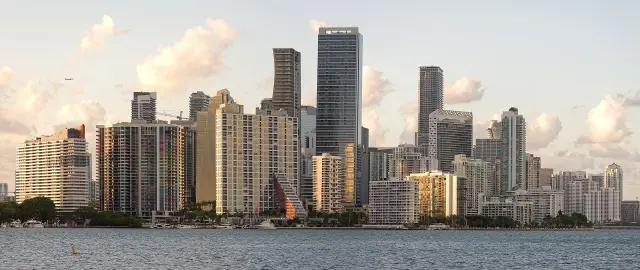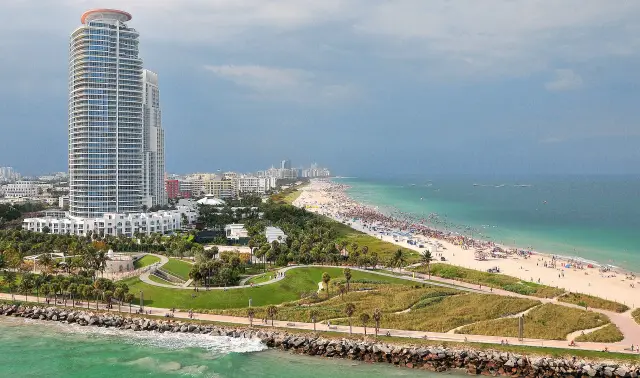
Short answer: Miami-Dade County is Florida's most populous county, with 2,738,356 residents (ACS 2020-2024 5-year) across 34 municipalities and an unincorporated area of more than one million people. Mayor Daniella Levine Cava and a 13-member commission run it from the Stephen P. Clark Center, 111 NW 1st Street, Miami, and 311 answers questions. Since January 7, 2025 the property appraiser, tax collector and elections office are independent elected offices.
Last verified: October 15, 2026, against the sources listed at the end of this page.
Where is Miami-Dade County, and how big is it?
Miami-Dade County covers more than 2,000 square miles at the southeast tip of the Florida peninsula, and one third of that land lies inside Everglades National Park.
Miami-Dade is bounded by Biscayne Bay and the Atlantic Ocean on the east, Everglades National Park on the west, the Florida Keys to the south and Broward County to the north (About Miami-Dade County). The county is larger than Rhode Island or Delaware. Early settlement grew near the Miami River and Biscayne Bay, and a lighthouse went up on Key Biscayne in 1825 to warn ships off the reefs.
Dade County was created on January 18, 1836, under the Territorial Act of the United States, and voters changed the name to Miami-Dade County on November 13, 1997 (Miami-Dade municipalities list). County government is run from the Stephen P. Clark Center at 111 NW 1st Street in downtown Miami, which also houses the Property Appraiser's main office and an elections branch office.
Immigration helped the county pass one million residents in 1962, as thousands of refugees from Cuba began arriving in the 1960s, and Miami International Airport makes Miami-Dade the North American gateway to Latin America and the Caribbean (About Miami-Dade County).
Which cities and towns are in Miami-Dade County?
Miami-Dade County holds 34 incorporated municipalities, from the City of Miami, incorporated in 1896, to Cutler Bay, incorporated in 2005, plus an unincorporated area of more than one million residents.
The full list kept by the Miami-Dade Office of Management and Budget runs in order of incorporation: Miami, Homestead, Florida City, Miami Beach, Coral Gables, Hialeah, North Miami, Opa-locka, Miami Springs, South Miami, Golden Beach, North Miami Beach, Miami Shores, Biscayne Park, Surfside, El Portal, Indian Creek Village, Sweetwater, North Bay Village, West Miami, Bay Harbor Islands, Bal Harbour, Virginia Gardens, Hialeah Gardens, Medley, Key Biscayne, Aventura, Pinecrest, Sunny Isles Beach, Miami Lakes, Palmetto Bay, Miami Gardens, Doral and Cutler Bay (Miami-Dade municipalities list). The City of Miami is the largest, followed by Hialeah, Miami Gardens, Miami Beach, North Miami and Coral Gables (About Miami-Dade County).
| Era | Miami-Dade municipalities incorporated | First and last in the era |
|---|---|---|
| 1896 to 1915 | Miami, Homestead, Florida City, Miami Beach | Miami, July 28, 1896; Miami Beach, March 26, 1915 |
| 1925 to 1949 | 21 towns from Coral Gables and Hialeah to Medley | Coral Gables, April 1, 1925; Medley, May 1, 1949 |
| 1991 to 2005 | Key Biscayne, Aventura, Pinecrest, Sunny Isles Beach, Miami Lakes, Palmetto Bay, Miami Gardens, Doral, Cutler Bay | Key Biscayne, June 18, 1991; Cutler Bay, November 8, 2005 |
| Abolished | City of Islandia | Created December 6, 1960; abolished March 6, 2012 |
Everything outside those 34 municipal boundaries is the Unincorporated Municipal Service Area, or UMSA, where the Miami-Dade Board of County Commissioners acts as the local government. With more than one million residents, UMSA would be the largest city in Florida if it were incorporated (About Miami-Dade County). The City of Islandia, created in 1960, was abolished on March 6, 2012 when the commission adopted Ordinance No. 12-14 and the area reverted to unincorporated status. A Miami-Dade postal address therefore does not settle which government collects the trash or answers a zoning question; the 311 Contact Center answers questions about local government services for both the county and the City of Miami.
How many people live in Miami-Dade County, and who lives there?
Miami-Dade County had an estimated 2,738,356 residents in the ACS 2020-2024 5-year estimates, with a median age of 40.7 and 16.9 percent of residents 65 or older.
Miami-Dade is a majority Hispanic county: 69.3 percent of residents are Hispanic or Latino of any race, and 35.1 percent of all residents are of Cuban origin (ACS DP05, Miami-Dade County). Some 54.5 percent of Miami-Dade residents were born outside the United States, and 75.3 percent of residents 5 and older speak a language other than English at home (ACS DP02, Miami-Dade County). The Miami-Dade 311 Contact Center answers calls in English, Spanish and Haitian Creole (Miami-Dade 311 Contact Center).
Median household income in Miami-Dade was $71,753, and workers averaged a 30.9 minute trip to work (ACS DP03, Miami-Dade County). Miami-Dade had 1,094,983 housing units; 52.2 percent of occupied homes were owner occupied, the median value of an owner-occupied home was $463,000 and the median gross rent was $1,829 a month (ACS DP04, Miami-Dade County).
Two population figures circulate for Miami-Dade, and they measure different things. The ACS 5-year number averages surveys from 2020 through 2024, while the county's own profile gives an estimated population of 2,802,029 in 2025 (About Miami-Dade County). The newer county estimate is the better guide to current size; the ACS table is the one to use when comparing Miami-Dade with other counties on income, age or housing, because every county is measured the same way. The Miami demographics section breaks these figures down for the City of Miami itself.
Who runs Miami-Dade County government, and how is it reached?
Miami-Dade County is run by an elected executive mayor, Daniella Levine Cava, and a 13-member Board of County Commissioners chaired by Anthony Rodriguez.
The Miami-Dade mayor can veto commission action items and, since January 2007, oversees the day-to-day operations of county government; a mayor may serve only two four-year terms (About Miami-Dade County). Each of the 13 commissioners is elected in a nonpartisan race from one of 13 districts, and residents vote only in the district where they live. A November 2012 charter amendment limits Miami-Dade commissioners to two consecutive four-year terms, with elections every two years. The current mayor is listed on the Office of the Mayor page, and the Board of County Commissioners page lists Chairman Anthony Rodriguez and Vice Chairman Kionne L. McGhee.
Most questions for Miami-Dade County government start at 311. Dialing 311, or 305-468-5900 from outside Miami-Dade County, reaches the 311 Contact Center, which is open Monday through Friday from 7 a.m. to 7 p.m. and Saturday from 8 a.m. to 5 p.m., and closed on Sundays and holidays (Miami-Dade 311 Contact Center). The center also takes service requests for the City of Miami, such as bulky waste pickup. Residents who need it can reach 311 through Florida Relay at 711.
The Miami-Dade Board of County Commissioners is the governing body of unincorporated Miami-Dade and sets countywide policy, while the county provides major metropolitan services countywide and city-type services in UMSA (About Miami-Dade County). The Mayor's office has posted the FY 2026-27 Proposed Budget, the plan that sets county spending for the 2026-27 fiscal year (Office of the Mayor).
Where are the Miami-Dade property appraiser, tax collector and elections offices?
Since January 7, 2025, the Miami-Dade Property Appraiser, Tax Collector, Supervisor of Elections, Sheriff, and Clerk of the Court and Comptroller have been independent elected offices rather than county departments.
The change came from Amendment 10, which Florida voters adopted on November 6, 2018; it required home rule counties such as Miami-Dade to reestablish constitutional offices, and voters elected the new officers in November 2024 (Miami-Dade constitutional offices). The county expects most services to stay the same under new leadership. One change is larger: the elected Tax Collector is taking over the state driver license services that the Florida Department of Highway Safety and Motor Vehicles provided, a transition phased in beginning in 2025.
| Office | Officeholder | Main office | Phone |
|---|---|---|---|
| Property Appraiser | Tomas Regalado | Stephen P. Clark Center, 111 NW 1 Street, Suite 710, Miami | 305-375-4712 |
| Property Appraiser, South Dade | Same office | South Dade Government Center, 10710 SW 211 Street, Suite 207, Cutler Bay | 305-232-3810 |
| Supervisor of Elections | Alina Garcia | 2700 NW 87th Avenue, Miami | 305-499-8683 |
| Elections branch office | Same office | Stephen P. Clark Center lobby, 111 NW 1st Street | 305-499-8421 |
| Tax Collector | Dariel Fernandez | 200 NW 2nd Ave, Miami | 305-375-5448 |
Property Appraiser offices in Miami-Dade are open from 8 a.m. to 5 p.m. Monday through Friday, excluding holidays, and the office handles homestead and other exemptions (Property Appraiser of Miami-Dade County). Elections questions go to the Supervisor of Elections at 2700 NW 87th Avenue or the branch in the Clark Center lobby (Miami-Dade Supervisor of Elections). The Tax Collector's main office at 200 NW 2nd Ave in downtown Miami keeps weekday hours of 8 a.m. to 5 p.m. plus Saturday hours from 8 a.m. to 1 p.m. (Miami-Dade Tax Collector). Because these offices left county government in 2025, each office's own website is the place to confirm who holds it.
Last verified: October 15, 2026, on the Miami-Dade County website.
What should Miami-Dade residents know about hurricanes and storm surge?
Miami-Dade County evacuates by storm surge planning zone, lettered A through E, and orders a zone or part of one to leave based on the hurricane's track and projected surge rather than its category alone.
Miami-Dade emergency management defines a storm surge planning zone as an area that could be affected by surge of 1 1/2 feet or higher during a hurricane (Miami-Dade storm surge planning zones). Zone A is at greatest risk, starting with Category 1 storms; Zone B with Category 2; Zone C with Category 3; Zone D with Category 4; and Zone E with Category 5. The zones are drawn from Sea, Lake and Overland Surge from Hurricanes (SLOSH) model grids, which is why areas along Miami-Dade canals and rivers well inland can carry a zone letter.
Two Miami-Dade rules apply regardless of zone. Mobile home residents and people who depend on electrically powered life-sustaining medical equipment should leave whenever any hurricane evacuation order is issued. And the surge zones say nothing about flood insurance: the county notes that the planning zones deal strictly with storm surge, not a property's flood zone. Emergency notifications go out through Miami-Dade Alerts, and the Miami-Dade Emergency Operations Center or the Mayor relays storm information through local media.
The Miami safety and weather sections go further on shelters, hurricane season and heat for the City of Miami.
What is changing in Miami-Dade, and which Digital Towns guides cover it?
The biggest recent change in Miami-Dade County is the move of five offices out of county government in January 2025, and the Digital Towns Miami guide is the deeper library for the county's largest city.
Residents feel the Miami-Dade transition most at the Tax Collector, which is taking on the state's driver license services, a transition phased in beginning in 2025 (Miami-Dade constitutional offices), on top of property taxes and vehicle tags (Miami-Dade Tax Collector). The Miami-Dade Sheriff's Office has also taken over most of what was the Miami-Dade Police Department, and the Clerk of the Court and Comptroller now serves as custodian of all county funds and clerk of the county commission.
The Miami guide on Digital Towns covers the City of Miami in sections on government, civic engagement, demographics, the economy and industries, real estate, schools, healthcare, transportation, utilities, weather, safety, parks, recreation, sports, landmarks, places, arts, events, history, the environment, wildlife, native plants, agriculture and the future of the city. Other Miami-Dade municipalities, from Homestead and Coral Gables to Doral and Cutler Bay, do not yet have their own Digital Towns guides, so for them this county page and the 311 Contact Center are the starting points.
Frequently asked questions
What is the county seat of Miami-Dade County?
Miami is the county seat; the seat moved there from Indian Key in 1844, and county government is based in downtown Miami at the Stephen P. Clark Center, 111 NW 1st Street, which houses county offices along with the Property Appraiser's main office and an elections branch office. The City of Miami, incorporated in 1896, is the oldest and largest of the county's 34 municipalities.
How many cities are in Miami-Dade County?
Miami-Dade County has 34 incorporated municipalities, from Miami (1896) to Cutler Bay (2005). The largest are Miami, Hialeah, Miami Gardens, Miami Beach, North Miami and Coral Gables. More than one million people live in the unincorporated area, where the county commission acts as the local government.
What is the population of Miami-Dade County?
The Census Bureau's ACS 2020-2024 5-year estimates put Miami-Dade County at 2,738,356 residents with a median age of 40.7. The county's own profile gives a newer estimate of 2,802,029 residents for 2025, which makes Miami-Dade the most populous county in Florida.
Who is the mayor of Miami-Dade County?
Daniella Levine Cava is mayor of Miami-Dade County as of October 2026. The Miami-Dade mayor can veto commission items, oversees daily county operations, and may serve two four-year terms. Anthony Rodriguez chairs the 13-member Board of County Commissioners.
How is the Miami-Dade storm surge zone for an address found?
Miami-Dade emergency management publishes storm surge planning zones A through E with an address lookup, and the 311 Contact Center (305-468-5900 from outside the county) can also help. Mobile home residents in Miami-Dade should leave under any hurricane evacuation order, whatever their zone.
Sources
- ACS 2020-2024 5-year DP05, Miami-Dade County, Florida (U.S. Census Bureau) https://data.census.gov/api/access/data/table?id=ACSDP5Y2024.DP05&g=050XX00US12086 Used for: population, median age, share 65 and older, Hispanic and Cuban shares
- ACS 2020-2024 5-year DP03, Miami-Dade County, Florida (U.S. Census Bureau) https://data.census.gov/api/access/data/table?id=ACSDP5Y2024.DP03&g=050XX00US12086 Used for: median household income, mean travel time to work
- ACS 2020-2024 5-year DP04, Miami-Dade County, Florida (U.S. Census Bureau) https://data.census.gov/api/access/data/table?id=ACSDP5Y2024.DP04&g=050XX00US12086 Used for: housing units, owner occupancy, median home value, median gross rent
- ACS 2020-2024 5-year DP02, Miami-Dade County, Florida (U.S. Census Bureau) https://data.census.gov/api/access/data/table?id=ACSDP5Y2024.DP02&g=050XX00US12086 Used for: foreign-born share, language other than English at home
- Miami-Dade County Municipalities (Miami-Dade Office of Management and Budget) https://www.miamidade.gov/global/management/municipalities.page Used for: 34 municipalities and incorporation dates, 1836 creation, 1997 renaming, Islandia, Stephen P. Clark Center address
- About Miami-Dade County (miamidade.gov) https://www.miamidade.gov/global/disclaimer/about-miami-dade-county.page Used for: 2025 population estimate, 2,000 square miles, Everglades share, boundaries, mayor and commission structure, largest cities, UMSA
- Constitutional Offices (miamidade.gov) https://www.miamidade.gov/global/management/constitutional-offices.page Used for: Amendment 10, five independent constitutional offices since January 7, 2025, Tax Collector driver license transition
- Contact the Property Appraiser of Miami-Dade County https://www.miamidade.gov/pa/contact.asp Used for: Property Appraiser Tomas Regalado, offices, phone numbers, hours
- Contact the Office of the Supervisor of Elections (Miami-Dade) https://www.miamidade.gov/global/elections/contact-elections.page Used for: Supervisor of Elections Alina Garcia, main and branch office addresses and phones
- Storm Surge Planning Zones (Miami-Dade County Emergency Management) https://www.miamidade.gov/global/emergency/hurricane/storm-surge-zones.page Used for: zones A to E, 1.5 foot surge threshold, mobile home rule, Miami-Dade Alerts
- Office of the Mayor (miamidade.gov) https://www.miamidade.gov/global/government/mayor/home.page Used for: Mayor Daniella Levine Cava, FY 2026-27 Proposed Budget
- Board of County Commissioners (miamidade.gov) https://www.miamidade.gov/global/government/commission/home.page Used for: Chairman Anthony Rodriguez, Vice Chairman Kionne L. McGhee
- 311 Contact Center (miamidade.gov) https://www.miamidade.gov/global/311/home.page Used for: 311 and 305-468-5900, languages, hours
- Miami-Dade County Office of the Tax Collector https://mdctaxcollector.gov/ Used for: Tax Collector Dariel Fernandez, main office address, phone and hours
- Office of the Supervisor of Elections of Miami-Dade County https://www.miamidade.gov/global/elections/home.page Used for: Supervisor of Elections Alina Garcia
How this page was made
Digital Towns uses AI assistance to research and write its guides, and every page is only as good as the sources it cites. Our goal is the most accurate, useful local information possible.
This page was fact-checked twice before publishing.
If you see an error, or anything you can show is false, tell us right away and we will take a third look.
Report an error
Thank you. We'll take a third look and correct the page if it's wrong.