Short answer: Hugh Taylor Birch State Park is a 175 acre state park on the Fort Lauderdale barrier island, entered from East Sunrise Boulevard off A1A. It is open 8 a.m. to sunset every day; a car with up to eight people pays $6, a single occupant $4, and walkers or cyclists $2. Long Lake, a hammock trail, picnic shelters, group camps and the 1940 Terramar House visitor center are inside.
Last verified: October 19, 2026, against the sources listed at the end of this page.
When is Hugh Taylor Birch State Park open, and how much is entry?
Hugh Taylor Birch State Park is open 8 a.m. to sunset every day of the year, and a car with up to eight people pays $6 to enter.
| Entry type | Fee |
|---|---|
| Vehicle, up to eight people | $6 |
| Single-occupant vehicle or motorcycle | $4 |
| Pedestrian or bicyclist | $2 |
| Extra passenger | $2 |
| Passenger riding with an Annual Individual Entrance Pass holder | $2 |
Florida State Parks lists the park as open 365 days a year from 8 a.m. to sunset (Florida State Parks, Hugh Taylor Birch hours and fees). Walkers and cyclists pay $2 against $6 for a car carrying up to eight people. The state's statewide information line is 850-245-2157.
Where is Hugh Taylor Birch State Park, and where do visitors park?
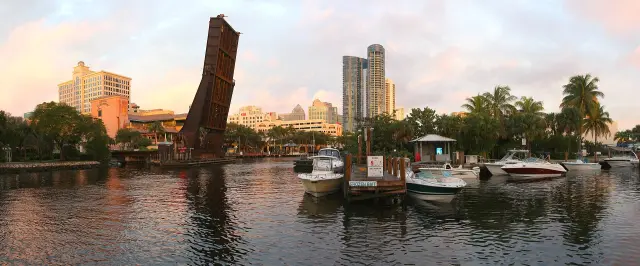
Hugh Taylor Birch State Park sits on the Fort Lauderdale barrier island between the Intracoastal Waterway and State Road A1A, with its entrance on East Sunrise Boulevard.
The Florida DEP management plan says access to the park is from East Sunrise Blvd, a street off State Road A-1-A, and calls the park a barrier island in urban downtown Ft. Lauderdale (Florida DEP, Hugh Taylor Birch State Park Unit Management Plan). Its facility list counts four public parking lots: the Main Picnic Area (82 vehicles), the North Picnic Area (100 vehicles), the Long Lake and Beach Access Area (70 vehicles) and the Garden Center (5 vehicles).
The plan's facility list includes beach access tunnels, and it says a small area of beach on the Atlantic side is managed under contract by the City of Fort Lauderdale, which provides a lifeguard in exchange for public use of the park restroom near the beach access tunnel (DEP management plan). Bonnet House Museum and Gardens is the neighbour to the south; the plan places Birch's Terramar estate less than half a mile north of the Bonnet House.
What can visitors do at Hugh Taylor Birch State Park?
Hugh Taylor Birch State Park offers beach access, paddling on Long Lake, a hammock trail, picnic shelters, group camping and ranger programs on Fridays and Saturdays.
The 2020 plan lists beach access, bicycling, camping, paddling, kayaking, fishing, hiking, swimming and wildlife viewing among the park's activities, and names beach access, picnicking, kayaking, hiking and interpretation of the historic Terramar House as the most popular (Florida DEP, Hugh Taylor Birch plan). Facilities include the Beach Hammock Trail of about 1,500 feet, a canoe launch on Long Lake, two large picnic shelters and a playground at the main day use area, a two mile park road, the Elk's Group Camp with six cabins and a dining hall, and a primitive group camp.
Rangers run interpretive walks through mangrove, hammock and dune habitats and a one-hour Live Animal Presentation, and the Terramar Visitor Center shows an interactive timeline of South Florida beginning from 8000 BC. The park is part of the Great Florida Birding and Wildlife Trail, and an environmental day camp for local children, Camp Live Oak, runs through the summer and over school breaks (DEP management plan). The Federated Garden Club of Ft. Lauderdale runs the Glenn F. Bates Garden Center in the south of the park, open to the public during scheduled events.
What natural areas does Hugh Taylor Birch State Park protect?
Hugh Taylor Birch State Park protects 60.72 acres of maritime hammock and 56.77 acres of estuarine tidal swamp, plus Long Lake, a freshwater lagoon that runs almost the full length of the park.
The Division of State Lands staff report for the 2020 plan lists 60.72 acres of maritime hammock, 56.77 acres of estuarine tidal swamp, 5.61 acres of coastal strand and 0.21 acres of beach dune, and says five species of imperiled plants and sixteen species of imperiled animals have been identified in the park (Florida DEP, ARC staff report, August 2020). The report calls the park's estuarine tidal swamp, coastal strand and maritime hammock among the largest remaining examples of these community types in southeast Florida, a subtropical oasis in Fort Lauderdale between the Atlantic Ocean and the Intracoastal Waterway.
The park beach is nesting habitat for loggerhead, leatherback and green sea turtles, but nesting inside the Hugh Taylor Birch boundary is light: the plan says it has ranged from zero to five nests a season, mostly loggerheads (DEP management plan). The maritime hammock and the fresh water and marine tidal swamps are designated protected zones, where parking lots and intensive development are generally not allowed.
How did Hugh Taylor Birch's estate become a Fort Lauderdale state park?
Chicago attorney Hugh Taylor Birch began buying Fort Lauderdale beachfront in 1893, built his last home on the land in 1940, and his estate became a state park that opened in 1949.
The DEP plan says Birch bought his ocean front property for about a dollar an acre and ultimately owned a three and half mile stretch of land along the beach. In 1940, at the age of 90, he built his final residence on a 180-acre estate he called Terramar, land to the sea; the Mediterranean Revival style Terramar House now serves as the park's main interpretation center (Florida DEP, Hugh Taylor Birch State Park Unit Management Plan). The 1984 National Register nomination for Bonnet House describes him as a prominent attorney and real estate developer in Ohio and Illinois and a large landowner in Ft. Lauderdale (NPS, Bonnet House nomination).
The plan gives two dates for the transfer of the Hugh Taylor Birch land without reconciling them. Its introduction says the park was initially acquired on December 31, 1941 with Land Acquisition Trust Fund money, while its Past Uses section says Birch donated his property to the State in March of 1942 (DEP management plan). The Trustees of the Internal Improvement Trust Fund leased the park to the Division of Recreation and Parks on January 23, 1968 under a 99-year lease (DEP ARC staff report), which the plan says will expire on January 22, 2067.
Did Hugh Taylor Birch State Park once have a train ride?
Yes: a narrow-gauge electric railroad built in 1965 carried Hugh Taylor Birch State Park visitors on a three mile loop with a 30 minute narrated tour until it was decommissioned in 1985.
The DEP plan says the engine was made to look like a steam train, and that sections of track, canals, train trestles and a bridge are all that remain of the ride (Florida DEP, Hugh Taylor Birch plan). An old 600 foot train tunnel is listed among the park's facilities as closed. The plan also dates much of the park's built fabric to the years before and after its 1949 opening: an entrance station, a concession building and the Elk's Youth Camp in the mid 1940s and early 1950s, the beach underpass and canoe shed in the late 1950s, and picnic restrooms and shelters in the 1960s.
A Florida Master Site File review cited in the 2020 staff report found one resource group, twenty-four historic structures and one historic railroad within the Fort Lauderdale park (DEP ARC staff report). The North Bridge trestle over Long Lake is one of the pieces the plan proposes to reuse.
What improvements are planned at Hugh Taylor Birch State Park?
The 2020 Hugh Taylor Birch State Park management plan proposes a pedestrian path from East Sunrise Boulevard to the ranger station, preservation of the Terramar House and a boardwalk on the old North Bridge trestle.
The full list in the Division of State Lands staff report adds an interpretive seating area near the south end of Long Lake, playground and pavilion improvements, maintenance of the park's two-mile loop road, replacement of culverts bordering the Intracoastal Waterway and general flood adaptations at the north end of the park (Florida DEP, ARC staff report). The plan covers ten years, so the list dates from 2020; the DEP document page for the approved plan shows a last modified date of October 1, 2026 but posts no project status (DEP Office of Park Planning, approved UMP).
The plan recorded 407,352 visitors in FY 2018/2019 and, by DRP estimates, $36.6 million in direct economic impact, equal to adding 513 jobs to the local economy (DEP management plan). The same plan gives two acreages without comparing them: 175 acres for the park today and 180 acres for Birch's Terramar estate.
Last verified: October 18, 2026, against the Florida State Parks fee schedule for the park, the Florida DEP plan approved August 21, 2020 and its Division of State Lands staff report, and the National Park Service Bonnet House nomination.
Frequently asked questions
How much does it cost to get into Hugh Taylor Birch State Park?
Florida State Parks charges $6 per vehicle for up to eight people, $4 for a single-occupant vehicle or motorcycle, and $2 for pedestrians, bicyclists and extra passengers.
What are the hours of Hugh Taylor Birch State Park?
The park is open from 8 a.m. to sunset, 365 days a year, according to Florida State Parks.
Where is the entrance to Hugh Taylor Birch State Park?
The Florida DEP plan says access is from East Sunrise Blvd, a street off State Road A1A, on the Fort Lauderdale barrier island between the Intracoastal Waterway and A-1-A.
How big is Hugh Taylor Birch State Park?
The Florida DEP management plan gives the park 175 acres. The same plan gives 180 acres as the size of Hugh Taylor Birch's Terramar estate.
Can visitors kayak at Hugh Taylor Birch State Park?
Yes. The 2020 DEP plan lists paddling and kayaking among the park's activities and a canoe launch on Long Lake, the freshwater lagoon that runs almost the length of the park.
Sources
- Florida State Parks, Hugh Taylor Birch State Park, Hours and Fees https://www.floridastateparks.org/parks-and-trails/hugh-taylor-birch-state-park/hours-fees Used for: open 8 a.m. to sunset 365 days a year, $6 per vehicle up to eight people, $4 single occupant or motorcycle, $2 pedestrians and bicyclists
- Florida DEP Division of Recreation and Parks, Hugh Taylor Birch State Park Unit Management Plan, approved August 21, 2020 https://floridadep.gov/sites/default/files/HTBSP_08.21.2020%20ARC%20Approved%20UMP.pdf Used for: access from East Sunrise Blvd, December 31, 1941 acquisition, 175 acres, lease to 2067, Birch 1893 purchase, Terramar 1940, opened 1949, March 1942 donation, facilities, parking lots, railroad 1965 to 1985, visitors FY 2018/2019, city lifeguard contract, sea turtle nesting
- Florida DEP Division of State Lands, ARC Item 5, Hugh Taylor Birch State Park Management Plan, August 2020 https://floridadep.gov/sites/default/files/August%2021%2C%202020%20ARC%20Item%2005%20Hugh%20Taylor%20Birch%20State%20Park%20MP.pdf Used for: January 23, 1968 99-year lease, natural community acreages, imperiled species counts, proposed improvements, economic impact
- Florida DEP Office of Park Planning, Hugh Taylor Birch State Park 08.21.2020 Approved UMP document page https://floridadep.gov/parks/parks-office-park-planning/documents/hugh-taylor-birch-state-park-08212020-approved-ump Used for: approved plan document listing and last modified date
- National Park Service, National Register nomination, Bonnet House (1984) https://npgallery.nps.gov/GetAsset/cbb54db8-a1fb-4148-9792-c4f5acb42475 Used for: Hugh Taylor Birch described as a prominent attorney and real estate developer and a large landowner in Fort Lauderdale
How this page was made
Digital Towns uses AI assistance to research and write its guides, and every page is only as good as the sources it cites. Our goal is the most accurate, useful local information possible.
This page was fact-checked twice before publishing.
If you see an error, or anything you can show is false, tell us right away and we will take a third look.
Report an error
Thank you. We'll take a third look and correct the page if it's wrong.