Short answer: LaVilla, a historic Jacksonville neighborhood, was platted in 1866, settled by U.S. Colored Troops, Gullah Geechee people and freed families, and incorporated as a town in 1869 before Jacksonville annexed it in 1887. It became Florida's premier Chitlin Circuit stop, then lost large parts of its historic fabric to the 1901 fire, Interstate 95 and 1990s urban renewal. The self-guided LaVilla Heritage Trail, completed in 2026, connects 22 historic sites.
Last verified: October 15, 2026, against the sources listed at the end of this page.
What was LaVilla in Jacksonville?
LaVilla is a historic Black neighborhood of Jacksonville, platted in 1866, incorporated as its own town in 1869 and annexed by the City of Jacksonville in 1887.
The land was a plantation before it was a town. Named after the LaVilla Plantation, LaVilla was platted in 1866 by attorney Francis F. L'Engle and settled by United States Colored Troops, Gullah Geechee people and freed men and women (Downtown Investment Authority, LaVilla Heritage Trail). L'Engle served as the town's first mayor, and the trail timeline traces the plantation name to 1851, when the tract changed hands and was renamed LaVilla (LaVilla Heritage Trail).
LaVilla grew on work. By 1870, seventy percent of LaVilla's residents were African American, many of them employed in Jacksonville's hotels, lumber yards, port, building trades and railroads (Downtown Investment Authority, LaVilla Heritage Trail). When Jacksonville annexed it in 1887, LaVilla was the city's largest suburb, with 3,000 residents (Downtown Investment Authority, LaVilla Heritage Trail). The trail's home page also names Cuban, Syrian, Greek, Jewish and Chinese immigrant families in LaVilla's diverse community (LaVilla Heritage Trail).
Self-government in LaVilla was real for a generation. The Jacksonville City Council's civil rights history task force counted 110 African American men who held public office between 1869 and 1907 in the Town of LaVilla, the City of Jacksonville and Duval County (Civil rights timeline, LaVilla Heritage Trail).
How did LaVilla become a center of Black music and entertainment?
LaVilla became Florida's premier Chitlin Circuit stop in the early 20th century, a transportation hub anchored by the Jacksonville Terminal at a time when Black performers were not allowed in most white-owned venues.
The Jacksonville Terminal, organized by Henry Flagler in the 1890s, opened on November 17, 1919, employed more than 2,000 people and handled more than 110 trains on opening day (Jacksonville Terminal marker). Traffic through the LaVilla station peaked in 1944 at 40,000 trains (Downtown Investment Authority, LaVilla Heritage Trail).
West Ashley Street between Broad and Davis streets, known locally as Uptown, was the entertainment district for Florida's Black community before desegregation, and the Colored Airdome was built at its northwest corner in 1909 (Old Stanton School and West Ashley Street marker). The first published account of blues singing on a public stage in the United States comes from LaVilla's Colored Airdome on April 16, 1910 (Downtown Investment Authority, LaVilla Heritage Trail).
LaVilla emerged as Florida's premier Chitlin Circuit destination during the early 20th century, with venues such as the Lenape Bar, Manuel's Tap Room, Knights of Pythias Hall, the Strand Theatre, the Duval County Armory and the Two Spot (Chitlin Circuit marker). Walter Barnes, the Chicago jazz musician credited as an early originator of the circuit, kept a winter headquarters in LaVilla in the 1930s and promoted southern tours through his position at the Chicago Defender (Downtown Investment Authority, LaVilla Heritage Trail). Ray Charles moved to LaVilla in 1945 and began his professional career there at fifteen (Downtown Investment Authority, LaVilla Heritage Trail).
The Ritz Theatre opened in LaVilla to a large crowd in September 1929, designed by Jefferson Powell in a blend of Art Deco, Mediterranean Revival and Egyptian Revival styles (Ritz Theatre marker).
Which schools and businesses shaped LaVilla?
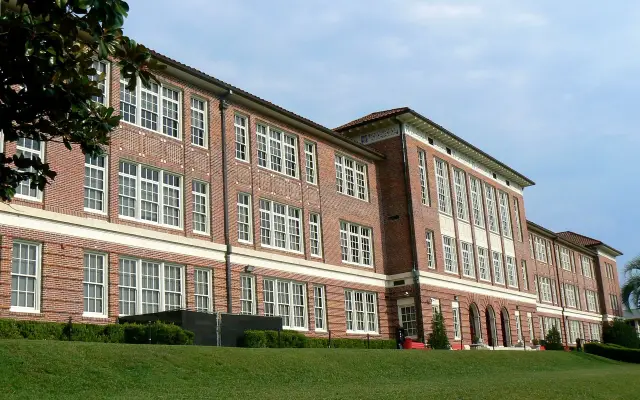
LaVilla's schools, lodges, churches and businesses built Black civic life in Jacksonville, starting with Stanton, the first school for Black children in Florida, which opened in April 1869.
Stanton was financed with Freedmen's Bureau aid and opened on April 10, 1869, as the first school of education for Black children in Florida (Old Stanton School marker). James Weldon Johnson later became its principal in 1894 and made it the only high school for African Americans in the city (Old Stanton School marker). On February 12, 1900, Lift Ev'ry Voice and Sing was first performed by five hundred children at Stanton for Booker T. Washington (Old Stanton School marker); the song has its own Digital Towns guide, Lift Every Voice and Sing in Jacksonville.
After the 1901 fire, the school was rebuilt poorly, and when the Duval County School Board planned in 1915 to replace Stanton with smaller schools, the Stanton trustees went to court in one of the first civil rights cases in Jacksonville; the rebuilt school opened in 1917 (Downtown Investment Authority, LaVilla Heritage Trail).
Black enterprise in Jacksonville in those years, as the trail's civil rights marker records it, included the Afro-American Life Insurance Company, set up in 1901 to provide affordable health insurance and death benefits for the Black community, and the Central Trust and Investment Company, opened in 1902 as the city's first Black-owned bank (Civil rights timeline). In 1905 attorney Judson Douglas Wetmore challenged Jacksonville's ordinance mandating racial separation on streetcars; the Florida Supreme Court upheld his victory, but the city soon modified the ordinance and reimposed streetcar segregation (Civil rights timeline).
What happened to LaVilla's historic buildings?
Large parts of historic LaVilla were lost in three waves: the Great Fire of 1901, Interstate 95 in 1958, and the River City Renaissance clearances that began in 1993.
The trail timeline says the Great Fire of 1901 originated in LaVilla (LaVilla Neighborhood marker). Florida Memory says it began on May 3, 1901, when a kitchen spark at lunchtime lit drying Spanish moss at a mattress factory at Davis and Beaver streets, and by 8:30 p.m. it had destroyed 2,368 buildings across Jacksonville (Florida Memory, State Archives of Florida). The Digital Towns Great Fire of 1901 guide covers the rebuilding.
Highways and renewal did the rest. The Jacksonville Expressway, Interstate 95, was completed through the heart of LaVilla in 1958, and the $235 million River City Renaissance urban renewal plan of 1993 destroyed significant portions of LaVilla east of Interstate 95 (Downtown Investment Authority, LaVilla Heritage Trail). Between 1916 and 1917, before either, more than 6,000 African Americans had already left Jacksonville in the Great Migration, a move the trail ties to economic conditions, white militancy and Jim Crow laws (Downtown Investment Authority, LaVilla Heritage Trail).
| Year | What happened in LaVilla |
|---|---|
| 1866 | Francis F. L'Engle plats LaVilla |
| 1869 | LaVilla incorporates as a town; Stanton opens April 10 |
| 1887 | Jacksonville annexes LaVilla, then 3,000 residents |
| 1901 | Great Fire starts May 3 at Davis and Beaver streets |
| 1919 | Jacksonville Terminal opens November 17 |
| 1929 | Ritz Theatre opens in September |
| 1958 | Interstate 95 completed through LaVilla |
| 1993 | $235 million River City Renaissance clears much of LaVilla east of I-95 |
| 2026 | LaVilla Heritage Trail completed |
Two LaVilla landmarks survived in new forms. The Ritz closed in 1971 and was partly demolished and rebuilt under the River City Renaissance plan as a $4.2 million African American cultural center with a 426-seat theater and a museum (Ritz Theatre marker). The Jacksonville Terminal closed in 1974, joined the National Register of Historic Places in 1976 and became the Prime F. Osborn III Convention Center after a $37.2 million Jacksonville City Council vote on November 23, 1983 (Jacksonville Terminal marker). Most buildings on West Ashley Street were razed in the 1990s as a target of the River City Renaissance program (Old Stanton School and West Ashley Street marker).
How can LaVilla's history be visited today?
LaVilla's history can be walked on the self-guided LaVilla Heritage Trail, which connects 22 historic sites, and at Lift Ev'ry Voice and Sing Park, 120 N Lee Street, open sunrise to sundown.
The trail map numbers its 22 stops from 01, The LaVilla Neighborhood, and 02, Jacksonville Terminal, through Broad Street, the Maceo Elks Lodge, the Richmond Hotel, Ray Charles, the Chitlin Circuit, the Clara White Mission, Old Stanton School and West Ashley Street, Hansontown, the Great Fire of 1901, the Ritz Theatre, Davis Street and the Black Church, to 21, Brewster Hospital, and 22, the Boylan School for Girls (LaVilla Heritage Trail map).
Lift Ev'ry Voice and Sing Park, at 120 N Lee Street, Jacksonville, FL 32204, is open from sunrise to sundown (City of Jacksonville Parks). Its center is a restored LaVilla shotgun house inside three glass walls, which the city describes as the only vestige of African American domestic memory in LaVilla, and the Emerald Trail runs along the park's eastern edge toward the old Jacksonville Terminal (City of Jacksonville Parks).
Questions about the LaVilla trail go to the Downtown Investment Authority at City Hall at St. James Building, 117 West Duval Street, Suite 310, phone 904-255-5693 (LaVilla Heritage Trail).
What is changing in LaVilla now?
LaVilla is in what the trail calls a period of rebirth and revitalization, with the 2019 LaVilla Neighborhood Development Strategy completed and the heritage trail completed in 2026.
The Downtown Investment Authority completed the LaVilla Neighborhood Development Strategy in 2019 and lists the heritage trail as completed in 2026 (Downtown Investment Authority, LaVilla Heritage Trail). Today the Ritz Theatre is LaVilla's primary performance venue (Ritz Theatre marker).
The DIA pages do not always agree with each other, so dates are worth checking marker by marker. The LaVilla timeline on marker 01 lists Stanton opening in 1868, while the Stanton marker gives April 10, 1869 and the civil rights marker also gives 1869 (LaVilla Neighborhood marker; Old Stanton School marker; Civil rights timeline). The neighborhood marker dates LaVilla to 1866, the year it was platted, while the town itself was incorporated in 1869; both dates are correct for different events (Downtown Investment Authority, LaVilla Heritage Trail).
Frequently asked questions
Where is LaVilla in Jacksonville?
LaVilla is a historic Jacksonville neighborhood whose self-guided heritage trail connects 22 sites, from the Jacksonville Terminal to Davis Street and West Ashley Street. Lift Ev'ry Voice and Sing Park, at 120 N Lee Street, Jacksonville, FL 32204, stands where the Johnson brothers' home once stood.
When was LaVilla its own town?
LaVilla was incorporated as a town in 1869 and annexed by the City of Jacksonville in 1887, when it had 3,000 residents and was the city's largest suburb, according to the Downtown Investment Authority's LaVilla Heritage Trail.
Why was LaVilla called a Chitlin Circuit center?
The LaVilla Heritage Trail calls LaVilla Florida's premier Chitlin Circuit destination in the early 20th century. The circuit was a network of Black-owned clubs and theaters where Black entertainers could perform during segregation, and Chicago jazz musician Walter Barnes kept a winter headquarters in LaVilla in the 1930s.
What happened to LaVilla's old buildings?
Much of LaVilla was lost to the 1901 fire, which started at Davis and Beaver streets, to Interstate 95, completed through the neighborhood in 1958, and to the $235 million River City Renaissance plan of 1993, which cleared significant portions east of I-95.
What is on the LaVilla Heritage Trail?
The Downtown Investment Authority's LaVilla Heritage Trail is self-guided and connects 22 historic sites; the trail's timeline lists it as completed in 2026. Lift Ev'ry Voice and Sing Park, a city park at 120 N Lee Street, is open from sunrise to sundown.
Sources
- LaVilla: Lift Ev'ry Voice and Sing Heritage Trail, home and map (Downtown Investment Authority, City of Jacksonville) https://lavillaheritagetrail.com/ Used for: 22 historic sites, self-guided trail, numbered marker list, Cuban, Syrian, Greek, Jewish and Chinese immigrant families
- 01. The LaVilla Neighborhood, LaVilla Heritage Trail (Downtown Investment Authority, City of Jacksonville) https://lavillaheritagetrail.com/poi/lavilla-neighborhood/ Used for: platting in 1866, incorporation 1869, settlers, 1870 population share, 1887 annexation at 3,000 residents, Colored Airdome 1910, Ray Charles 1945, Interstate 95 in 1958, River City Renaissance 1993, 2019 strategy, 2026 trail
- 02. Jacksonville Terminal, LaVilla Heritage Trail (Downtown Investment Authority) https://lavillaheritagetrail.com/poi/jax-terminal/ Used for: terminal opening November 17, 1919, 2,000 workers, 1944 peak, closure 1974, National Register 1976, 1983 council vote for convention center
- 12. Chitlin Circuit, LaVilla Heritage Trail (Downtown Investment Authority) https://lavillaheritagetrail.com/poi/chitlin-circuit/ Used for: LaVilla as Florida's premier Chitlin Circuit stop, named venues, Walter Barnes winter headquarters
- 18. Ritz Theatre, LaVilla Heritage Trail (Downtown Investment Authority) https://lavillaheritagetrail.com/poi/ritz-theatre/ Used for: Ritz opening September 1929, closure 1971, $4.2 million rebuild with 426 seats and a museum
- 05. Civil Rights, LaVilla Heritage Trail (Downtown Investment Authority, from the Jacksonville City Council Task Force on Civil Rights History timeline) https://lavillaheritagetrail.com/poi/civil-rights/ Used for: 110 Black officeholders 1869 to 1907, Afro-American Life Insurance Company 1901, Wetmore streetcar challenge 1905
- 14. Old Stanton School and West Ashley Street, LaVilla Heritage Trail (Downtown Investment Authority) https://lavillaheritagetrail.com/poi/stanton-west-ashley/ Used for: Stanton opening April 10, 1869, Grant visit 1877, rebuilt 1917, West Ashley Street as Uptown, Colored Airdome 1909
- Lift Ev'ry Voice and Sing Park, City of Jacksonville Parks and Recreation https://www.jacksonville.gov/departments/parks-and-recreation/jaxparks/all-parks/lift-ev-ry-voice-and-sing-park Used for: address 120 N Lee Street, hours sunrise to sundown, restored shotgun house, Emerald Trail edge
- Great Jacksonville Fire of 1901, Florida Memory (State Archives of Florida) https://www.floridamemory.com/learn/exhibits/photo_exhibits/jacksonvillefire/ Used for: fire start May 3, 1901 at a mattress factory at Davis and Beaver streets, 2,368 buildings destroyed
How this page was made
Digital Towns uses AI assistance to research and write its guides, and every page is only as good as the sources it cites. Our goal is the most accurate, useful local information possible.
This page was fact-checked twice before publishing.
If you see an error, or anything you can show is false, tell us right away and we will take a third look.
Report an error
Thank you. We'll take a third look and correct the page if it's wrong.