Short answer: No official map rates sinkhole risk for an individual Orlando address. The 2026 Orange County hazard plan says sinkholes often emerge in the northwestern, western and southern parts of the county and names Apopka, Winter Garden and sections of Orlando as zones of notable risk. Lake Eola began as a sinkhole, and Florida law requires every property insurer to cover catastrophic ground cover collapse.
Last verified: October 15, 2026, against the sources listed at the end of this page.
Which parts of Orlando and Orange County have the highest sinkhole risk?
Orange County's 2026 hazard plan says sinkholes often emerge in the northwestern, western and southern parts of the county and names Apopka, Winter Garden and sections of Orlando as zones with notable risk (2026 Orange County Local Mitigation Strategy).
The plan, a September 1, 2026 reviewer draft with adoption pending, ties the first pattern to mapped karst terrain, and the Orlando listing is based on claims data and historical reports. The Orange County plan says sinkhole risk is not uniform across the county and is most likely where limestone bedrock lies near the surface; locations with thin overburden, high groundwater fluctuations and intensive water withdrawal are typically more exposed. It also flags corridor-based vulnerabilities along certain roadways and developments where heavy infrastructure or changes in water management may add to subsidence potential (Orange County LMS).
| Area or condition | What the plan says |
|---|---|
| Northwestern, western and southern Orange County | Sinkholes often emerge here, where mapped karst terrain is prevalent |
| Apopka, Winter Garden and sections of Orlando | Identified as zones with notable subsidence and sinkhole risk, based on claims data and historical reports |
| Thin overburden, high groundwater fluctuations, intensive water withdrawal | Typically more exposed |
| Roadway and development corridors | Vulnerable where heavy infrastructure or water management changes may add to subsidence |
| Individual Orlando neighborhoods | No category assigned; the plan has no validated predictive map |
The last row matters most to an Orlando buyer. Without a validated predictive map, the county plan describes localized exposure rather than assigning a risk category to neighborhoods or facilities, and it says data limitations preclude precise future delineations (Orange County LMS).
Is there an official sinkhole map for an Orlando address?
No official map rates sinkhole risk for a single Orlando address: the Florida Geological Survey says there is no ready reference on sinkhole prediction or risk assessment, because underground cavities are largely undetectable without expensive surveys or drilling (Florida Geological Survey).
What does exist for Orlando and Orange County is a statewide list of reports. The Florida Geological Survey keeps a downloadable database of reported subsidence incidents statewide, but the majority of the incidents have not been field-checked and the cause of subsidence is not verified (Florida Geological Survey). A majority of the records come from the State Watch Office, which logs reports that county, city and state dispatchers choose to send, and records tied to insurance claims are a small fraction of the total; the data is viewed through the DEP Map Direct tool (FGS Subsidence Incident Reports). A dot near an Orlando street marks a reported incident that may not be a verified sinkhole.
Insurers fill the gap with their own data. The state FAQ says many insurance companies rely on regional maps of sinkhole occurrences or private sinkhole data, and that at least one geotechnical company sells a fee-based risk registry to insurers (FGS). The county plan reaches the same conclusion for Orange County: a complete, quality-controlled county event inventory with comparable diameter, depth and loss fields was not identified (Orange County LMS).
What sinkholes has the Orlando area already had?
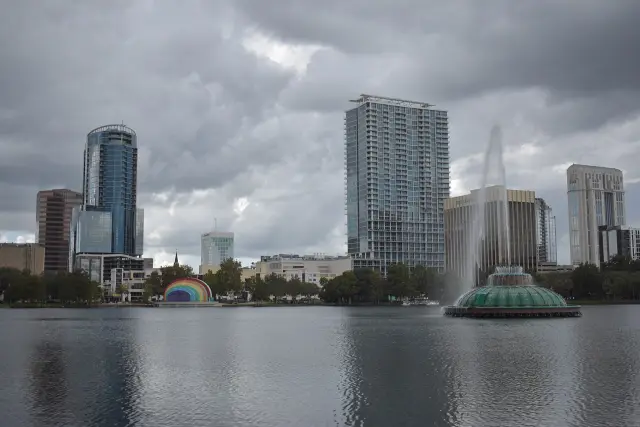
Lake Eola in downtown Orlando started as a sinkhole: the City of Orlando says the lake began as a sink hole forming on the edge of Jacob Summerlin's land shortly after he bought it in 1873 (City of Orlando).
With a natural aquifer 200 feet below ground and stormwater flooding, the Lake Eola hollow became a lake known to the public as Sandy Beach. The Summerlin family donated a strip of land around it for public use in 1883, the lake was renamed Lake Eola, and in 1888 it was recognized as a City of Orlando public park (City of Orlando).
The major sinkhole in the county plan's record of past occurrences is in Winter Park. The plan records that a major sinkhole began in Winter Park on May 8, 1981, damaging property and infrastructure and drawing national attention, with no fatalities reported in the USGS summary it cites (Orange County LMS). Smaller subsidence incidents have occurred across Orange County, but no federal disaster declaration specific to an Orange County sinkhole was identified in the declaration data the county reviewed (Orange County LMS).
What causes sinkholes under Orlando, and what sets them off?
Sinkholes under Orlando and the rest of Orange County form in karst terrain, where limestone is dissolved by groundwater over time (Orange County LMS).
The county plan names two primary natural types: solution sinkholes, from gradual dissolution of limestone at or near the ground surface, and cover-collapse sinkholes, where overlying soil or sediment suddenly collapses into underlying cavities (Orange County LMS).
Timing in Orlando follows water, not the calendar. The county plan says there is no pronounced seasonal pattern for sinkhole occurrence, but heavy rainfall, drought followed by intense rain, and changes in water tables can raise the likelihood, and human activity such as excessive groundwater extraction and altered drainage can add to the risk (Orange County LMS). The Florida Geological Survey explains the mechanism: when a drought lowers the aquifer, voids that held water fill with air, and a large rain event can push the overburden down into that air-filled void, so sinkhole activity is greatest when a dry spell gives way to normal rainfall (Florida Geological Survey).
Not every dip in an Orlando yard is a sinkhole. The state lists other causes of sunken ground: subsurface clay or organic layers that compress as water is removed, decomposing stumps, collapsed or broken sewer and drain pipes, broken septic tanks, poorly compacted soil after excavation, and buried trash (FGS). The Orange County plan makes the same point: a reported dip or subsidence incident is not, by itself, proof of a geologically confirmed sinkhole (Orange County LMS).
What should an Orlando property owner do when a hole opens?
An Orlando owner who finds a new hole should mark and secure it, keep children and pets away, keep water out of it, and call the insurance adjuster if walls crack (Florida Geological Survey).
If walls are sinking, sagging or cracking, the state advice is to stay out of the building and report it to the insurer immediately. No public agency will come to inspect an Orlando hole. The Florida Geological Survey says no agency in Florida has responsibility or authority for sinkhole inspections, and that sinkholes on private property are the responsibility of the property owner; its Sinkhole Helpline, 850 245-2118, connects callers with a licensed professional geologist who can talk through the situation (FGS). The state still asks owners to file a subsidence incident report so the event is documented (FGS). Home inspectors and insurance adjusters are not qualified to determine sinkhole activity; licensed professional geologists or engineers are (FGS).
In an Orlando yard, small holes often need only clean sand or soil, and in general no permit is needed to fill a new sinkhole; one in a wetland area, or one whose filling would alter surface water flows or contribute to water pollution, may need an environmental resources permit first, and a sinkhole in a structure built under such a permit, such as a stormwater pond, must be reported to the permitting party. Fill should be native earth materials or concrete, with clayey sand to help keep water from seeping downward (FGS).
A hole in a street is a public problem. The state advice is to cordon it off, call local law enforcement, and call the city or county road department (FGS). On City of Orlando streets, road problems inside city limits go to the Streets and Stormwater Division at 407.246.2238 or [email protected], with a response expected within two business days (City of Orlando). If life and property are in immediate danger, the state advice is to call 911 (FGS).
Does Orlando homeowners insurance cover sinkholes?
Every insurer selling property insurance in Florida, including in Orlando, must cover catastrophic ground cover collapse, but broader sinkhole loss coverage is an optional add-on for an extra premium (Florida Statutes 627.706).
The bar for the mandatory coverage is high for an Orlando homeowner. Under section 627.706 of the 2026 Florida Statutes, catastrophic ground cover collapse means an abrupt collapse of the ground cover, a sunken area in the ground cover clearly visible to the naked eye, structural damage to the covered building including the foundation, and the structure being condemned and ordered vacated by the governmental agency; damage consisting merely of settling or cracking of a foundation, structure or building does not qualify. Insurers must make sinkhole loss coverage available for an appropriate additional premium, may require an inspection first, and may set a sinkhole deductible of 1, 2, 5 or 10 percent of dwelling limits; a policy that excludes sinkhole losses must say so in bold type (Florida Statutes 627.706).
Paid claims follow an Orlando house. Under section 627.7073, an insurer that has paid a sinkhole loss claim files the engineer or geologist report and certification, any stabilization certification and the payment amount with the county clerk of court, who records them, and a seller whose sinkhole claim was paid must tell the buyer before closing that a claim was paid and whether the full amount went to repairs (Florida Statutes 627.7073).
Insurers can also decline to cover an Orlando home. The Florida Geological Survey notes that a company may decline to issue a policy because of sinkholes in an area or within a set distance, that those definitions vary from company to company, and that other companies may have more liberal policies, so shopping around is its suggestion (FGS).
Last verified: October 15, 2026, on the Orange County, Florida Department of Environmental Protection and Florida Legislature websites.
Frequently asked questions
Are sinkholes common in Orlando?
Sinkholes are a recognized Orange County hazard. The 2026 county hazard plan lists sections of Orlando, along with Apopka and Winter Garden, as zones with notable sinkhole risk based on claims data and historical reports, but it has no validated predictive map for neighborhoods.
Is Lake Eola a sinkhole?
Yes. The City of Orlando says Lake Eola began as a sink hole forming on the edge of Jacob Summerlin land after his 1873 purchase, filled through a natural aquifer and stormwater, and became a City of Orlando public park in 1888.
Who inspects a sinkhole in Orlando?
No government agency inspects sinkholes on private property in Florida. Orlando owners call their insurer and a licensed professional geologist or engineer; the Florida Geological Survey Sinkhole Helpline at 850 245-2118 offers guidance.
Does homeowners insurance in Orlando cover sinkholes?
Florida law requires every property insurer to cover catastrophic ground cover collapse, which requires an abrupt visible collapse and a condemned structure. Wider sinkhole loss coverage must be offered for an additional premium, with deductibles of 1, 2, 5 or 10 percent.
Where can an Orlando buyer check for past sinkhole claims?
Florida law has paid sinkhole reports recorded with the county clerk of court, and sellers must disclose a paid claim before closing. The Florida Geological Survey database lists reported incidents, though most are not field-checked.
Sources
- 2026 Orange County Local Mitigation Strategy, Subsidence/Sinkhole section, Orange County Government https://www.ocfl.net/Portals/0/Library/Emergency-Safety/docs/2026%20Orange%20County%20Local%20Mitigation%20Strategy.pdf Used for: where sinkhole risk is noted in Orange County, causes, triggers, Winter Park 1981, data gaps
- Sinkhole FAQ, Florida Geological Survey, Florida Department of Environmental Protection https://floridadep.gov/fgs/sinkholes/content/sinkhole-faq Used for: what to do, helpline, no inspecting agency, risk prediction limits, filling, insurance and disclosure notes
- Subsidence Incident Reports, Florida Geological Survey https://floridadep.gov/fgs/sinkholes/content/subsidence-incident-reports Used for: what the statewide subsidence database holds and its limits
- Florida Statutes 627.706 (2026), Sinkhole insurance; catastrophic ground cover collapse http://www.leg.state.fl.us/statutes/index.cfm?App_mode=Display_Statute&URL=0600-0699/0627/Sections/0627.706.html Used for: insurance coverage rules and definitions
- Florida Statutes 627.7073 (2026), Sinkhole reports http://www.leg.state.fl.us/statutes/index.cfm?App_mode=Display_Statute&URL=0600-0699/0627/Sections/0627.7073.html Used for: recording of sinkhole reports and seller disclosure
- Lake Eola History, City of Orlando https://www.orlando.gov/Parks-the-Environment/Directory/Lake-Eola-Park/Lake-Eola-History Used for: sinkhole origin of Lake Eola
- Report a Pothole or Road Issue, City of Orlando https://www.orlando.gov/Parking-Transportation/Report-a-Transportation-Issue/Report-a-Pothole Used for: reporting road problems on city streets
- Request a Residential Sewer Connection, City of Orlando https://www.orlando.gov/Building-Development/Permits-Inspections/Other/Request-a-Residential-Sewer-Connection Used for: Orange County Comptroller recording of permit notices
How this page was made
Digital Towns uses AI assistance to research and write its guides, and every page is only as good as the sources it cites. Our goal is the most accurate, useful local information possible.
This page was fact-checked twice before publishing.
If you see an error, or anything you can show is false, tell us right away and we will take a third look.
Report an error
Thank you. We'll take a third look and correct the page if it's wrong.