Short answer: Palm Bay wildlife rules center on the Florida Scrub-Jay, a federally Threatened bird: under a 2007 federal permit, lots in mapped scrub-jay areas can be built on but not cleared from March 1 through June 30, and the city scrub-jay lots page lists an extra $125 per quarter acre on permits there. Gopher tortoises need an FWC relocation permit before any clearing. At Turkey Creek Sanctuary the city lists manatees, alligators and ospreys.
Last verified: October 15, 2026, against the sources listed at the end of this page.
What wildlife can be seen in Palm Bay, and where?
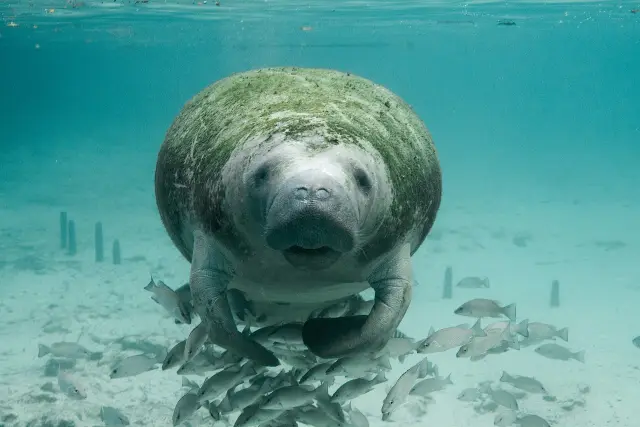
Turkey Creek Sanctuary, a free 130 acre preserve at 1518 Port Malabar Blvd. NE, is where the City of Palm Bay says visitors can see manatees, alligators, Florida cooters, ospreys and owls, and might see an otter or a gar.
The City of Palm Bay describes manatees, alligators and Florida cooter turtles in Turkey Creek and ospreys and owls in the pine canopy, and the sanctuary boardwalk crosses wet hammock, moist hammock and sand pine scrub (Turkey Creek Sanctuary). It is part of the Brevard County Environmentally Endangered Lands program and the East Florida section of the Great Florida Birding Trail. Feeding squirrels or any other animal in the Palm Bay sanctuary is prohibited, because human food harms the animals and can lead to aggression and dependency; an aggressive animal is reported to Margaret Hames Nature Center staff. Pets are not allowed in the sanctuary, and its Margaret Hames Nature Center is open 9 AM to 4 PM.
The city runs a free ranger-led walk at Turkey Creek Sanctuary on the 1st and 3rd Sunday of each month from 10 AM to 11 AM, starting at the nature center, which covers about 1 to 1.5 miles of boardwalk and sandy trail focused on common plants and animals (Turkey Creek Sanctuary). Paddlers can watch the creek from the water: the Turkey Creek Kayak Launch is at 815 Briar Creek Blvd, Palm Bay, where the city lists guided kayak tours by reservation. The Palm Bay sanctuary also offers a self-guided QR code tour.
Outside the sanctuary, the Palm Bay wildlife rules for property owners concern the Florida scrub-jay polygons in the Port Malabar subdivisions in the southeast of the city, the eastern indigo snake and the gopher tortoise, so the rest of this guide deals with permits and phone numbers.
Why does the Florida scrub-jay matter so much in Palm Bay?
The Florida scrub-jay has been federally listed as Threatened since June 3, 1987, and Palm Bay holds over 42,500 acres of anticipated scrub-jay permit area, so the bird shapes building rules in the mapped polygons in the southeast of the city.
The U.S. Fish and Wildlife Service lists the Florida scrub-jay as Threatened wherever found, with a listing date of 06-03-1987 (USFWS ECOS Florida scrub-jay profile). In 2007, after approving the Palm Bay Habitat Conservation Plan, the Service issued the city an Incidental Take Permit under Section 10 of the Endangered Species Act, and Palm Bay has three recognized scrub-jay habitat areas, called occupied habitat polygons (City of Palm Bay habitat conservation news).
The permit is city-wide and allows lot owners within the scrub-jay areas to build on their property. In exchange, Palm Bay collects an environmental service fee with each building permit, which a conservation agency chosen by the Service uses to buy large tracts of habitat (Palm Bay Habitat Conservation Plan). The plan also covers the Eastern Indigo Snake. The fee rules sit in Chapter 172, Environmental Regulations, of the Palm Bay Code of Ordinances, where the city points for more information. The Palm Bay Florida scrub-jay guide traces the listing history and the federal notices behind the plan.
Can a Palm Bay lot in a scrub-jay area be built on or cleared?
Yes, a Palm Bay lot inside a scrub-jay polygon can be built on year round, but it cannot be cleared from March 1 through June 30, the scrub-jay nesting season, unless an exception applies.
The Palm Bay exceptions are narrow: a biological survey showing no active scrub-jay nest, vegetation that poses a persistent fire hazard to neighboring developed property, or nuisance vegetation within 25 feet of an adjacent developed lot (Palm Bay Habitat Conservation Plan). Outside nesting season, owners may get a permit to clear from July 1 through the end of February if the lot meets certain requirements (City of Palm Bay habitat conservation news).
The Palm Bay scrub jay lots page, written for the start of permitting on April 23, 2007, says permits in scrub-jay areas will be charged an additional $125 per quarter acre and that annual nest monitoring and reporting are required; the page gives no later amount, and the habitat plan page points to Chapter 172 for the fee (Palm Bay Scrub Jay Lots). The mapped polygons lie in the Port Malabar subdivisions in the southeast section of Palm Bay, drawn from the city Unit Map with polygons supplied by the Service. The city posts an interactive scrub-jay map, so a buyer of a vacant Port Malabar lot can check it before setting a clearing date, and questions on the permit go to the Palm Bay Building Department at (321) 953-8924 (City of Palm Bay habitat conservation news).
What happens if a gopher tortoise is on a Palm Bay lot?
A gopher tortoise burrow on a Palm Bay lot means the owner must get an FWC relocation permit and have the tortoise moved before any land clearing, because both the tortoise and its burrow are protected under Florida law.
For Palm Bay lots, the governing agency is the Florida Fish and Wildlife Conservation Commission, which lists the gopher tortoise as Threatened in Florida and calls it a keystone species, since its burrows shelter more than 350 other species (FWC gopher tortoise). Property owners must obtain FWC permits before capturing and relocating tortoises, and relocation comes before clearing or development.
The City of Palm Bay sends tortoise questions to FWC and lists the local FWC officers at 321-383-5535 for relocation questions (Palm Bay Habitat Conservation Plan). One Palm Bay detail is worth knowing: the city news post on the 2007 permit lists three covered species including the gopher tortoise, while the city habitat plan page names only the scrub-jay and eastern indigo snake and says tortoise permits come from FWC. Either way, the city habitat plan page says gopher tortoise permits must be obtained from FWC.
What is the eastern indigo snake, and why is it in the Palm Bay plan?
The eastern indigo snake is a non-venomous, bluish-black snake that can reach eight feet, federally listed as Threatened, and it is the second species covered by the Palm Bay Habitat Conservation Plan.
FWC lists the snake as federally Threatened and as a Federally-designated Threatened species under Florida rules, and describes its habitat as pine flatwoods, hardwood forests, moist hammocks and the edges of cypress swamps (FWC eastern indigo snake profile). The Palm Bay Habitat Conservation Plan and the city Incidental Take Permit cover the snake together with the Florida scrub-jay, and the city plan page links English and Spanish fliers on the indigo snake, the scrub-jay and the gopher tortoise (Palm Bay Habitat Conservation Plan).
Who handles alligators and wildlife problems in Palm Bay?
A Palm Bay resident concerned about an alligator calls the FWC Nuisance Alligator Hotline at 866-392-4286, and the city lists 1 (888) 404-3922 for reporting wildlife law concerns to FWC.
FWC generally treats an alligator as a nuisance when it is at least 4 feet long and the caller believes it poses a threat, and it sends a contracted trapper (FWC Statewide Nuisance Alligator Program). The city lists alligators among the animals in Turkey Creek. For protected species questions, the Palm Bay Growth Management Department answers at (321) 733-3042 (Palm Bay Habitat Conservation Plan), and the U.S. Fish and Wildlife Service North Florida Field Office, which supplied the scrub-jay polygons, at (904) 731-3121 (Palm Bay Scrub Jay Lots).
| Species or issue | Status or rule | Contact |
|---|---|---|
| Florida scrub-jay | Federally Threatened since 06-03-1987; no clearing in polygons March 1 to June 30 | Palm Bay Building Department, (321) 953-8924 |
| Eastern indigo snake | Covered by the Palm Bay Habitat Conservation Plan | Palm Bay Growth Management, (321) 733-3042 |
| Gopher tortoise | State Threatened; FWC permit before relocation and clearing | Local FWC officers, 321-383-5535 |
| Nuisance alligator | Generally 4 feet or longer and a threat | FWC hotline, 866-392-4286 |
| Wildlife law concern | Reported to FWC | 1 (888) 404-3922 |
| Scrub-jay polygon maps | Port Malabar, southeast Palm Bay | USFWS North Florida Field Office, (904) 731-3121 |
Last verified: October 15, 2026, on the City of Palm Bay and FWC websites.
Which Palm Bay wildlife guide goes deeper?
The Palm Bay Florida scrub-jay guide is the one deep guide in this section, and it answers the scrub-jay questions on this page in more detail.
| Question | Key fact | Where answered |
|---|---|---|
| Why is the scrub-jay protected? | Federally Threatened since 1987 | Florida scrub-jay guide |
| What does the Palm Bay permit allow? | City-wide ITP issued in 2007 | Florida scrub-jay guide |
| When is clearing barred? | March 1 to June 30 | This hub and the Florida scrub-jay guide |
| What does a scrub-jay lot cost extra? | $125 per quarter acre, per the city page written for April 23, 2007 | This hub |
| What about gopher tortoises? | FWC permit first | This hub |
| Where can wildlife be watched? | Turkey Creek Sanctuary, free | This hub |
The Palm Bay Florida scrub-jay guide links from the related content block below this answer.
Frequently asked questions
Can land be cleared in Palm Bay during scrub-jay nesting season?
Not inside the mapped scrub-jay polygons. From March 1 through June 30 Palm Bay bars clearing there unless a survey finds no active nest, vegetation is a persistent fire hazard to developed neighbors, or nuisance vegetation sits within 25 feet of a developed lot.
How much extra is a building permit on a Palm Bay scrub-jay lot?
The city scrub jay lots page, written for the April 23, 2007 start of permitting, says permits in scrub-jay areas will be charged an additional $125 per quarter acre. The city habitat plan page says the environmental service fee collected with each permit goes to a conservation agency designated by the U.S. Fish and Wildlife Service to help buy large tracts of habitat.
Is a permit needed to move a gopher tortoise in Palm Bay?
Yes. The gopher tortoise is listed as Threatened in Florida, and both the tortoise and its burrow are protected. Palm Bay owners need an FWC permit before capturing or relocating a tortoise, and relocation must happen before land clearing. Local FWC officers answer at 321-383-5535.
Who removes a nuisance alligator in Palm Bay?
FWC handles nuisance alligators in Palm Bay through its Statewide Nuisance Alligator Program. The hotline is 866-FWC-GATOR (866-392-4286), and an alligator generally qualifies when it is at least 4 feet long and believed to threaten people, pets or property.
Where can manatees be seen in Palm Bay?
The City of Palm Bay lists manatees, alligators and Florida cooters in Turkey Creek at Turkey Creek Sanctuary, 1518 Port Malabar Blvd. NE. The sanctuary is free, open daily from 7 AM until sunset, and has a 1.85 mile boardwalk.
Sources
- Habitat Conservation Plan, City of Palm Bay Building Department https://www.palmbayfl.gov/government/city-departments-a-to-e/building-permits-inspections/habitat-conservation-plan Used for: USFWS approved HCP and city-wide ITP covering Florida scrub-jay and eastern indigo snake, March 1 to June 30 clearing limits and exceptions, gopher tortoise FWC permits, contacts
- Scrub Jay Lots, City of Palm Bay https://www.palmbayfl.gov/government/city-departments-a-to-e/building-permits-inspections/habitat-conservation-plan/scrub-jay-lots Used for: permits since April 23, 2007, $125 per quarter acre, annual monitoring, polygons in southeast Port Malabar, USFWS contact
- Habitat Conservation Measures Effective from March 1 to June 30, City of Palm Bay news https://www.palmbayfl.gov/Home/Components/News/News/10167/1319?arch=1 Used for: 2007 ITP, over 42,500 acres of permit area, three habitat areas, nesting season, Building Department phone
- Turkey Creek Sanctuary, City of Palm Bay https://www.palmbayfl.gov/government/city-departments-f-to-z/recreation/turkey-creek-sanctuary Used for: wildlife seen in the creek and canopy, no feeding rule, EEL and birding trail status
- Gopher Tortoise, Florida Fish and Wildlife Conservation Commission https://myfwc.com/wildlifehabitats/wildlife/gopher-tortoise/ Used for: state Threatened listing, burrow protection, relocation permits, 350 commensal species
- Eastern Indigo Snake profile, FWC https://myfwc.com/wildlifehabitats/profiles/reptiles/snakes/eastern-indigo-snake/ Used for: federal Threatened status, appearance, habitat
- Statewide Nuisance Alligator Program, FWC https://myfwc.com/wildlifehabitats/wildlife/alligator/snap/ Used for: nuisance alligator hotline and 4 foot threshold
- Florida scrub-jay species profile, U.S. Fish and Wildlife Service ECOS https://ecos.fws.gov/ecp/species/B082 Used for: federal Threatened listing date 06-03-1987, wherever found
How this page was made
Digital Towns uses AI assistance to research and write its guides, and every page is only as good as the sources it cites. Our goal is the most accurate, useful local information possible.
This page was fact-checked twice before publishing.
If you see an error, or anything you can show is false, tell us right away and we will take a third look.
Report an error
Thank you. We'll take a third look and correct the page if it's wrong.