Short answer: Port Tampa Bay, Hillsborough County's public port authority, handles about 33 million tons of cargo a year, led by petroleum, and carried a record 1.66 million cruise passengers in 2025. It credits itself with $34.6 billion in economic impact and 192,000 jobs, while BLS payroll data count only hundreds of direct private maritime jobs in the county. A fourth cruise terminal is due in 2029.
Last verified: October 18, 2026, against the sources listed at the end of this page.
What is Port Tampa Bay and who runs it?
Port Tampa Bay is the public port authority for Hillsborough County, an independent special district of the State of Florida created by the Port Enabling Act and governed by a seven-member board that includes the Mayor of Tampa.
The port, created as the Tampa Port Authority, holds broad powers to plan, develop and manage maritime facilities across Hillsborough County (Port Tampa Bay, About The Port). It is a state special district with its own governing board, not a City of Tampa department.
Five of the seven board members are appointed by the Governor of Florida subject to Senate confirmation, one comes from the Hillsborough Board of County Commissioners and the last seat belongs to the Mayor of the City of Tampa, which Mayor Jane Castor occupies (Port Tampa Bay Governing Board). The board page still shows several seat terms that ended between 2021 and 2024, so its term dates are out of date as posted (Governing Board).
The headquarters is at 1101 Channelside Drive, Tampa, FL 33602, telephone 813-905-7678, toll free 800-741-2297 (Port Tampa Bay). Besides the downtown terminals along the Channel District, the authority markets satellite land at Port Redwing in southern Hillsborough County, with more than 50 acres available, and at Southbay, with another 135 (About The Port).
How much of the Tampa economy depends on the port?
Port Tampa Bay reports more than $34.6 billion in economic impact and more than 192,000 supported jobs in Central Florida, but that is the port's own estimate, and federal payroll data for Hillsborough County show a far smaller direct maritime workforce.
The two numbers measure different things. Port Tampa Bay's figure counts jobs it says depend on port activity across the region (About The Port). The U.S. Army Corps of Engineers page for the Tampa Harbor study still prints an older version of the same claim, over $17 billion in economic impact and more than 85,000 jobs (USACE Tampa Harbor). The two pages do not agree, and neither names the year of the study behind its number.
Payroll records give a narrower view. The rows below are private ownership rows (ownership code 5, Private, in the QCEW ownership titles) for four water transportation industry codes in the Bureau of Labor Statistics Quarterly Census of Employment and Wages for Hillsborough County; rail, trucking and warehouse employers carry separate codes in the same QCEW industry titles list, and government employers are reported under other ownership codes, so none of them are in the rows. The two six-digit rows are part of the 4883 total, not additions to it.
| Industry (NAICS) | Establishments | Average jobs | Average annual pay |
|---|---|---|---|
| Water transportation (483) | 17 | 191 | $119,154 |
| Support activities for water transportation (4883) | 34 | 484 | $82,498 |
| Marine cargo handling (488320) | 7 | 277 | $75,652 |
| Navigational services to shipping (488330) | 16 | 99 | $85,036 |
The rows come from the 2025 annual Hillsborough County file (BLS QCEW, county 12057), with industry names from the BLS title list (QCEW industry titles). The pay figures sit above the Hillsborough County private average of $78,261 in the same file for every row except marine cargo handling (BLS QCEW). Private employment in water transportation (191) and support activities for water transportation (484) together comes to 675 average jobs in the 2025 file, against the 192,000 jobs the port's own estimate credits to Central Florida.
What cargo moves through Port Tampa Bay?
Fuel is the largest line: the port says it delivers nearly 15 million tons of petroleum products a year out of about 33 million total tons, and that more than 45% of Florida's petroleum flows through Tampa.
The fuel is gasoline, diesel and jet fuel for airports, and most of it stays in west and central Florida (Port Tampa Bay Cargo Overview). Phosphate fertilizer, first discovered in Central Florida in the late 1800s, is still a cornerstone of exports, alongside aggregates such as granite, limestone, cement and gypsum (Cargo Overview). The port puts its total at 33 million tons of cargo per year on 5,000 acres and calls itself Florida's largest port by tonnage and by land (About The Port); the federal study page agrees that Port Tampa Bay is the largest in Florida in cargo tonnage and land area (USACE Tampa Harbor).
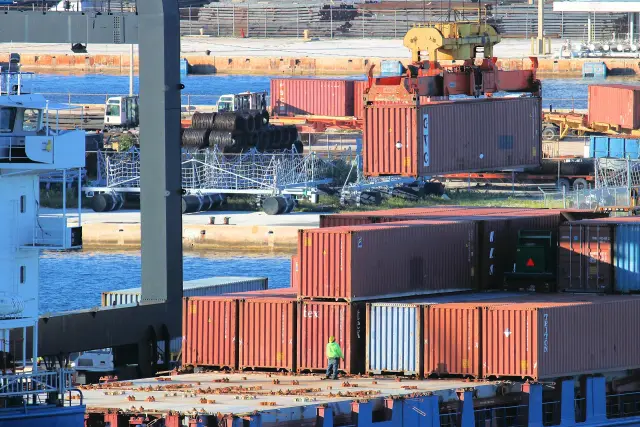
Containers are where the Tampa port says it continues to scale up. Working with Ports America, the port now runs a 100-acre container terminal with a new gate complex and six post-Panamax cranes, and a third deep-water berth is underway (Cargo Overview). Port Logistics Refrigerated Services offers a 14-acre, 135,000-square-foot on-dock cold storage facility with a 700-foot berth near what the port calls Florida's grocery and food and beverage distribution corridor (Cargo Overview).
Room to grow is the Tampa port's main pitch to tenants: more than 1,000 acres of industrially zoned land with deepwater access, plus 265 acres of non-waterfront industrial real estate served by CSX rail and the interstate system (About The Port).
How busy are the Tampa cruise terminals?
Busier than ever: Port Tampa Bay counted 1.66 million cruise passengers in 2025, its highest total, and in March 2026 anticipated 394 cruise ship calls in 2026 while tracking toward 1.8 million passengers.
Crowding at the Channel District terminals is the visible change. The port expects 53 three-ship days in 2026, when three cruise ships are in port at once, against roughly 20 in previous years, and March 2026 was scheduled for a record 51 calls (Port Tampa Bay, March 10, 2026). The port credits annual cruise activity with more than $648 million in economic impact (Port Tampa Bay).
| Terminal | Address | Note |
|---|---|---|
| Cruise Terminal 2 | 651 Channelside Drive, Tampa, FL 33602 | Next to the Florida Aquarium at 701 Channelside Drive |
| Cruise Terminal 3 | 815 Channelside Drive, Tampa, FL 33602 | Central terminal; port parking garage across the street |
| Cruise Terminal 6 | 1333 McKay Street, Tampa, FL 33602 | The only terminal listed on McKay Street |
The terminal guide places all three along the Channel District, prices the valet upgrade at $20 and warns that there is no baggage storage at any terminal for early arrivals; the Florida Aquarium next to Terminal 2 stores luggage for free with a discounted admission ticket (Port Tampa Bay Terminal Guide).
What is Port Tampa Bay building next?
A fourth cruise terminal: Port Tampa Bay began filling the former Metroport site, once the Banana Docks, in 2026 for its first new cruise terminal in more than 25 years, with completion expected in 2029.
The first phase restores more than five acres of new land and relocates stormwater lines, and it runs through late 2026, followed by a settlement period before building starts (Port Tampa Bay, August 3, 2026). HDR, working with BEA Architects, is designing the terminal and a parking garage. The port expects the new terminal to accommodate more than 200 additional annual ship calls, lift cruise traffic past 2 million passengers a year and add an estimated $100 million in annual economic impact (Port Tampa Bay).
The money side is stable. On October 16, 2026 Port Tampa Bay announced that Fitch Ratings reaffirmed its A+ credit rating with a stable outlook, covering about $59.1 million in outstanding bonds and notes backed by port revenues (Port Tampa Bay, October 16, 2026). The port's About page still lists a Fitch A rating (About The Port); the October release is the newer statement.
Will the Tampa Harbor shipping channel be deepened?
Not yet: the Chief of Engineers signed the chief's report with recommendations to Congress for the Tampa Harbor Navigation Improvement Study on August 14, 2024, and the study page lists Congressional authorization and a separate construction appropriation as the steps still ahead.
Today the federal project includes roughly 70 miles of channels from the Egmont Bar to the City of Tampa, including the Hillsborough River, the Alafia River and the Upper Channels (USACE Tampa Harbor). The main stem is about 42 miles long, 500 feet wide and 43 feet deep, was last deepened in 1970, and is shared with Port Manatee, St. Petersburg Harbor and Weedon Island (USACE). The draft study published in July 2023 proposed improvements that would remove approximately 21.3 million cubic yards of limestone rock, sand and silt from existing federal channels (USACE Jacksonville District).
One branch is already done. The Big Bend Channel in the upper-east part of Tampa Bay was deepened from 34 feet to 41 feet, under authority from the 1999 Water Resources Development Act, and physical construction finished on March 28, 2019 (USACE Big Bend fact sheet). The two agencies give different Big Bend dimensions: the Corps fact sheet lists an authorized depth of 41 feet mean lower low water, with an additional 2 feet dredged for advanced maintenance and the entrance channel widened from 200 to 250 feet (USACE), while Port Tampa Bay describes the Big Bend Channel serving its Redwing land as 43 feet deep and 250 feet wide (About The Port).
The two agencies describe the main channel differently. Port Tampa Bay's own page speaks of a harbor channel deepening and widening as underway (About The Port), while the Corps page lists Congressional authorization and appropriations as steps still ahead (USACE). Neither page gives a start date for dredging the Tampa main channel.
Last verified: October 18, 2026, against Port Tampa Bay's own pages and releases, the USACE Jacksonville District study pages and the BLS QCEW 2025 file for Hillsborough County.
Frequently asked questions
Who owns the Port of Tampa?
Port Tampa Bay is an independent special district of the State of Florida created by the Port Enabling Act. A seven-member board runs it: five appointees of the Governor, one Hillsborough County commissioner and the Mayor of Tampa.
How many cruise passengers use Port Tampa Bay?
Port Tampa Bay welcomed 1.66 million cruise passengers in 2025, its highest total, and was tracking toward 1.8 million in 2026 with 394 cruise ship calls anticipated, according to its March 10, 2026 release.
What is the biggest cargo at the Port of Tampa?
Petroleum. Port Tampa Bay says it delivers nearly 15 million tons of petroleum products a year, including gasoline, diesel and jet fuel, and that more than 45% of Florida's petroleum flows through the port.
Where are the Tampa cruise terminals?
All three are in the Channel District: Cruise Terminal 2 at 651 Channelside Drive, Terminal 3 at 815 Channelside Drive and Terminal 6 at 1333 McKay Street. The port's parking garage sits across the street from Terminal 3.
When will the new Tampa cruise terminal open?
Port Tampa Bay expects its fourth cruise terminal, on the former Metroport site, to be complete in 2029. Site filling runs through late 2026, followed by a settlement period before construction moves ahead.
Sources
- About The Port, Port Tampa Bay https://www.porttb.com/about-the-port/ Used for: 33 million tons and 5,000 acres, $34.6 billion and 192,000 jobs (port's own figures), 1,000 acres of industrial land, 265 non-waterfront acres, Port Redwing and Southbay acreage, Port Enabling Act, Fitch A on page
- Cargo Overview, Port Tampa Bay https://www.porttb.com/cargo/cargo-overview/ Used for: petroleum tonnage and share, 100-acre container terminal with Ports America, six post-Panamax cranes, cold storage facility
- Governing Board, Port Tampa Bay https://www.porttb.com/governing-board/ Used for: seven-member board composition and seat terms shown
- Terminal Guide, Port Tampa Bay https://www.porttb.com/cruise/terminal-guide/ Used for: three cruise terminal addresses in the Channel District, garage location, valet fee, Florida Aquarium luggage note
- Site Preparation Underway for Port Tampa Bay's New Cruise Terminal, August 3, 2026 https://www.porttb.com/2026/08/03/site-preparation-underway-for-port-tampa-bays-new-cruise-terminal/ Used for: fourth terminal on former Metroport site, completion 2029, 200 more calls, 2 million passengers, $100 million
- Port Tampa Bay to Set New Cruise Record, March 10, 2026 https://www.porttb.com/2026/03/10/port-tampa-bay-to-set-new-cruise-record-as-spring-break-travel-reaches-peak/ Used for: 51 March calls, 394 calls in 2026, 53 three-ship days, 1.66 million passengers in 2025, $648 million
- Port Tampa Bay Maintains Strong Credit Rating, October 16, 2026 https://www.porttb.com/2026/10/16/port-tampa-bay-maintains-strong-credit-rating-stable-outlook/ Used for: Fitch A+ stable, $59.1 million in bonds and notes
- Tampa Harbor Navigation Improvement Study, USACE Jacksonville District https://www.saj.usace.army.mil/Tampa-Harbor/ Used for: 70 miles of channels, 42-mile main stem 500 feet wide and 43 feet deep, last deepened 1970, chief's report August 14, 2024, WRDA and appropriations, $17 billion and 85,000 jobs figure
- Tampa Big Bend Deepening fact sheet, USACE Jacksonville District https://www.saj.usace.army.mil/About/Congressional-Fact-Sheets-2025/Tampa-Big-Bend-Deepening-C/ Used for: Big Bend authorization in WRDA 1999, 34 to 41 feet, completed March 28, 2019
- USACE Jacksonville publishes draft GRR/EIS of Tampa Harbor Navigation Improvement Study https://www.saj.usace.army.mil/Media/News-Releases/Article/3468710/usace-jacksonville-publishes-draft-grreis-of-tampa-harbor-navigation-improvemen/ Used for: 21.3 million cubic yards of material
- BLS QCEW 2025 annual averages, Hillsborough County (12057) CSV https://data.bls.gov/cew/data/api/2025/a/area/12057.csv Used for: private establishments, jobs and average annual pay in NAICS 483, 4883, 488320 and 488330
- QCEW industry titles, Bureau of Labor Statistics https://www.bls.gov/cew/classifications/industry/industry-titles.htm Used for: NAICS titles for 483, 4883, 488320, 488330
- QCEW ownership titles, Bureau of Labor Statistics https://www.bls.gov/cew/classifications/ownerships/ownership-titles.htm Used for: ownership code 5 = Private for the QCEW rows
How this page was made
Digital Towns uses AI assistance to research and write its guides, and every page is only as good as the sources it cites. Our goal is the most accurate, useful local information possible.
This page was fact-checked twice before publishing.
If you see an error, or anything you can show is false, tell us right away and we will take a third look.
Report an error
Thank you. We'll take a third look and correct the page if it's wrong.