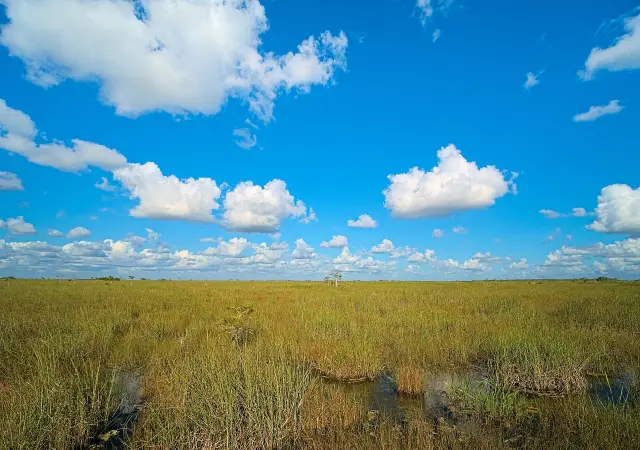
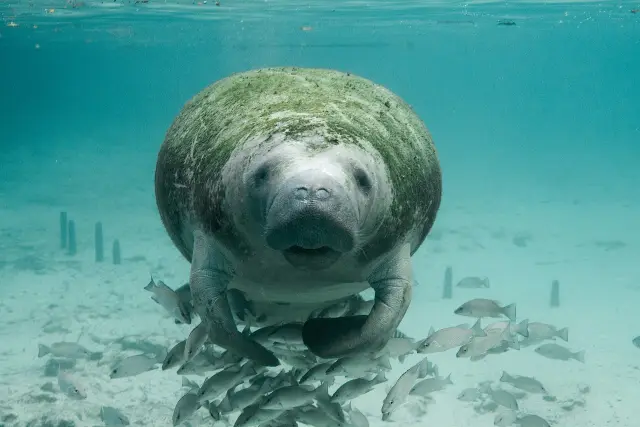
Short answer: Tampa wildlife watching centers on Tampa Bay: manatees gather in the Big Bend discharge canal at the Tampa Electric Manatee Viewing Center in Apollo Beach, which reopens November 1, 2026, and spoonbills, pelicans and egrets nest on the Alafia Banks islands, which FWC keeps closed year-round. NOAA asks people to watch dolphins from at least 50 yards, and Tampa Bay has no open bay scallop harvest zone.
Last verified: October 15, 2026, against the sources listed at the end of this page.
Where can manatees be seen near Tampa, and when?
Near Tampa, manatees are watched at the Tampa Electric Manatee Viewing Center in Apollo Beach, open daily November 1 to April 15, which reopens for the 2026 to 2027 season on November 1, 2026 (Tampa Electric Manatee Viewing Center).
Manatees gather there because the Big Bend Power Station draws water from Tampa Bay for cooling and returns it clean and warm to a discharge canal. The center, at 6990 Dickman Rd., Apollo Beach, opens 10 a.m. to 5 p.m. in season, with trails closing at 4 p.m., and parking and admission are free; it closes Thanksgiving Day, Christmas Day and Easter, and at 3 p.m. on Christmas Eve (Manatee Viewing Center). A 900 foot walkway ends at the Big Bend discharge canal, and questions go to 813-228-4289.
Water temperature decides the crowd. FWC says manatees seek warm water whenever the water drops below about 68 degrees (FWC, Manatee Habitat), and the Apollo Beach center says many manatees are likely once the water falls below 68 degrees Fahrenheit (Tampa Electric). FWC adds that power plants let manatees spend the winter in Tampa Bay, north of their historical range, so the Tampa Bay animals rely on these refugia more than manatees at a south Florida plant (FWC, Warm Water Refugia). The Tampa manatees guide covers the refuges, seasons and protection zones in more depth.
A practical note for a mid October visit to Tampa Bay: the Apollo Beach center is still closed until November 1, 2026, and its webcams run only through the April 15 end of its season (Tampa Electric), so the first chance to watch from the center comes on November 1, and a crowd depends on the water dropping below 68 degrees.
Can visitors go to the Alafia Bank Bird Sanctuary in Tampa Bay?
No: both Alafia Banks islands in Hillsborough Bay and the water buffer around them are closed to public access year-round, and FWC notes in-water markers for the area (FWC, Alafia Banks Critical Wildlife Area).
FWC lists the Alafia Banks Critical Wildlife Area at 92 acres in Hillsborough County, made up of two islands known locally as Bird Island and Sunken Island at the mouth of the Alafia River. It is part of the Richard T. Paul Alafia Banks Sanctuary, managed by Audubon Florida, and its focal species are herons, egrets, ibis, roseate spoonbill, brown pelican and American oystercatcher (FWC). The site hosts thousands of birds in the nesting season and through the winter.
Both Alafia islands began as dredge disposal sites. Port Tampa Bay says they are owned by Port Tampa Bay and Mosaic Co., and on February 17, 2026 it announced completed habitat restoration work at the sanctuary to improve nesting conditions and support larger bird populations, work it says benefited 17 species of nesting waterbirds, five of them state threatened (Port Tampa Bay, February 17, 2026). The spoonbill count cited here is older: Audubon Florida, which manages the sanctuary, reported on June 2, 2022 that nearly 100 roseate spoonbill chicks, from about 50 to 75 pairs, were ready to fledge at Alafia Bank (Audubon Florida, June 2, 2022). The Alafia Bank Bird Sanctuary guide covers the spoonbill colony and its history.
Where do brown pelicans nest around Tampa Bay?
Brown pelicans breed in colonies on estuarine islands, and in Tampa Bay FWC lists the brown pelican among the focal species of the Alafia Banks Critical Wildlife Area (FWC, Alafia Banks).
FWC's species profile says brown pelicans breed in colonies of several hundred pairs in trees or bushes, usually on estuarine islands, and that in Florida they nest mostly in mangroves (FWC, Brown Pelican). Their habitat includes beaches, sandbars, docks, dredge spoil islands and mangrove islands, and the two Alafia Banks islands are themselves former dredge disposal islands (Port Tampa Bay). The Tampa brown pelicans guide covers the Tampa Bay colonies and the fishing line entanglement that threatens pelicans near piers.
How close can boats get to dolphins in Tampa Bay?
NOAA Fisheries asks people in Tampa Bay and everywhere else to watch wild dolphins from at least 50 yards (150 feet), and it is illegal to feed or harass them (NOAA Fisheries, Protect Wild Dolphins).
NOAA explains that dolphins fed by people learn to beg, lose their fear of humans and swim too close to boat propellers and fishing lines, and that feeding disrupts their social groups (NOAA Fisheries). For a Tampa Bay boater or angler the practical rule is to keep the 50 yard gap and never offer bait or catch to a dolphin, since NOAA notes that dolphins that associate people with food can die after becoming entangled in fishing hooks and lines. The dolphins of Tampa Bay guide covers the resident dolphin communities and where they are studied.
Can bay scallops be harvested in Tampa Bay?
No: FWC allows bay scallop harvest only in listed zones, and the southernmost, the Pasco Zone, ends at the Anclote Key Lighthouse in northern Pinellas County, north of Tampa Bay (FWC, Bay Scallop).
Even that nearest zone shut early in 2026: FWC closed the Pasco Zone effective August 6, 2026 after detecting the toxin producing algae Pyrodinium bahamense, and the Gulf County Zone stayed closed all season; the latest 2026 seasons, in the Franklin through northwestern Taylor County zone and the Levy, Citrus and Hernando zone, ran through September 24 (FWC). In Tampa Bay itself, scallops are counted rather than harvested. The Tampa Bay Estuary Program lists a sustainable scallop population as a priority in its Comprehensive Conservation and Management Plan and uses data from the Great Bay Scallop Search, an annual citizen science event organized by Tampa Bay Watch in which boaters search lower Tampa Bay (Tampa Bay Estuary Program, Bay Scallops).
TBEP calls scallops a key indicator of Tampa Bay health because they need clear, salty water and healthy seagrass (TBEP). The Tampa Bay scallops guide covers the search results and trends.
Which Tampa wildlife guide answers which question?
Six Tampa wildlife guides go deeper than this hub, each built on FWC, NOAA or Tampa Bay agency sources.
| Question | Key fact (checked October 14, 2026) | Guide |
|---|---|---|
| Where are manatees in winter? | Apollo Beach center open Nov. 1 to Apr. 15, free; manatees seek water warmer than about 68 degrees | Tampa manatees guide |
| Can the Alafia bird islands be visited? | No, 92 acres closed year-round (FWC) | Alafia Bank Bird Sanctuary guide |
| Where do pelicans nest? | Colonies of several hundred pairs, mostly in mangroves | Tampa brown pelicans guide |
| How close to dolphins? | At least 50 yards; feeding is illegal (NOAA) | Dolphins of Tampa Bay guide |
| Can scallops be taken in Tampa Bay? | No open harvest zone south of Anclote Key | Tampa Bay scallops guide |
| Do sea turtles nest near Tampa? | FWC publishes 2025 nesting totals by county | Tampa sea turtles guide |
Sea turtle nest counts near Tampa come from FWC's Statewide Nesting Beach Survey, which publishes 2025 season nest counts divided into east and west regions and by county (FWC, Sea Turtle Nesting); the Tampa sea turtles guide reads those numbers for the Tampa Bay coast. Last verified: October 14, 2026, on the FWC, NOAA Fisheries, Tampa Bay Estuary Program, Tampa Electric, Port Tampa Bay and Audubon Florida websites.
Frequently asked questions
When does the Manatee Viewing Center in Apollo Beach open?
The Tampa Electric Manatee Viewing Center at 6990 Dickman Rd. opens daily from November 1 to April 15, 10 a.m. to 5 p.m., with free parking and admission. It is closed in October 2026 and reopens for the season on November 1, 2026.
Is Alafia Bank Bird Sanctuary open to the public?
No. FWC keeps both Alafia Banks islands, Bird Island and Sunken Island in Hillsborough Bay, and the surrounding water buffer closed to public access year-round. FWC lists herons, egrets, ibis, roseate spoonbill, brown pelican and American oystercatcher as its focal species.
Is scalloping allowed in Tampa Bay?
No. FWC allows bay scallop harvest only in listed Gulf coast zones, and the southernmost ends at the Anclote Key Lighthouse in northern Pinellas County. In 2026 even that Pasco Zone closed early, on August 6, because of toxin producing algae.
Is it legal to feed dolphins in Tampa Bay?
No. NOAA Fisheries says it is illegal to feed or harass wild dolphins and asks people to watch them from at least 50 yards, or 150 feet. NOAA says dolphins that learn to beg can swim too close to boat propellers or become entangled in fishing hooks and lines.
What water temperature brings manatees to Apollo Beach?
FWC says manatees seek warm water when the water drops below about 68 degrees Fahrenheit. The Apollo Beach center says many manatees are likely in the Big Bend Power Station discharge canal once Tampa Bay water falls below that mark.
Sources
- FWC, Alafia Banks Critical Wildlife Area https://myfwc.com/conservation/terrestrial/cwa/alafia/ Used for: 92 acres, closed year-round, Bird Island and Sunken Island, focal species, Audubon Florida
- Port Tampa Bay, Project Restores Nesting Habitat for Protected Birds (Feb. 17, 2026) https://www.porttb.com/?p=16309 Used for: former dredge disposal islands, ownership, 2026 habitat work
- Audubon Florida, Roseate Spoonbill Chicks Ready to Fledge at Alafia Bank (June 2, 2022) https://www.audubon.org/florida/news/roseate-spoonbill-chicks-ready-fledge-alafia-bank-bird-sanctuary Used for: nearly 100 spoonbill chicks, 50 to 75 pairs, reddish egret, oystercatchers
- Tampa Electric, Manatee Viewing Center https://www.tampaelectric.com/company/mvc/ Used for: closed until November 1, 2026, season, hours, address, free parking, 68 degrees, Big Bend Power Station
- FWC, Manatee Habitat https://myfwc.com/wildlifehabitats/wildlife/manatee/habitat/ Used for: manatees seek warm water below about 68 degrees
- FWC, Manatee Warm Water Refugia https://myfwc.com/wildlifehabitats/wildlife/manatee/habitat/refugia/ Used for: power plants let manatees winter in Tampa Bay, north of historical range
- FWC, Bay Scallop regulations https://myfwc.com/fishing/saltwater/recreational/bay-scallops/ Used for: harvest zones, Pasco Zone closed Aug. 6, 2026, southern limit at Anclote Key
- Tampa Bay Estuary Program, Bay Scallops https://tbep.org/bay-scallops/ Used for: Great Bay Scallop Search, lower Tampa Bay, CCMP goal
- FWC, Brown Pelican profile https://myfwc.com/wildlifehabitats/profiles/birds/shorebirdsseabirds/brown-pelican/ Used for: colonies of several hundred pairs, nest mostly in mangroves, habitat
- NOAA Fisheries, Protect Wild Dolphins https://www.fisheries.noaa.gov/national/marine-life-viewing-guidelines/protect-wild-dolphins-admire-them-distance Used for: illegal to feed or harass, 50 yards
- FWC, Sea Turtle Nesting https://myfwc.com/research/wildlife/sea-turtles/nesting/ Used for: Statewide Nesting Beach Survey 2025 totals by county
How this page was made
Digital Towns uses AI assistance to research and write its guides, and every page is only as good as the sources it cites. Our goal is the most accurate, useful local information possible.
This page was fact-checked twice before publishing.
If you see an error, or anything you can show is false, tell us right away and we will take a third look.
Report an error
Thank you. We'll take a third look and correct the page if it's wrong.