Short answer: St. Petersburg wildlife centers on Tampa Bay and the Pinellas beaches. FWC lists the TECO Manatee Viewing Center at Apollo Beach among its Tampa Bay manatee viewing sites, sea turtles nest in Pinellas from May 1 through October 31, NOAA says feeding wild dolphins is illegal, and FWC asks anglers not to cut the line on a hooked pelican. Boyd Hill Nature Preserve and Fort De Soto Park, where more than 328 bird species have been documented, are where the city and county name their wildlife.
Last verified: October 18, 2026, against the sources listed at the end of this page.
Where can wildlife be seen in and near St. Petersburg?
Two public places where the managing agency names the wildlife are the city's Boyd Hill Nature Preserve on Lake Maggiore and Pinellas County's Fort De Soto Park, where more than 328 bird species have been documented.
Boyd Hill spans 400 acres in the heart of St. Petersburg at 1101 Country Club Way S. and connects to Lake Maggiore; the city names gopher tortoises, alligators and marsh rabbits among the animals that live along its trails, and programs such as camps and hikes start from the Lake Maggiore Environmental Education Center. As checked October 18, 2026, the city page notes that renovations have shut the nature center's exhibits, though visitors can still use the preserve and its trails (St. Petersburg Parks and Recreation, Boyd Hill).
Fort De Soto, the largest park in the Pinellas County Park System, covers 1,136 acres on five interconnected keys with beach plants, mangroves, wetlands, palm hammocks and hardwoods (Pinellas County, Fort De Soto Park). Ornithologists have documented more than 328 bird species there over a 60-year span, and the county says new species are added every year.
| Place | Run by | What the managing agency names there | Contact |
|---|---|---|---|
| Boyd Hill Nature Preserve, Lake Maggiore | City of St. Petersburg | Gopher tortoises, alligators, marsh rabbits on 400 acres | Lake Maggiore Environmental Education Center programs |
| Fort De Soto Park, five keys | Pinellas County | More than 328 bird species in 60 years; loggerhead nesting beach | Pinellas County Parks |
| TECO Manatee Viewing Center, Apollo Beach, discharge canal off Tampa Bay | Tampa Electric Company | Hundreds of manatees in a warm water discharge canal | (813) 228-4289 |
| Spring Bayou, Tarpon Springs | Listed by FWC, near Craig and Coburn Parks | Manatees November through May; parking limited in the historic district | (727) 937-6109 |
Where can manatees be seen near St. Petersburg, and how are they protected?
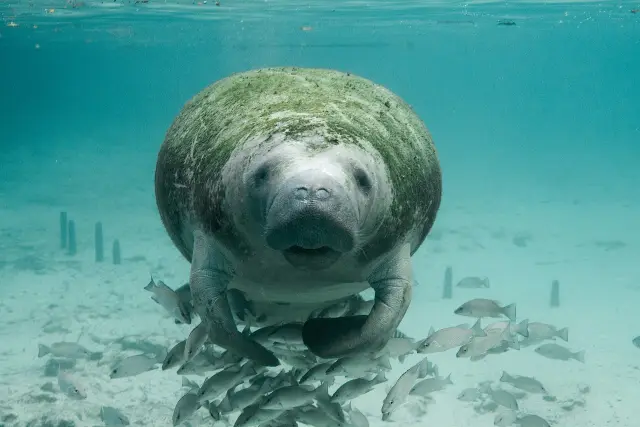
FWC's manatee viewing list includes the TECO Manatee Viewing Center at Apollo Beach, on a discharge canal off Tampa Bay, where visitors see hundreds of manatees in the warm water discharge canal.
FWC lists the TECO center, phone (813) 228-4289, with a visitor center, overlook and boardwalk, and it also lists Spring Bayou near Craig and Coburn Parks in Tarpon Springs, phone (727) 937-6109, where manatees come into the freshwater bayou from November through May (FWC, Where to See Manatees). ZooTampa at Lowry Park, phone (813) 935-8552, has a manatee exhibit and an on-site hospital used for manatee rehabilitation.
FWC counts at least 8,350 Florida manatees today, the growth that led to their federal reclassification in May 2017 from endangered to threatened (FWC, Florida Manatee). A distressed or dead manatee in Tampa Bay waters is reported to FWC at 888-404-FWCC (888-404-3922), or #FWC or *FWC from a cell phone. On the county side, the Pinellas Comprehensive Plan supports no-wake zones, seagrass protection areas and manatee caution signage, and the county asks people to secure items on vessels and near waterbodies and to bring a container with a lid for plastic bags or fishing line (Pinellas County, Manatees).
The St. Petersburg manatees guide covers the Weedon Island winter outflow, boating rules and the law on touching or feeding manatees in more depth.
When do sea turtles nest on Pinellas beaches near St. Petersburg?
Pinellas County gives sea turtle nesting and hatching season as May 1 through October 31, and the loggerhead is the most common sea turtle found in Pinellas County.
A nesting female comes ashore in the dark, digs a hole with her rear flippers and lays 100 to 150 eggs at a time, and she lays three to eight nests in a season (Pinellas County, Sea Turtle Protection). Hatchlings emerge at night after 45 to 70 days and head for the moonlight on the Gulf, and only about one in a thousand reaches adulthood. Pinellas County set a record of 669 sea turtle nests in 2019 and says the numbers are in decline.
Through the season the county asks beachfront residents and managers to limit light visible from the beach, switch off lights that the beach can see after sunset and use an FWC-approved amber light where light is needed (Pinellas County). A turtle in trouble goes to FWC at (888) 404-3922 or to Clearwater Marine Aquarium at (727) 441-1790, extension 1.
One inconsistency to know about: the same county's Fort De Soto page says loggerheads nest at that park between April and September (Pinellas County, Fort De Soto Park), a window that starts and ends a month earlier than the May 1 through October 31 nesting and hatching season on the county sea turtle page. The lighting rules follow the May to October dates. The St. Petersburg sea turtles guide goes deeper on nesting beaches and protection.
Can dolphins in Tampa Bay off St. Petersburg be fed or approached?
No: under the federal rule NOAA Fisheries describes, feeding or harassing wild dolphins is illegal off St. Petersburg as anywhere else, and NOAA wants viewers to keep a gap of 50 yards (150 feet) or more.
NOAA explains why the rule matters for St. Petersburg anglers and boaters as much as anyone: dolphins that people feed learn to beg, lose their fear of humans, swim too close to churning boat propellers and become entangled in fishing hooks and lines, and they can get sick from bait and human food (NOAA Fisheries, Protect Wild Dolphins). Feeding or attempting to feed wild dolphins is prohibited under the Marine Mammal Protection Act, and NOAA says violations can bring fines of up to $100,000 and/or up to 1 year in jail. Its Protect Wild Dolphins and Don't Feed Wild Dolphin signs are often posted near boat ramps, piers, docks, marinas and waterfront parks.
The Dolphins of Tampa Bay guide covers the dolphins off St. Petersburg and the Eckerd College research that tracks them.
What should be done when a brown pelican is hooked off a St. Petersburg pier?
FWC's rule for a hooked pelican on a St. Petersburg pier or seawall is Don't Cut the Line: reel the bird in slowly, remove the hook and line, then release it.
FWC asks anglers to get help if possible and reel the bird in slowly and evenly, without jerking the line (FWC, Hooked a Bird?). On a St. Petersburg fishing pier, the bird should stay on the water until a hoop net or similar net can lift it, because birds reeled up onto piers can be seriously injured. With a pelican, the handler holds the head behind the eyes, folds the wings against the body, can hold the beak but keeps it slightly open so the bird can breathe, and covers the head with a towel, hat or shirt to calm it.
Before release, FWC asks the rescuer to check the bird for other hooks or line. It also asks that cut line go into a monofilament recycling bin, or be cut into pieces under 3 inches and put in a lidded trashcan. For a bird that has swallowed a hook or is severely injured, FWC points to its app to find the nearest seabird rehabilitator and asks the rescuer to stay with the bird until help arrives. The St. Petersburg brown pelicans guide covers the birds themselves and where they nest around Tampa Bay.
Who handles a problem alligator in St. Petersburg?
A problem alligator in St. Petersburg is reported to the FWC Nuisance Alligator Hotline at 866-FWC-GATOR (866-392-4286), and FWC sends a contracted nuisance alligator trapper.
FWC runs the statewide nuisance alligator program and asks people never to feed alligators (FWC, Alligator Management). Alligators are part of the city's own preserve list too: the Boyd Hill Nature Preserve page names them, with gopher tortoises and marsh rabbits, among the wildlife on its Lake Maggiore trails (St. Petersburg Parks and Recreation).
Which St. Petersburg wildlife guide answers which question?
Four St. Petersburg wildlife guides go deeper than this hub: brown pelicans, the dolphins of Tampa Bay, manatees and sea turtles.
| Question | Key fact, checked October 18, 2026 | Where it is covered |
|---|---|---|
| Where are manatees near St. Pete? | TECO Manatee Viewing Center, Apollo Beach, (813) 228-4289 | St. Petersburg manatees guide |
| When do sea turtles nest? | May 1 through October 31 in Pinellas; loggerheads most common | St. Petersburg sea turtles guide |
| Can dolphins be fed? | No, feeding or harassing wild dolphins is illegal; watch from 50 yards | Dolphins of Tampa Bay guide |
| What if a pelican is hooked? | Do not cut the line; reel, remove, release | St. Petersburg brown pelicans guide |
| Who handles a nuisance alligator? | FWC hotline 866-392-4286 | This hub |
| Where are the most bird species? | Fort De Soto, more than 328 species in 60 years | This hub |
Last verified: October 18, 2026, against the FWC manatee, alligator and hooked bird pages, NOAA Fisheries dolphin guidance, the Pinellas County sea turtle, manatee and Fort De Soto pages, and the St. Petersburg Parks and Recreation Boyd Hill page. For any injured or stranded animal in St. Petersburg waters, the FWC line at 888-404-3922 is the first call (FWC).
Frequently asked questions
Where can manatees be seen near St. Petersburg?
FWC lists the TECO Manatee Viewing Center at Apollo Beach, on a warm water discharge canal off Tampa Bay, where hundreds of manatees gather; its phone is (813) 228-4289. FWC also lists Spring Bayou in Tarpon Springs, where manatees visit from November through May.
When is sea turtle nesting season in Pinellas County?
Pinellas County gives sea turtle nesting and hatching season as May 1 through October 31. The loggerhead is the most common sea turtle found in Pinellas County, and residents are asked to keep lights visible from the beach off after sunset during the season.
Is it illegal to feed dolphins in Tampa Bay?
Yes. Feeding or harassing wild dolphins is against the law, according to NOAA Fisheries, which wants viewers 50 yards or more away. Handouts teach dolphins to beg, and NOAA says fed dolphins may get too close to churning propellers or die tangled in hooks and line.
Who takes reports of an injured manatee or sea turtle in St. Petersburg?
FWC takes reports of distressed or dead manatees and sea turtles at 888-404-3922, or #FWC from a cell phone. For a sea turtle in Pinellas, Clearwater Marine Aquarium also answers at (727) 441-1790, extension 1.
What should an angler do after hooking a pelican on a St. Pete pier?
FWC says not to cut the line. Reel the pelican in slowly, keep it on the water until a hoop net can lift it onto the pier, hold the head behind the eyes, remove the hook and line, and then release the bird.
Sources
- Boyd Hill Nature Preserve, City of St. Petersburg Parks and Recreation https://www.stpeteparksrec.org/parks___facilities/boyd_hill.php Used for: 400 acres, Lake Maggiore, wildlife named on the trails, Lake Maggiore Environmental Education Center
- Fort De Soto Park, Pinellas County https://pinellas.gov/parks/fort-de-soto-park/ Used for: 1,136 acres on five keys, habitats, more than 328 bird species over 60 years, loggerhead nesting months
- Where to See Manatees in Florida, FWC https://myfwc.com/education/wildlife/manatee/where-to-see/ Used for: TECO Manatee Viewing Center at Apollo Beach, Spring Bayou in Tarpon Springs, ZooTampa manatee hospital, phone numbers
- Florida Manatee, FWC https://myfwc.com/wildlifehabitats/wildlife/manatee/ Used for: minimum population 8,350, May 2017 reclassification to threatened, 888-404-FWCC reporting line
- Manatees, Pinellas County https://pinellas.gov/manatees/ Used for: Comprehensive Plan measures: no-wake zones, seagrass protection areas, manatee caution signage
- Sea Turtle Protection, Pinellas County https://pinellas.gov/sea-turtle-protection/ Used for: loggerhead most common, May 1 to October 31 season, nesting biology, 669 nests in 2019, lighting rules, FWC and Clearwater Marine Aquarium numbers
- Protect Wild Dolphins: Admire Them from a Distance, NOAA Fisheries https://www.fisheries.noaa.gov/national/marine-life-viewing-guidelines/protect-wild-dolphins-admire-them-distance Used for: feeding and harassment illegal, 50 yard viewing distance, effects of feeding, signs at ramps and piers
- Hooked a Bird?, FWC https://myfwc.com/education/wildlife/unhook/ Used for: Reel, Remove, Release steps for a hooked pelican, hoop net from a pier, line disposal
- Alligator Management, FWC https://myfwc.com/wildlifehabitats/wildlife/alligator/ Used for: Nuisance Alligator Hotline 866-392-4286, contracted trapper dispatch, do not feed
How this page was made
Digital Towns uses AI assistance to research and write its guides, and every page is only as good as the sources it cites. Our goal is the most accurate, useful local information possible.
This page was fact-checked twice before publishing.
If you see an error, or anything you can show is false, tell us right away and we will take a third look.
Report an error
Thank you. We'll take a third look and correct the page if it's wrong.