Short answer: St. Petersburg's year divides into a wet season and a dry season more than into four seasons. June through September bring 33.82 of the 53.62 inches of normal yearly rain at the St. Petersburg station, while October through May average 1.64 to 2.94 inches a month. Highs reach 90.6 degrees in August and 70.6 in January. As of October 9, 2026, south Pinellas was in extreme drought, and the district's once-a-week lawn watering limit runs through March 31, 2027.
Last verified: October 15, 2026, against the sources listed at the end of this page.
Does St. Petersburg have four seasons, or a wet season and a dry season?
St. Petersburg runs on two seasons rather than four: a wet season from June through September that brings most of the year's rain, and a long dry season from October through May.
The numbers come from the St. Petersburg cooperative weather station, COOP ID 012873 in Pinellas County, whose 1991 to 2020 normals are published by the Florida Climate Center. Normal yearly precipitation at the station is 53.62 inches. June, July, August and September together supply 33.82 inches of that total, close to two thirds, while no month from October through May normally reaches 3 inches. July is the wettest month at 9.73 inches and November the driest at 1.64 inches.
Temperature changes far less than rain over the St. Petersburg year. The normal daily high rises from 70.6 degrees in January to 90.6 degrees in August, and the normal low from 52.5 to 76.3 degrees, so a midwinter afternoon on Tampa Bay is only about 20 degrees cooler than a midsummer one (Florida Climate Center normals). The station's normal heating degree days total 446 a year against 3,701 cooling degree days, a plain measure of how much more cooling than heating a St. Petersburg house needs.
What are the normal monthly highs, lows and rainfall in St. Petersburg?
St. Petersburg normals for 1991 to 2020 run from a 70.6 degree January high to a 90.6 degree August high, with monthly rain from 1.64 inches in November to 9.73 inches in July.
| Month | Normal high | Normal low | Normal rain | Season |
|---|---|---|---|---|
| January | 70.6 | 52.5 | 2.62 | Dry |
| February | 73.3 | 55.1 | 2.38 | Dry |
| March | 77.0 | 59.2 | 2.43 | Dry |
| April | 81.8 | 64.2 | 2.57 | Dry |
| May | 87.1 | 69.8 | 2.73 | Dry |
| June | 89.6 | 74.6 | 8.86 | Wet |
| July | 90.3 | 75.9 | 9.73 | Wet |
| August | 90.6 | 76.3 | 8.83 | Wet |
| September | 88.9 | 75.2 | 6.40 | Wet |
| October | 84.2 | 69.7 | 2.49 | Dry |
| November | 77.2 | 60.9 | 1.64 | Dry |
| December | 72.8 | 56.0 | 2.94 | Dry |
| Year | 81.9 | 65.8 | 53.62 | Both |
Every figure in the table is a 30 year average for the St. Petersburg station, taken from the Florida Climate Center 1991 to 2020 normals page. The annual mean temperature at the station is 73.9 degrees.
When does the St. Petersburg rainy season start and end?
For St. Petersburg and the rest of West Central Florida, the National Weather Service Tampa Bay office dates the rainy season from May 25 to October 10, starting ten days later and ending five days earlier than in Southwest Florida.
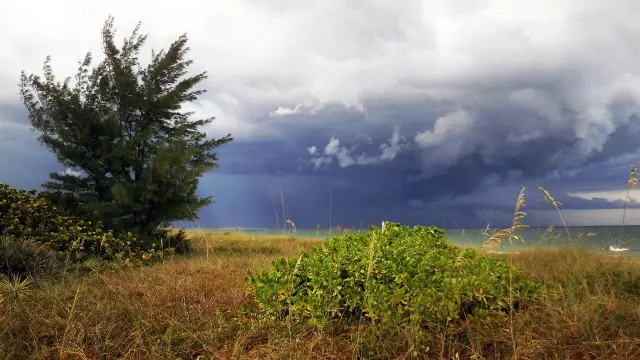
The NWS Tampa Bay thunderstorm season page sets the Southwest Florida season at May 15 to October 15 and describes the start as a transition rather than a single date. In some years it begins abruptly; in others it takes weeks. The signs are nearly daily showers and thunderstorms over the peninsula, late night and morning storms over the eastern Gulf, dew points that stay above 70 degrees, lows in the 70s to around 80 and highs from the upper 80s to the middle 90s.
The rainy season usually has three phases, according to the forecast office (NWS Tampa Bay). Late May through June is when severe storms are most likely, with hail, damaging winds and waterspouts on top of heavy rain and lightning. July through early September is the peak, when the severe threat eases but heavy rainfall and seasonal river flooding remain significant hazards, along with frequent lightning. Mid September through early October is the wind down, with more variable rain because tropical systems and early fall cold fronts can arrive. The St. Petersburg normals follow that curve: 8.86 inches in June, 9.73 in July, 6.40 in September and 2.49 in October (Florida Climate Center).
Where and when storms are favored on any given day depends on the position and strength of the Bermuda High, and NWS Tampa Bay uses eight subtropical ridge wind regimes to forecast that daily placement (NWS Tampa Bay).
How dry is the St. Petersburg dry season, and why is lawn watering limited to once a week?
The St. Petersburg dry season normally brings 1.64 to 2.94 inches of rain a month from October through May, and after below-average rain in the 2025 and 2026 summer rainy seasons, south Pinellas County was in extreme drought in October 2026.
The NWS Tampa Bay drought statement valid October 9, 2026 lists D3, Extreme Drought, in south Pinellas, and D2, Severe Drought, in north and central Pinellas, with the next update due October 16, 2026. The Southwest Florida Water Management District reports below average rainfall in both its 2025 and 2026 summer rainy seasons and a 12-month rainfall deficit through August 2026 of 15.4 inches (SWFWMD water restrictions). Its Modified Phase III one-day-per-week watering restrictions were extended through March 31, 2027 and cover all of Pinellas County.
For City of St. Petersburg water customers, established lawns may be watered from 5 to 9 a.m. or from 7 to 11 p.m., using only one 4-hour slot, although the FAQ on the same city page lets properties of one acre or larger use both slots (City of St. Petersburg watering restrictions). Addresses ending in an even number may irrigate on Saturday only, and odd-numbered addresses and locations with no address on Sunday only. Hand watering of plants other than lawns is allowed any day before 8 a.m. or after 6 p.m. Since April 17, 2026, the city issues a municipal ordinance violation citation for every violation. The page's FAQ gives a $193 fine plus court costs for a Class II offense, while its enforcement section still lists a $180 fine plus court costs, so the city page conflicts with itself on the amount.
One detail on the city page is out of date. On October 15, 2026 its FAQ still answered that the restrictions last until October 1, 2026, unless extended, modified or rescinded by the district (City of St. Petersburg), while the district page shows the once-a-week order extended through March 31, 2027 and tells residents to refer to city or county rules first (SWFWMD). The district adds that lawn and landscape watering remains limited to a once-per-week schedule and that residents should check with their city or county for their allowable day and times (SWFWMD). Last verified: October 15, 2026, on the City of St. Petersburg website.
How mild is a St. Petersburg winter?
A St. Petersburg winter is mild: January, the coolest month, has a normal high of 70.6 degrees and a normal low of 52.5 degrees at the city station (Florida Climate Center).
In its February 2026 and Winter 2025-26 summary, NWS Tampa Bay reported that winter temperatures across the region averaged from near normal to almost 2 degrees below normal, and that St. Petersburg was the exception: thanks to the influence of Tampa Bay it saw warmer low temperatures and averaged almost 2 degrees above normal.
Year to year, the Pacific matters. The NWS Tampa Bay ENSO winter page says that during El Nino, cold fronts cross the region with a jet stream that sits farther south and is stronger, so dry season rain over the Tampa Bay area is more widespread and usually above average. La Nina winters bring drier air and more fair weather days, and slightly above average temperatures. The same page notes that the Arctic Oscillation, which shifts on a monthly and sometimes weekly basis, does more to set Florida winter temperatures than ENSO does.
Frequently asked questions
When is the rainy season in St. Petersburg, Florida?
NWS Tampa Bay dates the rainy season for West Central Florida, including St. Petersburg, from May 25 to October 10. Rainfall coverage increases quickly in June and continues into early October, and July is the wettest month at the St. Petersburg station with 9.73 inches on average.
What is the coldest month in St. Petersburg?
January is the coldest month at the St. Petersburg station, with a 1991 to 2020 normal high of 70.6 degrees and a normal low of 52.5 degrees. February is close behind, with a normal low of 55.1 degrees, according to the Florida Climate Center.
How much rain does St. Petersburg get in a year?
The St. Petersburg station's 1991 to 2020 normal is 53.62 inches a year. Most of it falls from June through September, and November is the driest month with 1.64 inches. The Southwest Florida Water Management District reports below-average rainfall in both its 2025 and 2026 summer rainy seasons.
What day can St. Petersburg residents water their lawns?
City water customers with addresses ending in an even number may water established lawns on Saturday, and odd-numbered addresses on Sunday, during one 4-hour window from 5 to 9 a.m. or 7 to 11 p.m. The district's once-a-week restrictions run through March 31, 2027, although the city page still lists an October 1, 2026 end date.
Is St. Petersburg in a drought in 2026?
Yes. The NWS Tampa Bay drought statement valid October 9, 2026 placed south Pinellas County in extreme drought (D3) and north and central Pinellas in severe drought (D2), and the water management district reports below-average rain in its 2025 and 2026 summer rainy seasons.
Sources
- Florida Climate Center: St. Petersburg 1991-2020 Normals https://climatecenter.fsu.edu/products-services/data/1991-2020-normals/st-petersburg Used for: monthly normals, annual rain, degree days
- NWS Tampa Bay: Florida Thunderstorm Season https://www.weather.gov/tbw/RainySeason Used for: rainy season dates and phases
- NWS Tampa Bay Drought Information Statement, October 9, 2026 https://www.weather.gov/media/tbw/DGT/DGT_TBW_10092026.txt Used for: Pinellas drought categories
- City of St. Petersburg: Watering Restrictions https://www.stpete.org/residents/sustainability/water_conservation/water_restrictions.php Used for: watering days, hours, fines, end date on city page
- Southwest Florida Water Management District: District Water Restrictions https://www.swfwmd.state.fl.us/business/epermitting/district-water-restrictions Used for: extension through March 31, 2027 and rainfall deficit
- NWS Tampa Bay: ENSO Effect on Our Winter Weather https://www.weather.gov/tbw/ENSOWinter Used for: El Nino and La Nina winter patterns
- NWS Tampa Bay: February 2026 and Winter 2025-26 Summary https://www.weather.gov/media/tbw/climate/summaries/Feb2026_Winter2025_26_final.pdf Used for: St. Petersburg winter 2025-26 temperatures
How this page was made
Digital Towns uses AI assistance to research and write its guides, and every page is only as good as the sources it cites. Our goal is the most accurate, useful local information possible.
This page was fact-checked twice before publishing.
If you see an error, or anything you can show is false, tell us right away and we will take a third look.
Report an error
Thank you. We'll take a third look and correct the page if it's wrong.