Short answer: Emergencies in St. Petersburg go to 911, and police non-emergency calls to (727) 893-7780. St. Petersburg Fire Rescue covers about 300,000 people from 13 stations and holds an ISO Class 1 rating. Pinellas County orders evacuations by storm surge zone, which the city's Prepare, St. Pete map shows by address, and Alert Pinellas sends free warnings. FEMA flood maps in effect since August 24, 2021 set insurance requirements.
Last verified: October 19, 2026, against the sources listed at the end of this page.
Which numbers handle emergencies and storms in St. Petersburg?
In St. Petersburg, 911 is for any situation where a life or property is in danger; short of that, the city and county publish separate lines for police business, storm planning, evacuation rides and street flooding.
| Need | Number | Source |
|---|---|---|
| Life or property in danger now | 911 | St. Petersburg Police Department |
| Police matter that can wait | (727) 893-7780 | St. Petersburg Police Department |
| City storm and disaster office | 727-892-5200 | City Hurricane Center |
| County storm and disaster office | 727-464-3800 | City Hurricane Center |
| County hurricane information line, used only during emergencies | 727-464-4333 | City Hurricane Center |
| Sign up for an evacuation ride | 727-551-3822 | City Hurricane Center |
| Street or yard flooding report | 727-893-7231 | City flooding page |
Police headquarters sits at 1301 First Avenue North, main line (727) 893-7521 (SPPD). For general city questions during a storm, the city's storm page also gives its information line, 727-893-7111 (city storm page).
Four deeper St. Petersburg safety guides pick up from this table: the St. Petersburg emergency services guide (911, fire stations, alerts and shelters), the St. Petersburg hurricane evacuation zones guide (what the lettered zones mean and how surge sets them), the St. Petersburg flood zones guide (FEMA maps, insurance and the 49% rule) and the St. Petersburg sinkhole risk guide (state incident data and insurance law).
How big is St. Petersburg Fire Rescue?
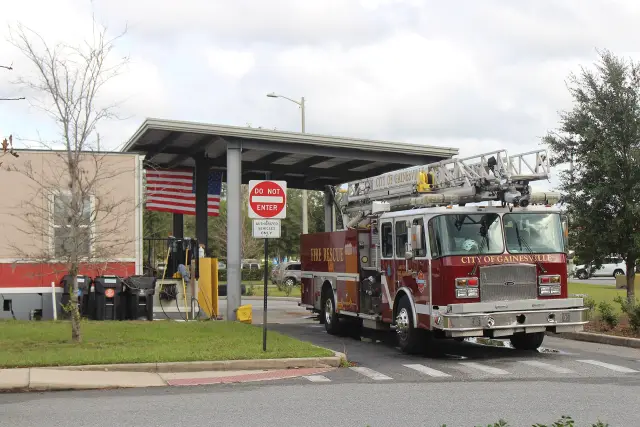
St. Petersburg Fire Rescue runs 14 fire companies out of 13 stations with a workforce of 389, including 357 sworn responders, covering about 300,000 people across 70 square miles.
SPFR provides fire and EMS service both inside and outside the St. Petersburg city limits, and its sworn crews work three rotating 24-hour shifts (St. Petersburg Fire Rescue). Each of the 13 stations is managed by a fire captain. The department's core services include fire operations, advanced life support EMS, emergency management and disaster planning, fire prevention and special operations.
ISO rates SPFR at Class 1, the best mark on a Public Protection Classification scale that runs to 10 and that many property insurers use when pricing fire coverage (SPFR). One number on the operations page is stale: it says that in 2018 SPFR answered more than 62,000 requests for emergency services, and its call totals table covers 2013 to 2018 only, ending at 62,178 calls in 2018, with no newer year posted there.
| Neighborhoods named | Station number and name | Street address |
|---|---|---|
| Old Northeast, Euclid/St Pauls, Crescent Lake, Crescent Heights | No. 4 (Old Northeast) | 2501 4th Street North |
| Driftwood, Old South East, Lake Maggiore Shores | No. 8 (Lake Maggiore) | 4701 9th Street South |
| Kenwood, Ponce De Leon | No. 10 (Ponce De Leon) | 2800 30th Avenue North |
| Greater Pinellas Point, Broadwater, the Skyway bridge | No. 11 (Lakewood) | 5150 31st Street South |
| Shore Acres, Snell Isle, Venetian Isles | No. 12 (Shore Acres) | 1651 Bayou Grande Blvd |
Station 12 in Shore Acres, built in 2003, is the only waterfront fire station in St. Petersburg, and Station 8 on 9th Street South, built in 2011, is LEED certified. The Lakewood station, No. 11, houses the Marine Rescue team, with dive, marine and fire boat units, and answers for the Skyway bridge plus mutual aid calls in Manatee County, while a new Station 2 is being built at 6560 26th Ave. N. to replace the current one (SPFR stations).
How does a St. Petersburg resident know when to evacuate?
St. Petersburg residents evacuate when Pinellas County orders their storm surge zone out, so the first step is looking up the zone on the city's Prepare, St. Pete map; mobile home residents leave for every order regardless of zone.
Pinellas County draws its evacuation zones from storm surge risk, and residents of any zone named in an order must leave; mobile and manufactured homes must always evacuate because of wind (Pinellas County evacuation). The county points to Hurricane Idalia in 2023, when it ordered a mandatory level A and mobile home evacuation, as a recent example.
By the city's own description, a large share of St. Pete sits inside evacuation zones. Its Prepare, St. Pete map layers the evacuation zones with the City Stormwater Floodplain, FEMA flood zones and active crane radius, so a single address lookup shows surge zone and rain flood risk together (City of St. Petersburg). The St. Petersburg hurricane evacuation zones guide explains what each zone letter means.
Where do St. Petersburg evacuees go?
Pinellas County opens general, special needs and pet friendly shelters only as a storm requires, and St. Petersburg residents who cannot drive themselves must pre-register with the Evacuation Assistance Program at 727-551-3822.
The county warns that not every shelter opens for every storm; the list depends on a storm's size and timing, and the status of each shelter, open, closed or full, is updated once an evacuation is ordered (Pinellas County shelters). Checking that list before leaving matters more than memorizing a shelter address.
Residents registered with the city's Evacuation Assistance Program are driven to one of three kinds of destination: a general evacuation shelter, the John Hopkins Middle School special needs shelter (701 16th St. S.), or an appropriate facility such as a hospital or nursing home. The city says residents must pre-register and should not wait until a storm is approaching (City of St. Petersburg Hurricane Center).
How are St. Petersburg residents alerted to emergencies?
St. Petersburg residents get emergency warnings through Alert Pinellas, a free county service that delivers texts, calls and emails, with more than 123,750 people signed up as of August 2026.
In 2025, Pinellas County sent 114 notifications through Alert Pinellas, for severe weather, tornadoes, water service outages and more (Pinellas County Emergency Management). Sign-up is free and is linked from both the county and the St. Petersburg Hurricane Center pages.
For rain flooding, the city names the National Weather Service office in Ruskin as the official voice on flood threats for St. Petersburg and the rest of Tampa Bay (City of St. Petersburg flooding).
How can a St. Petersburg owner check flood zone and flood insurance?
A St. Petersburg owner can ask the city for a Flood Insurance Rate Map determination, read against FEMA maps in force since August 24, 2021, and can buy NFIP flood coverage at any address in the city.
The determination answers two questions for a St. Petersburg parcel: is it inside a flood hazard area, and does federal law then make flood coverage mandatory. Owners in a flood zone also need to know the city's 49% Rule and its permit requirements before repairing or improving a building (City of St. Petersburg flooding). Flooding reports go to 727-893-7231 or [email protected], and permit questions to the same number or [email protected].
The FEMA map is not the whole picture in St. Petersburg. The city's own stormwater floodplain marks land with at least a one in 100 chance each year of flooding from heavy rainfall, drawn from local drainage patterns that FEMA maps can miss, so checking both layers on the Prepare, St. Pete map is the more complete test (City of St. Petersburg stormwater floodplain). The St. Petersburg flood zones guide covers the insurance discount and the 49% rule in detail.
Are sinkholes a risk in St. Petersburg?
Florida DEP says no part of Florida, St. Petersburg included, is technically free of sinkhole risk because the whole state sits on carbonate rock, and no database of every sinkhole in Florida exists within any government agency or private company.
The Florida Geological Survey keeps a downloadable database of reported subsidence incidents, but most entries have not been field-checked and the cause is not verified. A sinkhole on private property is the owner's responsibility, not a government agency's, though in some cases the owner's property insurance may cover evaluation and repair of a confirmed sinkhole, and where there is a risk of physical harm DEP says to call local law enforcement (Florida DEP sinkhole FAQ). The St. Petersburg sinkhole risk guide breaks down the Pinellas incident reports and the state insurance rules.
Last verified: October 18, 2026, against the City of St. Petersburg, St. Petersburg Fire Rescue, St. Petersburg Police Department, Pinellas County and Florida DEP pages linked above.
Frequently asked questions
Which number reaches St. Petersburg police when it is not an emergency?
Call (727) 893-7780 for a police matter that can wait; 911 is for emergencies. SPPD headquarters, at 1301 First Avenue North, has a separate main line, (727) 893-7521.
How many stations and firefighters does St. Petersburg Fire Rescue have?
SPFR works out of 13 stations, each run by a fire captain, and fields 14 fire companies from them. Its 389 employees include 357 sworn responders, and it protects approximately 300,000 people across 70 square miles.
How do St. Petersburg residents find their evacuation zone?
The City of St. Petersburg Prepare, St. Pete map shows each address's evacuation zone, which Pinellas County bases on storm surge risk. Mobile and manufactured home residents must evacuate for every order regardless of zone.
How do residents sign up for emergency alerts in St. Petersburg?
St. Petersburg residents sign up for Alert Pinellas, the free county system that sends text, phone and email alerts. The county counts 114 notifications sent in 2025 and over 123,750 sign-ups as of August 2026.
How old are the FEMA flood maps used in St. Petersburg?
FEMA's current maps for St. Petersburg date from August 24, 2021, the day the city says they took effect. The city provides Flood Insurance Rate Map determinations for individual properties, and flood insurance is available anywhere in the city through the NFIP.
Sources
- Hurricane Center, City of St. Petersburg https://www.stpete.org/residents/public_safety/hurricane_center.php Used for: emergency contacts, Prepare St. Pete map layers, Evacuation Assistance Program, special needs shelter site, registration line
- Operations, St. Petersburg Fire Rescue https://fire.stpete.org/about/operations.html Used for: 13 stations, 14 companies, 389 employees, 357 sworn, 70 square miles, about 300,000 people, 2018 call figure
- Stations, St. Petersburg Fire Rescue https://fire.stpete.org/stations.html Used for: station addresses, neighborhoods served, build years, Station 12 waterfront, Station 2 replacement site
- ISO and Accreditation, St. Petersburg Fire Rescue https://fire.stpete.org/about/administration/iso_accr.html Used for: Class 1 Public Protection Classification, ISO scale
- St. Petersburg Police Department https://police.stpete.org/ Used for: headquarters address, emergency, non-emergency and main numbers
- Evacuation, Pinellas County https://pinellas.gov/evacuation/ Used for: zones based on storm surge, mobile home rule, Idalia 2023 order
- Emergency Shelters, Pinellas County https://pinellas.gov/shelters/ Used for: not all shelters open, shelter types, status updates
- Emergency Management, Pinellas County https://pinellas.gov/department/emergency-management/ Used for: Alert Pinellas 2025 notifications and August 2026 sign-ups, county EM phone
- Flooding, City of St. Petersburg https://www.stpete.org/residents/public_safety/flooding.php Used for: FEMA maps effective Aug. 24, 2021, NFIP availability, FIRM determinations, 49% Rule, flooding report line, NWS Ruskin
- Sinkhole FAQ, Florida Department of Environmental Protection https://floridadep.gov/fgs/sinkholes/content/sinkhole-faq Used for: no sinkhole-free area of Florida, no complete database, subsidence incidents mostly not field-checked, private property responsibility
How this page was made
Digital Towns uses AI assistance to research and write its guides, and every page is only as good as the sources it cites. Our goal is the most accurate, useful local information possible.
This page was fact-checked twice before publishing.
If you see an error, or anything you can show is false, tell us right away and we will take a third look.
Report an error
Thank you. We'll take a third look and correct the page if it's wrong.