Short answer: Manatees around St. Petersburg gather at Tampa Bay warm-water sites in winter, including a federal sanctuary at the Bartow power plant outflow off Weedon Island where all waterborne activities are prohibited from November 15 to March 31. Tampa Electric's free Manatee Viewing Center in Apollo Beach is open daily from November 1 to April 15. Pinellas County waters carry state manatee zones under rule 68C-22.016, and injured manatees are reported to FWC at 1-888-404-3922.
Last verified: October 15, 2026, against the sources listed at the end of this page.
Where can manatees be seen near St. Petersburg?
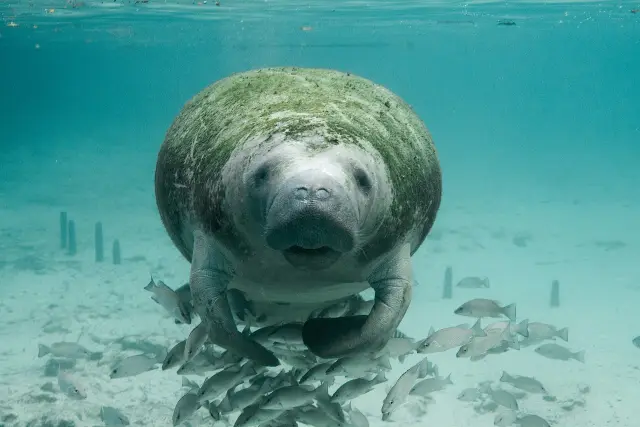
FWC says visitors see hundreds of manatees at the Tampa Electric Manatee Viewing Center in Apollo Beach, open daily from November 1 to April 15, and also lists Spring Bayou in Tarpon Springs and ZooTampa at Lowry Park in Tampa.
The Manatee Viewing Center sits at 6990 Dickman Rd., Apollo Beach, beside the warm-water discharge canal of Tampa Electric's Big Bend Power Station (Tampa Electric). It is open daily from November 1 to April 15, 10 a.m. to 5 p.m.; the trails close at 4 p.m., and the center closes on Thanksgiving Day, Christmas Day and Easter and at 3 p.m. on Christmas Eve. Parking and admission are free, pets are not allowed (service animals are), and questions go to 813-228-4289. When this page was checked on October 15, 2026, Tampa Electric listed the center as closed; it reopens for the season on November 1, 2026. Tampa Electric's own viewing cue is the water temperature: when it drops below 68 degrees Fahrenheit, many manatees are likely to be in the canal, and two live webcams over the gardens and boardwalks run through the end of the season on April 15.
FWC's statewide list of viewing sites also includes two in Tarpon Springs and Tampa (FWC). At Spring Bayou near Craig and Coburn Parks in Tarpon Springs, manatees visit the freshwater spring bayou from November through May; parking is limited in that historic district, and the contact number is 727-937-6109. ZooTampa at Lowry Park in Tampa (813-935-8552) has a manatee exhibit observation area and an on-site hospital used for manatee rehabilitation, with an entrance fee. FWC adds that in winter manatees head for warm waters such as springs and power plant discharge basins, and for the rest of the year they are widely dispersed in Florida's waterways.
Why is the Weedon Island power plant outflow a winter manatee sanctuary?
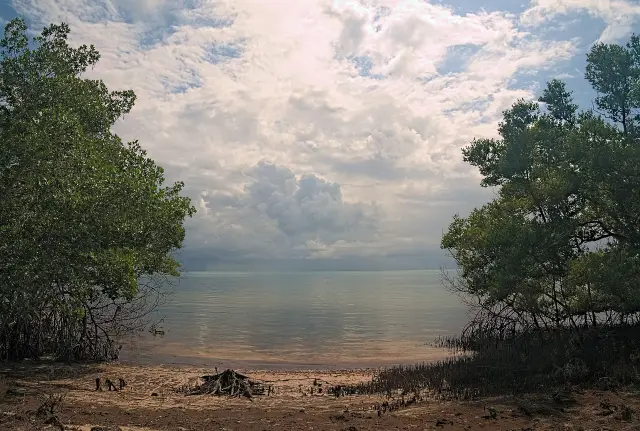
The Bartow Electric Generating Plant outflow on Weedon Island in St. Petersburg is a federal manatee sanctuary, closed to all waterborne activities from November 15 to March 31, because manatees gather at warm-water sites such as power plants in the coldest part of winter.
Federal rule 50 CFR 17.108 describes the sanctuary as part of Tampa Bay, St. Petersburg, Pinellas County, at the warm-water outflow of the Bartow Electric Generating Plant on the northern shore of Weedon Island, where the discharge enters the western shore of Old Tampa Bay; it is named the Bartow Electric Generating Plant Manatee Sanctuary and covers approximately 12.07 hectares, or 29.82 acres (eCFR). All waterborne activities are prohibited in the manatee sanctuaries listed in that rule during the period November 15 to March 31 of each year. The same rule lists the Tampa Electric Company Big Bend Manatee Sanctuary, approximately 12.08 hectares (29.85 acres), at the warm-water outflow of the Big Bend Electric Generating Station in eastern Tampa Bay, Hillsborough County, and requires watercraft to operate at idle speed from November 15 through March 31 in the Big Bend Manatee Refuge south of it.
The reason is temperature. FWC says prolonged exposure to water below 68 degrees can cause manatee cold-stress syndrome, which can result in death, and that wildlife managers deem the loss of warm-water habitat one of the most significant long-term threats to the population (FWC Fish and Wildlife Research Institute). The 2019 synoptic survey, conducted January 28 to February 2, 2019 following cold weather, gave preliminary results showing the highest counts in areas with the greatest amount of warm-water habitat from power plants and natural springs, such as Tampa Bay at more than 1,000 manatees, Lee County at more than 900 and the Crystal and Homosassa River areas at more than 800.
That Tampa Bay figure is a dated minimum count, not a population estimate. FWC says a synoptic survey provides a minimum count of manatees at warm-water sites, not a population size estimate, and FWC states that synoptic surveys were last conducted in 2019 (FWC).
What boating rules protect manatees in St. Petersburg waters?
Boats in St. Petersburg waters follow the Pinellas County manatee protection zones in Florida rule 68C-22.016, the Pinellas County boating restricted areas in rule 68D-24.010 and the federal Weedon Island sanctuary, and FWC advises boaters to abide by the regulations as posted on the water.
The FWC data and maps page lists those three layers for Pinellas County: state manatee protection zones under 68C-22.016, state boating restricted areas under 68D-24.010 and the federal protection area at 50 CFR 17.108(a)9, with county maps in PDF format (FWC). FWC notes that some zones in Florida are more protective in colder months and others in warmer months, and that other local, state or federal zones may also apply beyond those maps.
The Pinellas County Zones rule, in the Florida Manatee Sanctuary Act chapter, first took effect on January 5, 2005, and was last amended effective January 18, 2016 (Florida Administrative Code). The rule history shows that in 2014 the Commission was considering amendments to the existing Pinellas County rule to add zones in the western portion of the county, and that the proposed rule set out to limit allowable motorboat speed in portions of Pinellas County. The Pinellas County Boating Restricted Areas rule is older, first adopted on September 18, 1988, and its current version has been in effect since October 30, 2013 (Florida Administrative Code). FWC tells a boater who hits a manatee to obtain immediate help for the animal, because the sooner it is located and assessed, the better its chances for survival. A boater will not be cited for accidentally colliding with a manatee while obeying speed restrictions, and reports go to 888-404-FWCC (3922), or *FWC or #FWC from a cell phone (FWC).
Which manatee places, seasons and rules matter most around St. Petersburg?
The table below lists the manatee places, seasons and rules a St. Petersburg resident or visitor is most likely to need, each from the agency or operator that sets it.
| Place or rule | Where | Season or date | Key detail |
|---|---|---|---|
| Bartow Electric Generating Plant Manatee Sanctuary | Weedon Island, Old Tampa Bay, St. Petersburg | November 15 to March 31 | All waterborne activities prohibited; 29.82 acres |
| Manatee Viewing Center | 6990 Dickman Rd., Apollo Beach | November 1 to April 15, 10 a.m. to 5 p.m. | Free parking and admission; reopens November 1, 2026 |
| Spring Bayou | Near Craig and Coburn Parks, Tarpon Springs | November through May | Limited parking; 727-937-6109 |
| Pinellas County Zones, rule 68C-22.016 | Pinellas County waters | Effective January 18, 2016 | State manatee protection zones |
| Pinellas County Boating Restricted Areas, rule 68D-24.010 | Pinellas County waters | Effective October 30, 2013 | State boating restricted areas |
| FWC Wildlife Alert | Statewide | Not seasonal | 1-888-404-3922, press 7 |
Sources for the table: eCFR, Tampa Electric, FWC viewing sites, rule 68C-22.016, rule 68D-24.010 and FWC rescue statistics. Last verified: October 15, 2026, on the Florida Fish and Wildlife Conservation Commission, eCFR and Tampa Electric websites.
Who should be called about an injured or dead manatee in St. Petersburg?
An injured, sick, dead or tagged manatee in St. Petersburg is reported to the FWC Wildlife Alert line at 1-888-404-FWCC (1-888-404-3922), pressing 7 for an operator, or *FWC or #FWC from a cell phone.
FWC wildlife experts from five coastal field stations retrieve and examine reported carcasses to determine the cause of death, and FWC receives calls reporting manatees in distress, coordinates rescues and, when necessary, transports manatees to rehabilitation facilities (FWC Fish and Wildlife Research Institute). Pinellas County gives the same hotline number for a sick or injured manatee on its own manatee page (Pinellas County).
One of those field stations is in St. Petersburg. The Marine Mammal Pathobiology Laboratory, the FWC northwest field station, is on the campus of Eckerd College in St. Petersburg, and its staff respond to manatees from Escambia County at the Alabama border to Manatee County just south of Tampa Bay, and to dolphins and whales in the Tampa Bay area (FWC). It is the only field station with a dedicated necropsy lab, so the majority of manatee carcasses recovered statewide are transported there for necropsy.
What does the law say about touching or feeding manatees around Tampa Bay?
Touching, feeding, chasing or giving water to manatees around Tampa Bay goes against FWC viewing guidelines and can break state and federal law, because Florida manatees are protected by the Florida Manatee Sanctuary Act and two federal laws.
FWC viewing guidelines, which apply statewide and so cover the Tampa Bay viewing sites above, say to look but not touch, not to feed manatees or give them water, not to pursue or chase a manatee while swimming, snorkeling, diving, paddling or operating a boat, and not to separate a cow and her calf (FWC). The reason given is that manatees that become accustomed to people can lose their natural fear of boats and humans, which may make them more susceptible to harm. Federal protection comes from the Marine Mammal Protection Act of 1972 and the Endangered Species Act of 1973, and state protection from the Florida Manatee Sanctuary Act of 1978, which makes it unlawful to intentionally or negligently annoy, molest, harass or disturb any manatee. A state conviction carries a possible maximum fine of $500 and/or up to 60 days in jail, and a federal conviction a fine of up to $50,000 and/or one year in prison.
Florida manatees, Tampa Bay animals included, were first protected by Florida state law in 1893. FWC says the population has grown to a minimum of 8,350 animals and, as a result, in May 2017 the species was reclassified from endangered to threatened under the federal Endangered Species Act (FWC). A $5 donation at a Florida tax collector office buys a Save the Manatee decal that supports the program.
Why is St. Petersburg the home of Florida manatee research?
St. Petersburg is home to Florida manatee research because the FWC Fish and Wildlife Research Institute is headquartered at 100 8th Avenue Southeast, where nearly half of its 800-plus staff work.
The FWRI headquarters in downtown St. Petersburg can be reached at (727) 896-8626 (FWC). Colleagues stationed at the headquarters lead the core manatee research projects that field station staff take part in: the Manatee Photo-identification Program, population monitoring, radiotelemetry and tracking, genetics sampling and manatee warm-water habitat temperature monitoring (FWC field stations).
The current statewide estimate, which covers St. Petersburg waters along with the rest of Florida, comes from FWC's third abundance survey, flown December 1 to 15, 2021 on Florida's west coast and November 30 to December 6, 2022 on the east coast. FWC estimates 8,350 to 11,730 manatees statewide for 2021 to 2022, with 3,960 to 5,420 on the west coast and 3,940 to 6,980 on the east coast (FWC). Those ranges are 95 percent Bayesian credible intervals, not single point estimates, and because the 2021 to 2022 interval overlaps the 2015 to 2016 interval of 7,520 to 10,280, FWC says the population could have either increased or decreased since the previous survey.
Pinellas County backs the state work on land: its comprehensive plan supports enforcing no-wake zones, establishing seagrass protection areas and providing manatee caution signage, and its Environmental Management Division is listed at (727) 464-4425 (Pinellas County). The county also asks people to secure items on a vessel or near any waterbody, bring a container with a lid to store plastic bags or fishing line, and collect any plastic items or fishing line they see.
Frequently asked questions
When is the best time to see manatees near St. Petersburg?
Winter is best. Tampa Electric's Manatee Viewing Center in Apollo Beach is open daily from November 1 to April 15, and Tampa Electric says many manatees are likely in its canal when the water drops below 68 degrees Fahrenheit. For 2026 the center reopens on November 1.
Is the Apollo Beach Manatee Viewing Center free?
Yes. Tampa Electric offers free parking and free admission at the Manatee Viewing Center, 6990 Dickman Rd., Apollo Beach. It is open 10 a.m. to 5 p.m. in season, closed on Thanksgiving Day, Christmas Day and Easter, and does not allow pets.
Can boats go into the Weedon Island manatee sanctuary in St. Petersburg?
Not from November 15 to March 31. The Bartow Electric Generating Plant Manatee Sanctuary off Weedon Island is a federal sanctuary where all waterborne activities are prohibited during that period each year, under 50 CFR 17.108.
What number reports an injured manatee in Pinellas County?
Call the FWC Wildlife Alert line at 1-888-404-3922 (1-888-404-FWCC) and press 7 for an operator, or dial *FWC or #FWC from a cell phone. Pinellas County lists the same number for sick or injured manatees.
How many manatees live in Tampa Bay?
FWC presents its abundance estimates only on a statewide and coastal scale. Its 2019 winter synoptic survey, a minimum count rather than a population estimate, gave a preliminary count of more than 1,000 manatees in Tampa Bay, and the 2021 to 2022 abundance survey estimated 3,960 to 5,420 manatees on the whole west coast.
Sources
- Tampa Electric, Manatee Viewing Center https://www.tampaelectric.com/company/mvc/ Used for: season dates, daily hours, address, phone, free parking and admission, 68 degree viewing cue, November 1, 2026 reopening
- FWC, Where Can I See Manatees in Florida? https://myfwc.com/education/wildlife/manatee/where-to-see/ Used for: nearby viewing sites: Manatee Viewing Center, Spring Bayou in Tarpon Springs, ZooTampa at Lowry Park, with phone numbers
- FWC, Manatee Viewing Guidelines https://myfwc.com/education/wildlife/manatee/viewing-guidelines/ Used for: look but do not touch, no feeding or watering, federal and state protection statutes
- FWC, Florida Manatee Program https://myfwc.com/wildlifehabitats/wildlife/manatee/ Used for: threatened reclassification May 2017, protected since 1893, minimum 8,350 animals, report line, Save the Manatee decal
- FWC, Boat, PWC and Paddle-sport Operators https://myfwc.com/wildlifehabitats/wildlife/manatee/for-operators/ Used for: report line 888-404-FWCC, accidental collision while obeying speed limits is not cited
- FWC, Manatee Data and Maps https://myfwc.com/wildlifehabitats/wildlife/manatee/data-and-maps/ Used for: Pinellas County rule numbers for state zones, boating restricted areas and federal areas, seasonal zone changes, obey posted signs
- Florida Administrative Code, Rule 68C-22.016 Pinellas County Zones https://www.flrules.org/gateway/ruleNo.asp?id=68C-22.016 Used for: Pinellas County Zones rule, effective 2005, amended 2016 to add western county zones
- Florida Administrative Code, Rule 68D-24.010 Pinellas County Boating Restricted Areas https://www.flrules.org/gateway/ruleNo.asp?id=68D-24.010 Used for: Pinellas County Boating Restricted Areas rule, effective date 10/30/2013
- eCFR, 50 CFR 17.108 Designated Manatee Protection Areas https://www.ecfr.gov/current/title-50/chapter-I/subchapter-B/part-17/subpart-J/section-17.108 Used for: Bartow Electric Generating Plant Manatee Sanctuary on Weedon Island, 29.82 acres, November 15 to March 31 closure
- FWC Fish and Wildlife Research Institute, 2019 Manatee Synoptic Survey https://myfwc.com/research/manatee/research/population-monitoring/2019-synoptic-survey/ Used for: Tampa Bay count over 1,000 in 2019, 68 degree cold stress threshold, warm-water sites
- FWC Fish and Wildlife Research Institute, Manatee Population Monitoring https://myfwc.com/research/manatee/research/population-monitoring/ Used for: synoptic surveys last conducted in 2019
- FWC Fish and Wildlife Research Institute, Third Update to the Statewide Florida Manatee Abundance Estimate https://myfwc.com/research/manatee/research/population-monitoring/abundance/ Used for: statewide estimate 8,350 to 11,730, west coast range, survey dates
- FWC Fish and Wildlife Research Institute, Manatee Rescue and Mortality Statistics https://myfwc.com/research/manatee/rescue-mortality-response/statistics/ Used for: Wildlife Alert number, press 7, *FWC and #FWC
- FWC Fish and Wildlife Research Institute, Marine Mammal Field Stations https://myfwc.com/research/manatee/rescue-mortality-response/field-stations/ Used for: Marine Mammal Pathobiology Laboratory at Eckerd College, coverage area, statewide necropsy role
- FWC Fish and Wildlife Research Institute, FWRI Locations https://myfwc.com/research/about/locations/ Used for: FWRI headquarters address and phone, nearly half of 800-plus staff in St. Petersburg
- Pinellas County, Manatees https://pinellas.gov/manatees/ Used for: Pinellas County comprehensive plan measures, fishing line tip, Environmental Management phone
How this page was made
Digital Towns uses AI assistance to research and write its guides, and every page is only as good as the sources it cites. Our goal is the most accurate, useful local information possible.
This page was fact-checked twice before publishing.
If you see an error, or anything you can show is false, tell us right away and we will take a third look.
Report an error
Thank you. We'll take a third look and correct the page if it's wrong.