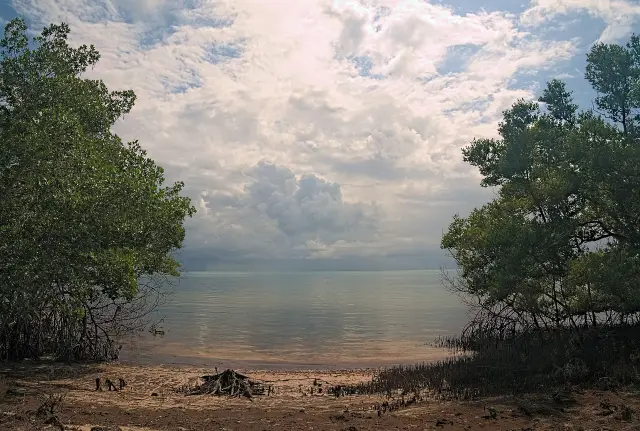
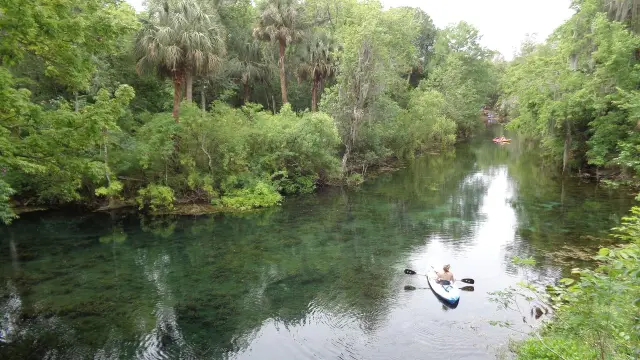
Short answer: Red, black and white mangroves grow along the St. Petersburg shoreline of Tampa Bay, and at Weedon Island Preserve in north St. Petersburg boardwalks run through tidal flats and mangrove forests. Florida protects all three under the 1996 Mangrove Trimming and Preservation Act, and Pinellas County runs that program locally: no mangrove may be cut below six feet, trees over 10 feet need a county-registered trimmer, and permit applications cost $810 for a single family lot as of October 1, 2026.
Last verified: October 15, 2026, against the sources listed at the end of this page.
Which mangroves grow along the St. Petersburg shoreline?
Three true mangroves grow on the St. Petersburg shoreline of Tampa Bay: red mangrove, black mangrove and white mangrove, the same three species Florida law protects (Florida DEP).
The Mangrove Trimming and Preservation Act of 1996, sections 403.9321 to 403.9334 of the Florida Statutes, names Rhizophora mangle (red), Avicennia germinans (black) and Laguncularia racemosa (white), and the act treats a dead mangrove on a St. Petersburg seawall lot the same as a living one (Florida DEP).
Tampa Bay supports all three species, and they sort themselves by elevation: red mangroves grow closest to the water, black mangroves next, and white mangroves farthest up the shore (Tampa Bay Estuary Program). The Florida Natural Areas Inventory adds buttonwood (Conocarpus erectus) to the mix as the plant of the highest, least tidal zone, often at the edge of the upland (FNAI). The Florida Fish and Wildlife Conservation Commission does not count buttonwood as a true mangrove, because it lacks the root and reproductive traits of the other three (FWC).
Freeze tolerance sets how far north each species forms forests. FNAI reports that black mangroves form dense stands north to Cedar Key on the Gulf coast, while red and white mangroves form dense forests only as far north as Tarpon Springs on the Gulf coast (FNAI). Mangroves most commonly stand 10 to 20 feet tall, though FNAI notes they range from trees more than 80 feet tall to dwarf shrubs (FNAI).
How can red, black and white mangroves be told apart in Pinellas County?
In Pinellas County the roots give each mangrove away: red mangroves stand on arching prop roots, black mangroves send up fingerlike roots from the mud (Pinellas County), and white mangroves often lack visible roots (FWC).
Pinellas County describes red mangroves with long aerial prop roots, waxy bright green leaves and pencil-like seedlings hanging from the branches; they are very sensitive to trimming, especially topping (Pinellas County homeowner guide). Black mangroves grow taller and more tree-like, with dark bark, and the upper side of the leaf is darker than the lower side and often crusted with salt. FWC calls the black mangrove roots pneumatophores: dark, woody projections growing straight up from the soil (FWC).
White mangroves around St. Petersburg are generally smaller and more shrub-like, with oval leaves that carry two small glands at the base of each leaf, and they generally tolerate trimming (Pinellas County). Buttonwood, the upland neighbor, is easiest to spot by its button-like, cone-shaped fruit clusters (FWC).
Where can mangrove forests be seen in St. Petersburg?
Mangrove forests can be seen at Weedon Island Preserve, 1800 Weedon Drive NE, where boardwalks run through tidal flats and mangrove forests on Old Tampa Bay (Weedon Island Preserve).
The preserve covers about 3,195 acres on the northwest shore of Old Tampa Bay, with more than half of it north of Gandy Boulevard; most of it is aquatic and wetland, laced with mosquito ditches dug in the late 1950s, and uplands make up the other 1,100 acres (Weedon Island Preserve ecosystems). Pinellas County rounds the size to a 3,000-acre natural area in north St. Petersburg, so the two county pages differ by about 195 acres (Pinellas County). The state of Florida owns the land and Pinellas County manages it under lease agreements (Weedon Island Preserve).
Weedon Island Preserve has almost two miles of accessible boardwalk and pavement, with the boardwalks running through tidal flats and mangrove forests over saltwater ponds, and a 45-foot observation tower on the west boardwalk loop looks over the preserve, Tampa Bay, St. Petersburg and Tampa (Weedon Island Preserve trails). Two self-guided paddling trails thread the islands and waterways, though Pinellas County lists the north trail as closed at this time, and the county counts more than 4.7 miles of boardwalks and trails in all (Pinellas County).
| Item | Detail | Source |
|---|---|---|
| Address | 1800 Weedon Drive NE, St. Petersburg, FL 33702 | Weedon Island Preserve |
| Preserve hours | Daily from 7 a.m. to a posted closing time about 15 minutes before sunset; closed the day after Thanksgiving and December 25 | Weedon Island Preserve |
| Cultural and Natural History Center | Thursday to Saturday 9 a.m. to 4 p.m., Sunday 11 a.m. to 4 p.m., closed Monday to Wednesday and county holidays, phone (727) 453-6500 | Weedon Island Preserve |
| Admission | Free, donations welcome | Weedon Island Preserve |
| Mangrove boardwalks | Almost 2 miles of boardwalk and pavement, 45-foot tower | Weedon Island Preserve trails |
| Pets | Not allowed, including dogs, cats, birds and horses | Weedon Island Preserve FAQ |
Weedon Island Preserve opens daily at 7 a.m. and closes at a time posted at the entrance, roughly 15 minutes before sunset, and admission to both the preserve and the Cultural and Natural History Center is free (Weedon Island Preserve). Pets are not allowed on the preserve, because the county treats it as the only refuge for many native animals (Weedon Island Preserve FAQ). Trails are for day use only and overnight parking is not allowed (Weedon Island Preserve trails).
Why do mangroves matter to Tampa Bay and St. Petersburg?
Mangroves are the dominant wetland plants of the Tampa Bay watershed, and they provide shelter and nursery areas for fish, crustaceans and shellfish (Tampa Bay Estuary Program).
The Tampa Bay Estuary Program says mangrove forests trap and cycle pollutants, serve as nursery areas, and form the base of the food chain for snook, snapper, tarpon, jack, sheepshead, red drum, oysters, crabs and shrimp; they also protect uplands from storms, waves and floods (TBEP). Pinellas County credits Weedon Island Preserve with reducing storm surge and protecting nearby development from flooding and erosion, and lists its pier and oyster bars as places to catch sea trout, snook and sheepshead (Pinellas County).
Losses frame the rules. Pinellas County says Florida has lost about 86 percent of its mangroves since the 1940s and the Tampa Bay region about half of its historic coverage (Pinellas County). TBEP counts almost half of the bay's original marshes and mangroves lost since the 1950s, with half of the natural shoreline altered by roads, causeways and subdivisions (TBEP).
The Tampa Bay Estuary Program Habitat Master Plan sets a target of 15,300 acres of mangrove forests in the watershed by no later than 2050, alongside 5,457 acres of salt marsh and 56 miles of living shoreline (TBEP Habitat Master Plan).
Who regulates mangrove trimming in St. Petersburg, and what do the rules allow?
Pinellas County regulates mangrove trimming on St. Petersburg shorelines, under authority the Florida DEP has delegated to the county (Florida DEP).
Florida DEP lists Pinellas County, phone 727-453-3385, among the local governments delegated to run the Mangrove Trimming and Preservation Act; questions about trimming in a delegated area go to that agency (Florida DEP delegated local governments). Pinellas County adopted its Mangrove Trimming and Preservation Code in 2003 with a citizen advisory committee, and the county says the code now provides the sole regulation over mangroves in Pinellas County (Pinellas County). The rules sit in Chapter 58, Article XVI of the county code, and trimming needs either an exemption or a permit (Pinellas County mangroves).
Every Pinellas County trim, exempt or permitted, must follow the general criteria: the mangroves must be on the owner's land or the adjacent state submerged land, outside any conservation or mitigation area; no mangrove may be cut below six feet measured from the mud; prop roots may not be cut; and no herbicides may be used (Pinellas County homeowner guide). A professional mangrove trimmer registered with Pinellas County must be used for mangroves over 10 feet tall, must notify Pinellas County Water and Navigation in advance, and must be on site; trees over 16 feet are cut in stages, with no more than 25 percent of the foliage removed a year (Pinellas County).
| Rule | Exempt trimming | Permitted trimming |
|---|---|---|
| Depth of mangrove fringe | Less than 50 feet | Less than 500 feet |
| Tree height | Not over 24 feet | 25 percent of trees over 16 feet left with canopy intact |
| Share of mangroves trimmed | No more than 65 percent on shorelines over 150 feet | No more than 65 percent |
| Season | Not listed among the exemption conditions | March 1 to November 30 |
| Application fee (effective Oct. 1, 2026) | No permit required | $810 single family, $1,610 multi-family or commercial |
| Review time | Staff can meet on site to confirm, if desired | Within 30 days |
Exempt trimming in Pinellas County requires a fringe less than 50 feet deep, trees no taller than 24 feet, no more than 65 percent of the mangrove area trimmed on shorelines longer than 150 feet, and mangroves that are not on an uninhabited island; maintenance trimming of mangroves legally trimmed in the past is also exempt (Pinellas County). A permit covers fringes up to 500 feet deep, with work only between March 1 and November 30, non-petroleum chain saw lubricants, removal of Brazilian pepper, melaleuca and Chinese tallow within 25 feet of the mangroves, and removal of all cut branches; Pinellas County reviews applications within 30 days (Pinellas County).
Last verified: October 15, 2026, on the Pinellas County and Florida DEP websites.
What should a St. Petersburg waterfront owner check before trimming mangroves?
The first call for a St. Petersburg owner is Pinellas County Water and Navigation at (727) 453-3385, the county line for exemption and permit questions; any tree over 10 feet also needs a county-registered trimmer (Pinellas County).
Pinellas County publishes a listing of professional mangrove trimmers registered in the county, a homeowner guide in English and Spanish, and a trimmer registration and renewal form on its mangroves page; permit questions go to Water and Navigation Permits at (727) 464-4170 (Pinellas County mangroves). County staff can meet an owner on site to confirm that a project qualifies as exempt (Pinellas County).
The Pinellas County fee schedule effective October 1, 2026 lists $810 for a single family mangrove trimming permit application, $1,610 for multi-family and commercial, and $200 (single family) or $400 (multi-use or commercial) for a pre-application mangrove survey (Pinellas County fee schedule).
Pinellas County adds two cautions: because no mangrove may be removed, destroyed or defoliated, some trees cannot be reduced to six feet or must be reduced in stages over time, and red mangroves are very sensitive to trimming, especially topping (Pinellas County homeowner guide). Outside the delegated counties, Florida DEP district offices take mangrove applications; for St. Petersburg the county office is the one to call (Florida DEP).
Frequently asked questions
Can mangroves be trimmed in St. Petersburg without a permit?
Yes, if the job meets the Pinellas County exemption: a mangrove fringe less than 50 feet deep, trees no taller than 24 feet, no more than 65 percent trimmed on shorelines over 150 feet, and no trimming below six feet. Trees over 10 feet still need a county-registered professional mangrove trimmer.
Who issues mangrove trimming permits for St. Petersburg?
Pinellas County handles them, because Florida DEP has delegated the state mangrove program to Pinellas County. The main line is (727) 453-3385 and the permits line is (727) 464-4170, according to the county mangroves page checked October 15, 2026.
How much is a Pinellas County mangrove trimming permit?
Under the Pinellas County fee schedule effective October 1, 2026, the application fee is $810 for a single family property and $1,610 for multi-family or commercial property. A pre-application mangrove survey costs $200 for single family or $400 for multi-use and commercial.
Where can mangroves be seen up close in St. Petersburg?
Weedon Island Preserve at 1800 Weedon Drive NE has almost two miles of accessible boardwalk and pavement, with boardwalks through tidal flats and mangrove forests, plus a 45-foot observation tower. It opens daily at 7 a.m., closes about 15 minutes before sunset, and admission is free.
Is buttonwood a mangrove?
Not a true one. FWC says buttonwood lacks the root and reproductive traits of red, black and white mangroves and usually grows above the tide line. Florida law defines mangroves as the three true species, and FNAI places buttonwood in the transition zone to the adjacent upland.
Sources
- Florida Department of Environmental Protection: Mangroves https://floridadep.gov/water/submerged-lands-environmental-resources-coordination/content/mangroves Used for: Mangrove Trimming and Preservation Act of 1996, sections 403.9321-403.9334 F.S., three species, dead mangroves regulated, district offices and delegated local governments
- Florida DEP: Mangrove Trimming Delegated Local Governments https://floridadep.gov/water/submerged-lands-environmental-resources-coordination/content/mangrove-trimming-delegated Used for: Pinellas County is a delegated local government, phone 727-453-3385
- Pinellas County: Mangroves https://pinellas.gov/mangroves/ Used for: county ordinance Chapter 58 Article XVI, exemption or permit, Water and Navigation phone, registered trimmers
- Pinellas County: Homeowner Guidelines for Trimming Mangroves https://pinellas.gov/homeowner-guidelines-for-trimming-mangroves/ Used for: 2003 county code, losses since the 1940s, trimming criteria, PMT over 10 feet, exemptions, permit conditions, March 1 to November 30 window, species descriptions
- Pinellas County: Water and Navigation and Mangrove Trimming Permit Application Fees https://pinellas.gov/water-and-navigation-and-mangrove-trimming-permit-application-fees/ Used for: fees effective Oct. 1, 2026
- Pinellas County: Weedon Island Preserve https://pinellas.gov/parks/weedon-island-preserve Used for: 3,000-acre natural area in north St. Petersburg, storm surge, paddling trails, 4.7 miles of boardwalks and trails, address
- Weedon Island Preserve: Ecosystems https://www.weedonislandpreserve.org/ecosystems.htm Used for: about 3,195 acres, more than half north of Gandy Boulevard, mosquito ditches from the late 1950s, state ownership and county management
- Weedon Island Preserve: Boardwalks and Trails https://www.weedonislandpreserve.org/boardwalks-trails.htm Used for: boardwalks through tidal flats and mangrove forests, 45-foot observation tower, day use only
- Weedon Island Preserve (Pinellas County) https://www.weedonislandpreserve.org/ Used for: preserve and center hours, free admission
- Weedon Island Preserve: FAQ https://www.weedonislandpreserve.org/faq.htm Used for: pets not allowed
- Florida Fish and Wildlife Conservation Commission: Mangrove Forests https://myfwc.com/research/habitat/coastal-wetlands/information/mangroves/ Used for: species, zonation, buttonwood not a true mangrove, functions
- Florida Natural Areas Inventory: Mangrove Swamp (Guide to the Natural Communities of Florida, 2010) https://www.fnai.org/PDFs/NC/Mangrove_Swamp_Final_2010.pdf Used for: zonation, heights, cold tolerance limits at Cedar Key and Tarpon Springs
- Tampa Bay Estuary Program: About the Bay https://tbep.org/about-the-bay/ Used for: loss of marshes and mangroves since the 1950s, functions, red black and white zonation in Tampa Bay
- Tampa Bay Estuary Program: Habitat Master Plan https://tbep.org/habitat-master-plan-update/ Used for: 15,300 acres of mangrove forests goal by 2050
How this page was made
Digital Towns uses AI assistance to research and write its guides, and every page is only as good as the sources it cites. Our goal is the most accurate, useful local information possible.
This page was fact-checked twice before publishing.
If you see an error, or anything you can show is false, tell us right away and we will take a third look.
Report an error
Thank you. We'll take a third look and correct the page if it's wrong.