Short answer: St. Petersburg has coastal (maritime) hammock at Weedon Island Preserve, where the one-mile Boy Scout Loop passes through pine flatwoods and maritime and xeric hammocks; the preserve opens daily at 7 a.m. with free admission. FNAI lists live oak, cabbage palm, red bay and red cedar as characteristic of temperate maritime hammock. Boyd Hill Nature Preserve, a 400-acre city preserve on Lake Maggiore, charges $3 for adults and is closed Mondays.
Last verified: October 15, 2026, against the sources listed at the end of this page.
What is a coastal hammock, and does St. Petersburg have one?
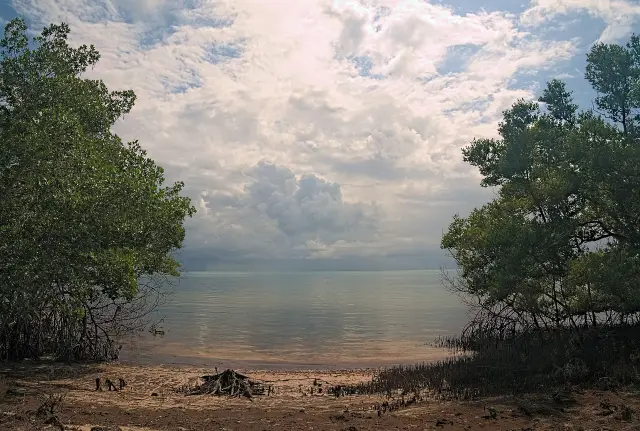
Yes: St. Petersburg has maritime hammock at Weedon Island Preserve, where the Boy Scout Loop passes through maritime and xeric hammocks (Weedon Island Preserve trails), and FNAI describes maritime hammock as an evergreen hardwood forest growing on stabilized coastal dunes (FNAI).
The Florida Natural Areas Inventory defines maritime hammock, one of the two hammock types on the Weedon Island Boy Scout Loop, as a predominantly evergreen hardwood forest on stabilized coastal dunes that lie at varying distances from the shore (FNAI maritime hammock). Along the Gulf coast from Pasco to Lee counties the usual type pairs temperate canopy trees with tropical understory shrubs; farther south, more tropical trees reach the canopy (FNAI).
On Weedon Island the dry land is a small share of the preserve. The uplands cover about 1,100 relatively flat acres, with Indian mounds and relic dune ridges at the higher elevations, while the rest of the roughly 3,195 acres is aquatic and wetland (Weedon Island Preserve ecosystems). Pinellas County sums it up as mostly marine ecosystems with some uplands, on Tampa Bay in north St. Petersburg (Pinellas County).
The Weedon Island Boy Scout Loop, a one-mile trail, passes through pine flatwoods and both maritime and xeric hammocks (Weedon Island Preserve trails). FNAI describes xeric hammock as an evergreen forest on well-drained sand with a low, mostly closed canopy of sand live oak (FNAI xeric hammock). The city's Boyd Hill Nature Preserve page describes trails through diverse habitats without naming them (city Boyd Hill page).
Which native plants grow in a St. Petersburg coastal hammock?
Live oak, cabbage palm, red bay and red cedar are characteristic of temperate maritime hammock (maritime hammock is one of the hammock types on the Weedon Island Boy Scout Loop), with saw palmetto, wax myrtle and yaupon among its typical shrubs (FNAI).
FNAI adds pignut hickory and southern magnolia to the canopy, American holly to the subcanopy, and tough bully to the shrub layer; the herb layer is sparse or missing (FNAI maritime hammock). The hammock grows low and streamlined, a profile FNAI says deflects wind and generally keeps hurricanes from uprooting the trees (FNAI). These are statewide FNAI descriptions; the Weedon Island Preserve trails page names the hammock types on the Boy Scout Loop but not the species in them (Weedon Island Preserve trails).
| Plant | Layer | Note | Source |
|---|---|---|---|
| Live oak (Quercus virginiana) | Canopy | 60 to 80 feet tall; tolerates salt, drought and alkaline soil | FNAI; UF/IFAS |
| Cabbage palm (Sabal palmetto) | Canopy | Characteristic of temperate maritime hammock | FNAI |
| Red bay (Persea borbonia) | Canopy | Characteristic of temperate maritime hammock | FNAI |
| Red cedar (Juniperus virginiana) | Subcanopy | Characteristic of temperate maritime hammock | FNAI |
| Sand live oak (Quercus geminata) | Canopy | Dominates xeric hammock on well-drained sand | FNAI |
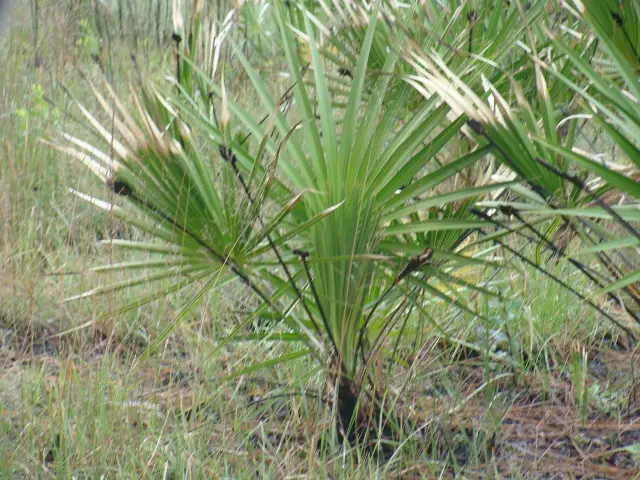
| Saw palmetto (Serenoa repens) | Shrub | Typical in both maritime and xeric hammock | FNAI |
| Wild coffee (Psychotria nervosa) | Shrub | 4 to 10 feet; shade loving; tropical understory shrub | FNAI; UF/IFAS |
Live oak, the first tree in the FNAI characteristic list, reaches 60 to 80 feet tall and 60 to 120 feet wide and tolerates alkaline soil, salt and drought, according to UF/IFAS Gardening Solutions (UF/IFAS). Wild coffee, one of the tropical understory shrubs FNAI lists for maritime hammock, grows 4 to 10 feet tall in partial to full shade, is moderately salt tolerant, and is cold tender north of zone 9 (UF/IFAS).
For xeric hammock, the second hammock type on the Weedon Island Boy Scout Loop, FNAI lists sand live oak as the dominant canopy tree, with Chapman oak, turkey oak, bluejack oak, sand post oak or laurel oak also possibly common and saw palmetto, myrtle oak and rusty staggerbush in the understory (FNAI xeric hammock).
On the Weedon Island Boy Scout Loop the hammocks share the trail with pine flatwoods (Weedon Island Preserve trails). FNAI separates temperate maritime hammock from xeric hammock by its live oak canopy, instead of sand live oak, and by the presence of cabbage palm, and notes that xeric hammocks intermediate with mesic hammock may have some live oak in the canopy (FNAI maritime hammock; FNAI xeric hammock).
Where can the coastal hammock be walked at Weedon Island Preserve?
The Boy Scout Loop at Weedon Island Preserve, 1800 Weedon Drive NE in St. Petersburg, is a one-mile trail through pine flatwoods and maritime and xeric hammocks, with 1.7 more miles of trail reached from it (Weedon Island Preserve trails).
Local Boy Scout troops helped build the Weedon Island loop, picnic areas sit along it in the shade of towering oaks, and the trails are kept in their natural state, so footbridges cross the routinely wet spots and other stretches can be seasonally wet (Weedon Island Preserve). Pinellas County counts more than 4.7 miles of boardwalks and trails across the whole preserve (Pinellas County).
Weedon Island Preserve opens daily at 7 a.m. and closes at a time posted at the entrance, about 15 minutes before sunset, and is closed the day after Thanksgiving and December 25; the Cultural and Natural History Center is open Thursday to Saturday 9 a.m. to 4 p.m. and Sunday 11 a.m. to 4 p.m. (closed Monday to Wednesday and county holidays), and admission to both is free (Weedon Island Preserve). Weedon Island trail rules bar dogs and horses, bicycles and other vehicles on the trails, alcohol and smoking, and they protect every plant and animal in the preserve (Weedon Island Preserve trail rules).
The state of Florida owns Weedon Island Preserve and Pinellas County manages it through lease agreements under a state-approved management plan (Weedon Island Preserve ecosystems).
What does Boyd Hill Nature Preserve offer, and when is it open?
Boyd Hill Nature Preserve is a 400-acre city preserve in St. Petersburg that connects to Lake Maggiore, with trails that pass through diverse habitats (city Boyd Hill page).
The city names gopher tortoises, alligators and marsh rabbits among the wildlife along the trails (city Boyd Hill page). The city Lake Maggiore Environmental Education Center page describes trails and boardwalks through diverse ecosystems, home to over 60 species of amphibians and reptiles, 50 species of butterflies and 165 bird species, and says the preserve is part of the Great Florida Birding Trail (Lake Maggiore Environmental Education Center). FNAI notes that gopher tortoises also often use maritime hammocks, though not as primary habitat (FNAI).
| Item | Detail |
|---|---|
| Address and phone | 1101 Country Club Way S., St. Petersburg, FL 33705; (727) 893-7326 |
| Admission | $3 adult; $1.50 ages 3 to 16; under 3 free |
| Hours, March 1 to October 31 | Tuesday to Friday and Sunday 9 a.m. to 7 p.m.; Saturday 7 a.m. to 7 p.m.; trail closes 6:30 p.m. |
| Hours, November 1 to February 25 | Tuesday to Friday and Sunday 9 a.m. to 6 p.m.; Saturday 7 a.m. to 6 p.m.; trail closes 5:30 p.m. |
| Closed | Mondays, Thanksgiving, Christmas and New Year's Day |
Boyd Hill admission is $3 for adults and $1.50 for children ages 3 to 16, with children under 3 free, and the preserve is closed on Mondays (city Boyd Hill page). From March 1 to October 31 the Boyd Hill trail closes at 6:30 p.m.; from November 1 to February 25 it closes at 5:30 p.m. (city Boyd Hill page). Last verified: October 15, 2026, on the St. Pete Parks and Rec Boyd Hill website.
What is changing at these preserves, and which figures differ between sources?
As of October 15, 2026, the Boyd Hill nature center exhibits are closed for renovations while the preserve and trails stay open, according to the City of St. Petersburg (city Boyd Hill page).
Weedon Island acreage differs between Pinellas County pages: the preserve ecosystems page gives approximately 3,195 acres and the preserve trails page over 3,195 acres (Weedon Island Preserve ecosystems; Weedon Island Preserve trails), while the county parks page calls it a 3,000-acre natural area (Pinellas County). The same county page lists the north paddling trail at Weedon Island as closed at this time (Pinellas County).
Regionally, the Tampa Bay Estuary Program Habitat Master Plan sets goals for the watershed by no later than 2050 that include 142,100 acres of native uplands, among them coastal hammocks and pine flatwoods, and 4,219 acres of coastal uplands (TBEP Habitat Master Plan).
FNAI says temperate and tropical maritime hammocks serve as crucial resting and foraging areas for songbirds on their fall and spring migrations to and from the tropics, and that gopher tortoises often use maritime hammocks, the hammock type named first on the Weedon Island Boy Scout Loop (Weedon Island Preserve trails; FNAI).
Frequently asked questions
Where can coastal hammock be seen in St. Petersburg?
Weedon Island Preserve in north St. Petersburg has maritime and xeric hammocks on its one-mile Boy Scout Loop, open daily from 7 a.m. to about 15 minutes before sunset with free admission. Boyd Hill Nature Preserve on Lake Maggiore is a 400-acre city preserve with trails through diverse habitats.
What trees define a coastal (maritime) hammock?
FNAI lists live oak, cabbage palm, red bay and red cedar as characteristic of temperate maritime hammock, and on the Gulf coast from Pasco to Lee counties the prevailing type pairs temperate canopy trees with tropical understory shrubs. Pignut hickory, southern magnolia and American holly also occur, with saw palmetto, wax myrtle and yaupon as shrubs.
How much does Boyd Hill Nature Preserve cost to enter?
Boyd Hill admission is $3 for adults and $1.50 for children ages 3 to 16, and children under 3 enter free, according to City of St. Petersburg Parks and Recreation on October 15, 2026. The preserve is closed on Mondays, Thanksgiving, Christmas and New Year's Day.
Are dogs allowed on the Weedon Island hammock trails?
No. Weedon Island Preserve trail rules bar domesticated animals, including dogs and horses, and also bicycles and other vehicles on the trails. All plants and animals in the preserve are protected.
How big is Boyd Hill Nature Preserve?
The City of St. Petersburg gives Boyd Hill Nature Preserve as spanning 400 acres and connecting to Lake Maggiore, as checked on October 15, 2026. Its trails close at 6:30 p.m. from March 1 to October 31 and at 5:30 p.m. from November 1 to February 25.
Sources
- City of St. Petersburg Parks and Recreation: Boyd Hill Nature Preserve https://www.stpeteparksrec.org/parks___facilities/boyd_hill.php Used for: 400 acres, Lake Maggiore, address, phone, admission, seasonal hours, nature center exhibits closed for renovations, gopher tortoises
- Weedon Island Preserve (Pinellas County): Boardwalks and Trails https://www.weedonislandpreserve.org/boardwalks-trails.htm Used for: Boy Scout Loop through pine flatwoods and maritime and xeric hammocks, 1.7 more miles, towering oaks, day use, trail rules
- Weedon Island Preserve (Pinellas County): Ecosystems https://www.weedonislandpreserve.org/ecosystems.htm Used for: 1,100 acres of uplands, Indian mounds and relic dune ridges, state ownership and county management
- Weedon Island Preserve (Pinellas County) https://www.weedonislandpreserve.org/ Used for: preserve hours, center hours, free admission
- Pinellas County: Weedon Island Preserve https://pinellas.gov/parks/weedon-island-preserve Used for: mostly marine ecosystems with some uplands, north St. Petersburg, 4.7 miles of boardwalks and trails
- Florida Natural Areas Inventory: Maritime Hammock (2010) https://www.fnai.org/PDFs/NC/Maritime_Hammock_Final_2010.pdf Used for: definition, Gulf coast Pasco to Lee type, characteristic species, wind profile, migrating songbirds, gopher tortoise
- Florida Natural Areas Inventory: Xeric Hammock (2010) https://www.fnai.org/PDFs/NC/Xeric_Hammock_Final_2010.pdf Used for: definition, sand live oak canopy, saw palmetto understory
- Tampa Bay Estuary Program: Habitat Master Plan https://tbep.org/habitat-master-plan-update/ Used for: 142,100 acres native uplands including coastal hammocks, 4,219 acres coastal uplands, 2050 goals
- UF/IFAS Gardening Solutions: Live Oak https://gardeningsolutions.ifas.ufl.edu/plants/trees-and-shrubs/trees/live-oak/ Used for: size, salt and drought tolerance
- UF/IFAS Gardening Solutions: Wild Coffee https://gardeningsolutions.ifas.ufl.edu/plants/trees-and-shrubs/shrubs/wild-coffee/ Used for: size, shade, salt tolerance, cold tenderness
- City of St. Petersburg Parks and Recreation: Lake Maggiore Environmental Education Center https://www.stpeteparksrec.org/parks___facilities/lmec.php Used for: trails and boardwalks through diverse ecosystems, species counts, Great Florida Birding Trail
How this page was made
Digital Towns uses AI assistance to research and write its guides, and every page is only as good as the sources it cites. Our goal is the most accurate, useful local information possible.
This page was fact-checked twice before publishing.
If you see an error, or anything you can show is false, tell us right away and we will take a third look.
Report an error
Thank you. We'll take a third look and correct the page if it's wrong.