Short answer: Coastal hammock around Tampa Bay is an evergreen forest of live oak, cabbage palm, red bay and red cedar, with shrubs such as yaupon, wax myrtle and saw palmetto, which Hillsborough County protects beside mangroves and salt marsh. The easiest public place to see it is Upper Tampa Bay Conservation Park, 8001 Double Branch Rd., open 8 AM to 6 PM for $2 per vehicle. Laurel wilt, in every Florida county by 2017, is killing its red bay.
Last verified: October 15, 2026, against the sources listed at the end of this page.
What is a coastal hammock on Tampa Bay?
A coastal hammock on Tampa Bay is an evergreen hardwood forest of live oak, cabbage palm, red bay and red cedar, a habitat Hillsborough County protects beside mangroves and salt marsh at Upper Tampa Bay Conservation Park.
The Florida Natural Areas Inventory, the state program that classifies Florida plant communities, calls the coastal type maritime hammock and describes it as a predominantly evergreen hardwood forest on stabilized coastal dunes (FNAI, Maritime Hammock). On the Gulf coast between Pasco and Lee counties, the stretch that takes in Hillsborough County and Tampa Bay, FNAI says the usual type pairs temperate canopy trees with tropical understory shrubs.
That mix sets a Tampa Bay hammock apart from hammocks farther south. FNAI says the temperate canopy of live oak, cabbage palm and red bay runs from the Georgia border to Cape Canaveral on the Atlantic side, while south of Lee County on the Gulf coast more tropical trees join the canopy, including Jamaican dogwood, which is absent from the east coast.
FNAI separates maritime hammock, the community it describes for the Gulf coast stretch that includes Tampa Bay, from coastal berm, which can share its species but sits on a low-energy, mangrove-dominated coast rather than a high-energy sandy one; from hydric hammock, which shows signs of flooding in the understory; and from shell mounds, which grow on piled shell rather than natural sand.
Which native plants grow in a Tampa Bay coastal hammock?
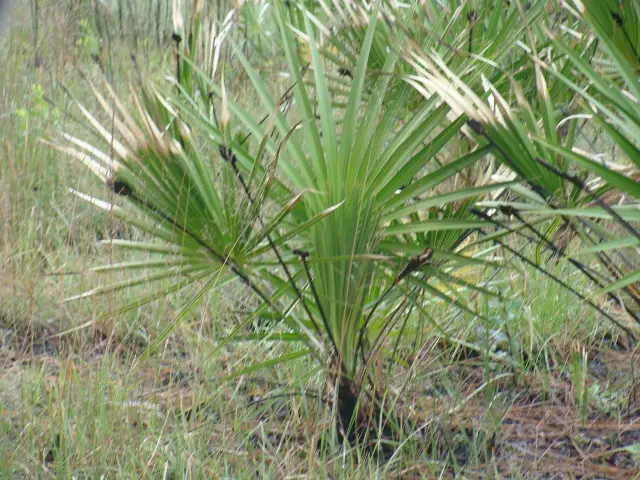
Live oak, cabbage palm and red bay form the canopy of a Tampa Bay coastal hammock, red cedar and American holly fill the subcanopy, and yaupon, wax myrtle and saw palmetto make up the shrub layer.
| Layer | Species | Note |
|---|---|---|
| Canopy | Live oak (Quercus virginiana), cabbage palm (Sabal palmetto), red bay (Persea borbonia) | Characteristic set for temperate maritime hammock |
| Additional canopy | Pignut hickory (Carya glabra), southern magnolia (Magnolia grandiflora) | Present in some stands |
| Subcanopy | Red cedar (Juniperus virginiana), American holly (Ilex opaca) | Red cedar is part of the characteristic set |
| Shrubs | Yaupon, tough bully, wax myrtle, saw palmetto | Herb layer sparse to absent |
| Shell mound plants | Saffron plum, soapberry, snowberry, white stopper | On mounds of clam, oyster and whelk shell |
In temperate maritime hammock, the type FNAI gives for the Tampa Bay stretch of the Gulf coast, the low, streamlined canopy deflects wind and generally keeps hurricanes from uprooting the trees, and salt spray kills exposed upper buds to produce smooth, pruned crowns that rise away from the water (FNAI, Maritime Hammock).
The cabbage palm, also called sabal palm, has been the Florida state tree since 1953 and grows in pine woodlands, hammocks and on river banks throughout Florida, the Tampa Bay area included (UF/IFAS Gardening Solutions, Sabal Palm). It tolerates salt spray on its leaves but not salt in its root zone, and its trunk grows to 40 feet tall.
Shell mounds add another plant community to Tampa Bay hammocks. FNAI says the calcareous soil on undisturbed mounds supports a diverse hardwood forest, with central Florida mounds often holding tropical species north of their usual range, and names saffron plum, soapberry, snowberry and white stopper as its characteristic set (FNAI, Shell Mound).
Where can coastal hammock be seen near Tampa?
Upper Tampa Bay Conservation Park, a Hillsborough County park at 8001 Double Branch Rd. in Tampa, is the public place near Tampa where coastal hammock sits beside mangroves, salt marsh and pine flatwoods along walking trails.
The park opens 8 AM to 6 PM, charges $2 per vehicle for up to 8 people, and offers boardwalks, a hiking trail, a canoe and kayak launch and a nature center (Hillsborough County, Upper Tampa Bay Conservation Park). Hillsborough County founded it in 1982 for nature study and passive recreation, and its 596 acres take up a peninsula. Live oaks and other hardwoods grow beside its shallow freshwater ponds, where red-shouldered hawks and bald eagles are sometimes seen.
A county article counts three trails at Upper Tampa Bay and lists its habitats as mangrove estuaries, tidal creeks, saltwater and freshwater marshes, oyster beds, coastal hammocks and pine flatwoods (Hillsborough County newsroom, Nov. 27, 2023).
At Upper Tampa Bay, canoes and kayaks rent at the nature center desk for $25 for up to four hours and $10 for each extra hour, tax included, and rentals can stop early when small craft advisories are issued. The park page gives two phone numbers, (813) 855-1765 at the top and (813) 844-1765 in the paddling section, so a call about rentals may need both.
Cockroach Bay Preserve State Park, at the mouth of the Little Manatee River in the southeast region of Tampa Bay, shows the other end of the gradient: its islands total 617 acres, about 500 of them mangrove swamp, and they can be reached only by private watercraft (Florida State Parks, Cockroach Bay).
Why are shell middens part of the Upper Tampa Bay hammock?
Upper Tampa Bay Conservation Park holds over 20 known archaeological sites, including well preserved oyster shell middens raised by the Tocobaga and other Indigenous people, and shell ground of that kind supports its own hammock plants.
The middens at Upper Tampa Bay are mostly oyster shell and take the form of low mounds or ridges built up over many centuries, according to Hillsborough County (Hillsborough County newsroom). Carbon dated artifacts from the park suggest people lived there as recently as 1300 AD. In the late 1960s a development called Bay Port Colony was proposed on about 3,000 acres of Upper Tampa Bay; after it was dropped, the county bought the land and opened the park in 1982.
FNAI explains why shell matters to plants: a rich calcareous soil develops on the piled shell, and on undisturbed mounds it supports a diverse hardwood forest (FNAI, Shell Mound). Most coastal shell mounds in Florida were dug up for road building in the early 1900s, and FNAI names the Madira Bickel Mound near Tampa Bay as one of three that botanist John Kunkel Small described that are now preserved in state or federal parks.
What is killing trees in Tampa Bay coastal hammocks?
Laurel wilt is the disease removing red bay from Tampa Bay hammocks, while storm surge salt water and invasive Brazilian pepper and Australian pine are the other main threats FNAI names.
The Florida Forest Service says laurel wilt was first documented in Florida in 2005 and by 2017 had caused widespread death of susceptible trees and shrubs in every county, which includes Hillsborough County (Florida Forest Service, Laurel Wilt leaflet). Red bay and swamp bay are confirmed hosts, and the fungus is carried by the non-native redbay ambrosia beetle.
FNAI says laurel wilt is fatal to red bay over 1 inch in diameter, and that wood, mulch or firewood from infected trees should not be moved, including for campfires near the coast (FNAI, Maritime Hammock). Its profile is a June 2009 draft that tracks the disease only as far as St. Lucie County, so the Forest Service statement is the current picture for Tampa Bay.
Storms add pressure on Tampa Bay shores. Hammock trees can die from standing salt water left in low spots by storm surge, and Australian pine and Brazilian pepper move in after storm damage.
Which coastal hammock plants suit a Tampa yard near the water?
For a Tampa yard near the bay, the coastal hammock species FNAI lists, such as live oak, cabbage palm, red cedar, yaupon, wax myrtle and saw palmetto, are the species FNAI lists for a forest shaped by salt spray and wind.
Cabbage palm is the most forgiving choice for salt spray but should not be planted where saltwater reaches the roots, since UF/IFAS describes it as intolerant of salt in the root zone (UF/IFAS, Sabal Palm). Low spots along Tampa seawalls that flood in storm surge are a poor site for it and for other hammock trees.
FNAI draws a practical lesson from coastal restoration projects: start with low-growing woody species rather than trees, so the new planting is not burned by salt spray, and expect taller hammock trees exposed to winds off the water by new parking lots to suffer salt spray dieback (FNAI, Maritime Hammock). The same approach works on a windy Tampa Bay lot, with shrubs like wax myrtle and yaupon set out before oaks.
Red bay is the one characteristic Tampa Bay hammock tree to skip for now, since laurel wilt has spread through every Florida county. Tree rules for Tampa properties are covered in the Tampa tree protection guide, and the scrub habitat guide covers the drier sand ridges inland.
Frequently asked questions
What trees grow in a coastal hammock in Tampa?
The Florida Natural Areas Inventory lists live oak, cabbage palm, red bay and red cedar as the characteristic trees of temperate coastal hammock, the type found around Tampa Bay, with pignut hickory, southern magnolia and American holly also present.
Where is the closest coastal hammock to downtown Tampa?
Upper Tampa Bay Conservation Park at 8001 Double Branch Rd. is the Hillsborough County park whose official habitat list includes coastal hammocks. It opens 8 AM to 6 PM and charges $2 per vehicle for up to 8 people.
Is a coastal hammock the same as a mangrove forest?
No. Hillsborough County lists mangrove forests and coastal hammocks as separate habitats at Upper Tampa Bay Conservation Park, and the Florida Natural Areas Inventory describes coastal (maritime) hammock as an evergreen hardwood forest of live oak, cabbage palm and red bay.
Why are red bay trees dying around Tampa Bay?
Red bay is a host of laurel wilt, a fungal disease spread by the non-native redbay ambrosia beetle. The Florida Forest Service says it was first documented in Florida in 2005 and by 2017 had killed susceptible trees in every county.
Is cabbage palm salt tolerant for a bayfront Tampa yard?
Partly. UF/IFAS says the cabbage palm, Florida state tree since 1953, tolerates salt spray on its leaves fairly well but does not tolerate salt in its root zone, so ground that floods with bay water is a poor site.
Sources
- Hillsborough County, Upper Tampa Bay Conservation Park https://hcfl.gov/locations/upper-tampa-bay-conservation-park Used for: address, hours, fee, phone numbers, 596 acres, 1982, habitats including coastal hammocks, live oaks near wetlands, rentals
- Hillsborough County, 2,000 Years Later, Traces Remain of Indigenous People in Upper Tampa Bay Conservation Park (Nov. 27, 2023) https://hcfl.gov/newsroom/2023/11/27/2-000-years-later-traces-remain-of-indigenous-people-in-upper-tampa-bay-conservation-park Used for: over 20 archaeological sites, oyster shell middens, Tocobaga, Bay Port Colony, 1300 AD, three trails
- Florida Natural Areas Inventory, Maritime Hammock community description (June 2009 draft) https://www.fnai.org/PDFs/NC/Mar_Hammock.pdf Used for: definition, canopy and shrub species, Gulf coast Pasco to Lee pattern, salt spray, storm surge, exotics, laurel wilt, restoration tip
- Florida Natural Areas Inventory, Shell Mound community description (June 2009 draft) https://www.fnai.org/PDFs/NC/Shell_Mound.pdf Used for: shell mound plants, calcareous soil, tropical species, Madira Bickel Mound near Tampa Bay
- Florida State Parks, Cockroach Bay Preserve State Park https://www.floridastateparks.org/parks-and-trails/cockroach-bay-preserve-state-park Used for: mangrove islands, 617 acres, about 500 acres mangrove swamp, water access only
- UF/IFAS Gardening Solutions, Sabal Palm https://gardeningsolutions.ifas.ufl.edu/home/plants/trees-and-more/palms-and-cycads/sabal-palmetto Used for: state tree 1953, salt spray tolerance, root-zone salt intolerance, height, habitats
- Florida Department of Agriculture and Consumer Services, Florida Forest Service, Laurel Wilt Disease leaflet https://ccmedia.fdacs.gov/content/download/4639/file/Leaflet-13-Laurel-Wilt-Disease.pdf Used for: first documented 2005, every county by 2017, redbay and swamp bay hosts, redbay ambrosia beetle
How this page was made
Digital Towns uses AI assistance to research and write its guides, and every page is only as good as the sources it cites. Our goal is the most accurate, useful local information possible.
This page was fact-checked twice before publishing.
If you see an error, or anything you can show is false, tell us right away and we will take a third look.
Report an error
Thank you. We'll take a third look and correct the page if it's wrong.