Short answer: Gifford High School was Indian River County's high school for Black students during segregation. It grew from the Gifford School, built on land William Edward Geoffrey donated after buying eighty acres in 1901, added high school grades in 1938 and moved into a new county-funded building at 45th Street and 28th Court in 1952. After the county integrated its schools in 1969, it graduated its last class and became a middle school.
Last verified: October 16, 2026, against the sources listed at the end of this page.
What was Gifford High School?
Gifford High School was the segregation-era high school for Black students in Indian River County, located in Gifford, which the state marker program lists under Vero Beach.
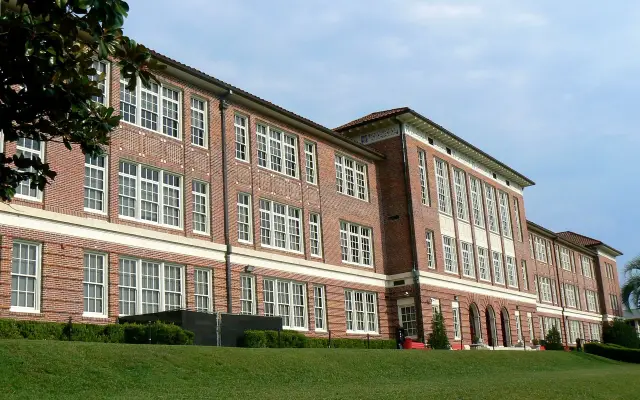
It grew out of a small school for Black children on land donated in 1901, added high school grades in 1938, moved into a county-built campus in 1952, and graduated its last class in 1969 when Indian River County schools were integrated. The Gifford High School Sundial Landmark marker records that the school then became a middle school and that the original facade is now part of the Gifford Middle School campus.
How did the Gifford School begin?
The Gifford School began on land donated by William Edward Geoffrey, an African American railroad worker from Darlington, South Carolina.
According to state Marker 1009, Geoffrey came to Gifford in 1892 to work on the Florida East Coast Railroad. The town's first school, built in 1898, served only white children. In 1901 Geoffrey bought eighty acres in Gifford and donated part of it for a park and a school for Black children, a small building on 38th Lane east of what is now US Highway 1. It taught grades one through six, and older students had to travel to Fort Pierce for high school.
The Gifford School and Hosie Schumann Park marker, dedicated in 2020, adds that the Gifford School was built with help from the Julius Rosenwald Foundation, which supported hundreds of Black schools across Florida and the Southeast. Its textbooks, furniture and equipment were donated secondhand. In the early years parents and the local church ran the school, and classes for Black children ran three months a year, when there were no beans to pick. The county's History of Gifford adds that Black children in the Wabasso area attended school in an old Masonic Hall.
Where did Gifford students go to high school before 1938?
Before 1938, Gifford students who wanted to finish high school had to travel to Fort Pierce, according to state Marker 1009.
The History of Gifford by Milt Thomas, edited by county historian Ruth Stanbridge and printed as Appendix E of the county's 2014 Gifford Neighborhood Plan, says the Gifford School went only through the sixth grade in the early 20th century, its students could not attend school in Vero or Fellsmere, and families lacked the resources to send children as far as Fort Pierce or Melbourne.
The same history credits John Broxton, a Wabasso-area settler who had sent his own children to Bethune Cookman School in Daytona to finish high school. Broxton saved for a used car and began carrying Black students to Fort Pierce for high school. In 1931 the Indian River County School Board agreed to pay him $10 a month for the trips, and he later bought an old school bus to carry students from Wabasso, Gifford, Oslo and St. Lucie to Fort Pierce.
When did Gifford become a high school, and who led it?
Gifford became a high school in 1938, and its first senior class that year had three graduates, according to state Marker 1112.
Marker 1009 and the county history both date the Gifford expansion to 1938, while Marker 1112 describes the change more loosely as a transition in the late 1930s. Marker 1112 adds that approximately 68 students graduated between 1938 and 1951 and lists the principals of the period by name and years.
| Principal | Years listed on Marker 1112 |
|---|---|
| W.A. Peck | 1936 to 1940 |
| Lamar Fort | 1940 |
| Arthur C. Madrey | 1941 to 1945 |
| Marcellus Goodwin | 1945 to 1950 |
| James R. Wiggins | 1951 to 1960 |
Conditions reflected the gap in county spending. The county history says textbooks reached the school only when they were too outdated and worn out by white students, the same was true of furniture and equipment, and the school had no heating, so on cold days students huddled around a fire on the outdoor basketball court. In 1952 the Indian River County School Board funded a new high school building at 45th Street and 28th Court, but the history says students and teachers still dealt with a shortage of equipment, and teachers spent hours raising money in the Black community for materials and supplies.
Why did Gifford High School close in 1969?
Gifford High stopped operating as a high school because Indian River County integrated its schools in 1969, as Marker 1009 records.
The county history credits Joe Idlette Jr. with a key role in that change. In his account, he asked in 1962 for his children to attend Vero Beach Elementary School, was turned down, and went to the NAACP, which sent a lawyer from Jacksonville and started a process that took seven more years. The history says the schools were integrated without serious incidents in 1969, and that Idlette was elected to the school board in 1974 and served four consecutive terms.
The History of Gifford calls integration a double-edged sword: Black students would receive the same education as white students, but it meant decommissioning Gifford High School, and for a community where family, church and school formed a single bond, the loss of its school affected the social fabric. Public office had begun to change a few years earlier: the history records that in 1964 Walter Jackson, whose family homesteaded in Gifford and who eventually owned 300 acres of citrus land, became the first Black man in Indian River County to hold elected office, on the school board.
What remains of Gifford High School today?
The facade of the 1952 building and a sundial from the Class of 1964 remain on the Gifford Middle School campus, where Marker 1009 stands at 4530 28th Court.
Marker 1009, placed in 2017, says the sundial was a gift from the Class of 1964 at graduation and calls the facade and sundial the last material remnants of the original Gifford High School. The site of the first Gifford School has its own marker: Marker 1112, at 1760 39th Street, says the property owners donated the land to Indian River County in 1971 as a community park, and Gulf and Western Sugar dedicated it to Hosie Shumann, an employee from 1942 until his death in 1971.
Nearby, the county plan describes Martin Luther King, Jr. Park, two acres at the northwest corner of 45th Street and 28th Court, as home to the historic Macedonia Baptist Church and Museum. The county history says the church was built in 1908 on land in Sebastian, largely by Black workers who had labored on the railroad, and in 1994 it was moved to Gifford and completely restored.
State arts funding has also reached the community. The Florida Department of State's African-American Cultural and Historical Grants program took applications from October 11 through November 30, 2021, and its ranked list shows $493,000 for the Cultural Council of Indian River County's Gifford Community Cultural & Resource Center project, an amount that also appears on the department's list of funded applications. Last verified: October 15, 2026, against state markers 1009 and 1112, the county's History of Gifford and the Department of State grant lists for this Gifford school history.
Frequently asked questions
When did Gifford High School graduate its first class?
State Marker 1112 records that its first senior class that year had three graduates, the year the Gifford School expanded to include high school grades. About 68 students graduated between 1938 and 1951.
When did Gifford High School close?
Gifford High graduated its last class in 1969, after Indian River County integrated its public schools, and the school became a middle school. State Marker 1009 says the original facade of the 1952 building is now part of the Gifford Middle School campus.
Who gave the land for the first Gifford School?
William Edward Geoffrey, an African American railroad worker who came to Gifford in 1892, bought eighty acres in 1901 and donated part of it for a park and a school for Black children, according to Florida Historical Marker 1009.
Was Gifford School a Rosenwald school?
Florida Historical Marker 1112 says the Gifford School was constructed with help from the Julius Rosenwald Foundation, which supported hundreds of Black schools across Florida and the Southeast, and that it originally served grades one through six.
Where are the Gifford High School historical markers?
Marker 1009, the Gifford High School Sundial Landmark, stands at 4530 28th Court on the Gifford Middle School campus. Marker 1112 stands at 1760 39th Street, Hosie Schumann Park, on the original Gifford School land donated to the county in 1971.
Sources
- Gifford High School Sundial Landmark, Florida Historical Marker 1009 (2017) https://markers.flheritage.com/home/details/1009 Used for: Geoffrey 1892 and 1901, white-only 1898 school, Gifford School location and grades, 1938 high school, 1952 building, 1969 last class, middle school, facade and Class of 1964 sundial
- Gifford School / Hosie Schumann Park, Florida Historical Marker 1112 (2020) https://markers.flheritage.com/home/details/1112 Used for: Rosenwald support, grades 1-6, donated used materials, three-month school year, late-1930s transition, principals 1936-60, first senior class of three in 1938, about 68 graduates 1938-51, 1971 park donation
- Gifford Neighborhood Plan 2014, Indian River County Community Development, including Appendix E, History of Gifford by Milt Thomas, page 32 https://indianriver.gov/Document%20Center/Services/Planning-and-Development/45th%20Street/2014-Gifford-Neighborhood-Plan.pdf#page=32 Used for: Martin Luther King, Jr. Park and the historic Macedonia Baptist Church and Museum
- Gifford Neighborhood Plan 2014, Indian River County Community Development, including Appendix E, History of Gifford by Milt Thomas, page 105 https://indianriver.gov/Document%20Center/Services/Planning-and-Development/45th%20Street/2014-Gifford-Neighborhood-Plan.pdf#page=105 Used for: Walter Jackson 1964; Macedonia Church built 1908 in Sebastian, moved to Gifford 1994
- Gifford Neighborhood Plan 2014, Indian River County Community Development, including Appendix E, History of Gifford by Milt Thomas, page 107 https://indianriver.gov/Document%20Center/Services/Planning-and-Development/45th%20Street/2014-Gifford-Neighborhood-Plan.pdf#page=107 Used for: Broxton transport and 1931 payment, 1938 expansion, textbooks, 1952 building, Idlette 1962 and 1974, 1969 integration
- Gifford Neighborhood Plan 2014, Indian River County Community Development, including Appendix E, History of Gifford by Milt Thomas, page 108 https://indianriver.gov/Document%20Center/Services/Planning-and-Development/45th%20Street/2014-Gifford-Neighborhood-Plan.pdf#page=108 Used for: integration as a double edged sword that decommissioned Gifford High School
- African-American Cultural and Historical Grants, funded applications (Florida Department of State) https://dos.fl.gov/media/705703/aach-funded-applications.pdf#page=2 Used for: $493,000 to the Cultural Council of Indian River County
- African-American Cultural and Historical Grants, ranked list approved (Florida Department of State) https://dos.fl.gov/media/705348/aach-ranked-list-approved.pdf#page=3 Used for: Gifford Community Cultural & Resource Center project name
- African-American Cultural and Historical Grants program page (Florida Department of State) https://dos.fl.gov/aach Used for: program name and purpose
How this page was made
Digital Towns uses AI assistance to research and write its guides, and every page is only as good as the sources it cites. Our goal is the most accurate, useful local information possible.
This page was fact-checked twice before publishing.
If you see an error, or anything you can show is false, tell us right away and we will take a third look.
Report an error
Thank you. We'll take a third look and correct the page if it's wrong.