Short answer: Fort Lauderdale incorporated as a city on March 27, 1911, fifteen years after the first train to Miami reached its New River crossing on February 22, 1896. Railroad builder Philemon Bryan and his sons bought land on both sides of the tracks, and in 1905 the New River Inn and Bryan houses formed the first residential neighborhood. The North New River Canal, open in 1912, made the town a shipping point, and in 1915 Central School opened as the first high school in newly organized Broward County.
Last verified: October 19, 2026, against the sources listed at the end of this page.
When was Fort Lauderdale founded as a city?
Fort Lauderdale's legal birthday is March 27, 1911, the incorporation date on both the city and police department websites (City; FLPD).
The city's own FY2024 annual financial report dates it the same way, stating in its government profile that the City was founded in 1911 (FY2024 ACFR). The settlement is older than the charter: the railroad reached the New River crossing in 1896 (Old Fort Lauderdale Village marker), and the name goes back to an 1838 army post (About Fort Lauderdale). Digital Towns covers the fort and the Stranahan trading post in their own guides, so this page follows the years from rail construction to the first schools of the new city.
| Year | What happened | Record |
|---|---|---|
| 1894 | Railroad roadbed crew arrives by boat from New Smyrna | Old Fort Lauderdale Village marker |
| 1896 | Rail service through to Miami begins (February 22) | Old Fort Lauderdale Village marker |
| 1905 | State creates the Everglades Drainage District | Everglades Drainage Project marker |
| 1906 | Dredging of the North New River Canal begins (July 4) | Everglades Drainage Project marker |
| 1910 | Evergreen Cemetery opened by the King family | Evergreen Cemetery marker |
| 1911 | City incorporated (March 27) | City of Fort Lauderdale |
| 1912 | Canal to Lake Okeechobee in operation | Lock No. 1 marker |
| 1915 | Central School, later Fort Lauderdale High, dedicated (September 16) | Fort Lauderdale High School marker |
| 1917 | City buys Evergreen Cemetery | Evergreen Cemetery marker |
All marker rows are drawn from the Florida Division of Historical Resources register for Broward County (Florida Historical Markers, Broward).
Why did a town grow at the New River railroad crossing?
A town grew at the crossing because the family hired to build that railway section also acquired the land on either side of the tracks, in what later became downtown (Old Fort Lauderdale Village marker).
The state marker explains how that family got the job. Philemon Bryan had been a grove owner, storekeeper and mayor of New Smyrna until the freeze of 1894-95 wiped him out, and Henry Flagler then hired him to build the line from the New River north to Pompano (Florida Historical Markers). The roadbed crew Bryan brought south numbered 400 African-American laborers, and Philemon and his sons acquired land on either side of the tracks (Old Fort Lauderdale Village marker).
The street grid still shows it. The city defines the Himmarshee St./SW 2nd Ave. Historic District as the oldest part of the commercial downtown, with the railroad tracks as its eastern edge, the New River as its southern edge and Nugent Ave. on the west (Historic Districts).
Which Fort Lauderdale buildings survive from before 1911?
The surviving pre-charter buildings cluster on SW 2nd St., where the state marker lists the New River Inn, two houses and the Acetylene Building, dated 1905 and 1907 (Old Fort Lauderdale Village marker).
Contractor Edwin T. King built the New River Inn for Philemon Bryan from hollow concrete block made on site, and in the same 1905 season raised houses for Bryan and his sons, which the marker treats as the first Fort Lauderdale residential neighborhood (Florida Historical Markers). The fourth building, the King-Cromartie House, followed in 1907, and the inn, which houses a Museum of History, is listed on the National Register of Historic Places (Old Fort Lauderdale Village marker).
The city's own description of the district adds two present-day uses: the historic Bryan Homes operate as the River House Restaurant, and a replica of the first Fort Lauderdale schoolhouse has been reconstructed within the district (City of Fort Lauderdale). Sailboat Bend, which the city calls its oldest neighborhood, has buildings dating from the early 1900s until the 1950s (Historic Districts). The citywide preservation inventory now totals 62 individually designated landmark sites and fifteen National Register listings (Historic Preservation).
How did Everglades drainage shape early Fort Lauderdale?
Drainage gave the young town a second transport line: from 1912 the North New River Canal floated Lake Okeechobee fish and inland farm produce down to Fort Lauderdale, where it was loaded onto trains for northern markets (Everglades Drainage Project marker).
The state set up the Everglades Drainage District in 1905, and on July 4, 1906 Governor Napoleon B. Broward launched the work as the dredge Everglades started cutting the North New River Canal (Florida Historical Markers). Lock No. 1, the first lock the district built, was vital to running the canal, which the marker calls a major transportation link between Lake Okeechobee and Fort Lauderdale; it carried traffic until roads and rail took over in the 1930s (North New River Canal Lock No. 1 marker).
The canal also had a passenger side: small steamers worked the network on trips toward Fort Myers, according to the drainage marker (Everglades Drainage Project marker). Lock No. 1 itself, in Davie, joined the National Register of Historic Places in March 1978 (North New River Canal Lock No. 1 marker).
Did Seminole families still live in Fort Lauderdale when it incorporated?
Yes: the state marker for Annie Tommie's Camp dates the family's camp on the north fork of the New River to about 1902, nine years before the charter, and ranks it as the final permanent Seminole camp inside Fort Lauderdale (Annie Tommie's Camp marker).
Visitors came to the camp as a sight in its own right, and its matriarch, Annie Jumper Tommie, is credited on the marker with starting the making and selling of Seminole dolls, later an important tribal industry (Florida Historical Markers). The boys of the camp kept their own baseball diamond and played local school teams, and the family later moved to the federal reservation west of Dania, now Hollywood, where the marker says Annie became the leading matriarch in June 1924 (Annie Tommie's Camp marker).
Settler burials tell the other side of the founding years. The marker for Evergreen Cemetery says a Miami funeral director moved many graves from the town's first burial ground near Andrews Avenue to the new cemetery in 1910 or 1911, that the city took ownership in 1917, and that the American Legion bought lots there for veterans in 1921 (Evergreen Cemetery marker).
What did Fort Lauderdale build in its first years as a city?
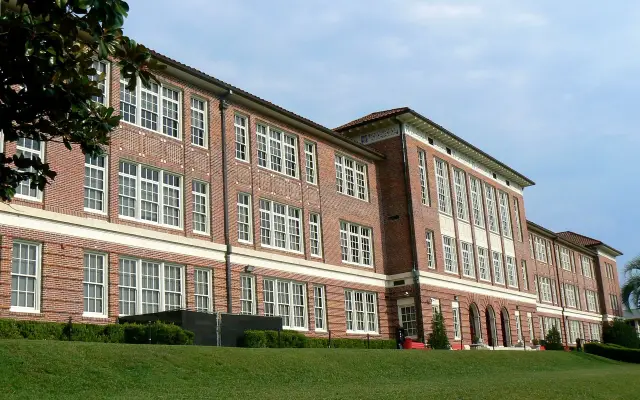
Within four years of incorporation the city had a twelve-grade school: Central School, dedicated on September 16, 1915 at a cost of $86,000 was the first high school in the newly organized county (Fort Lauderdale High School marker).
Its 13-acre block lay between Broward Boulevard, South Federal Highway, SE 3rd Avenue and SE 2nd Street, on land given by the Stranahans; the marker misspells the name as Strahanan (Florida Historical Markers). As the town grew it became a high school only in 1924, North Hall and new wings followed between 1924 and 1926, and the 1926 hurricane damaged the wings and auditorium roof (Fort Lauderdale High School marker). By the time the school moved in 1962, 48 classes totaling 8,833 students had graduated from the original campus (Fort Lauderdale High School marker).
The waterfront changed too: the Coast Guard began using the House of Refuge at today's Bahia Mar, moved to that site in 1892, in 1915 (Indian Haulover marker).
How large is Fort Lauderdale now, and why do official figures differ?
Today's city covers roughly 36 square miles and an estimated 186,220 residents by its own count, but a second official page carries smaller numbers (About Fort Lauderdale).
The police department's history page describes a city of more than 33 square miles with nearly 180,000 people, the largest of 30 Broward municipalities and the seventh largest city in Florida, while the city's About page says 31 municipalities and one of the ten largest cities in Florida (FLPD city history; City of Fort Lauderdale). Both give March 27, 1911 for incorporation; this guide reports each page's figures as stated rather than choosing between them (Fort Lauderdale Police Department).
The form of government is described in the same FY2024 report that fixes the founding at 1911: a mayor elected at large and four commissioners elected from single-member districts set policy, and the commission hires the city manager (FY2024 ACFR). Last verified: October 18, 2026, against the state marker register for Broward County, four City of Fort Lauderdale records and the police department history page.
Frequently asked questions
When was Fort Lauderdale incorporated?
March 27, 1911, according to the City of Fort Lauderdale and its police department. Rail service through the New River settlement had begun fifteen years earlier, on February 22, 1896.
Who founded Fort Lauderdale?
The official sources used here credit no single founder. State markers describe railroad builder Philemon Bryan and his sons acquiring the land beside the tracks that became downtown, and contractor Edwin T. King building the first homes there in 1905.
What is the oldest surviving building in downtown Fort Lauderdale?
The state marker at Old Fort Lauderdale Village lists three 1905 buildings, the New River Inn, the Philemon Bryan House and the Acetylene Building, plus the 1907 King-Cromartie House. The inn is on the National Register.
What role did the North New River Canal play?
Operational from 1912 after dredging began on July 4, 1906, the canal carried Lake Okeechobee fish and inland produce to Fort Lauderdale for shipment north by rail. It stayed in use until the 1930s.
What was the first high school in Broward County?
Central School in Fort Lauderdale, dedicated on September 16, 1915 for $86,000, was the first high school in the newly organized county. It became Fort Lauderdale High School and moved to 1600 NE 4th Avenue in 1962.
Sources
- Florida Division of Historical Resources, Florida Historical Markers: Broward County https://apps.flheritage.com/markers/markers.cfm?county=broward Used for: Old Fort Lauderdale Village marker (Bryan, Flagler, 1894 roadbed crew, first train February 22, 1896, 1905 New River Inn, first residential neighborhood); Everglades Drainage Project marker (1905 district, July 4, 1906 opening, North New River Canal); North New River Canal Lock No. 1 (operational 1912); Annie Tommie's Camp (c. 1902 to 1924); Evergreen Cemetery (1910, city purchase 1917); Fort Lauderdale High School 1915-1962 (dedicated September 16, 1915, first high school in newly organized Broward County); Indian Haulover (House of Refuge, Coast Guard 1915)
- City of Fort Lauderdale, About Fort Lauderdale https://www.fortlauderdale.gov/government/about-fort-lauderdale Used for: incorporated March 27, 1911; approximately 36 square miles; estimated population 186,220; largest of Broward County's 31 municipalities; named for 1838 fort
- Fort Lauderdale Police Department, City History https://www.flpd.gov/about-flpd/city-history Used for: incorporated March 27, 1911; older city overview: more than 33 square miles, population of nearly 180,000, largest of 30 municipalities, seventh largest city in Florida
- City of Fort Lauderdale, Annual Comprehensive Financial Report FY2024 https://www.fortlauderdale.gov/files/assets/public/v/1/finance/documents/financial-information-and-reports/2024-annual-comprehensive-financial-report.pdf Used for: Profile of the Government: the City was founded in 1911; commission/manager form
- City of Fort Lauderdale, Historic Districts https://www.fortlauderdale.gov/Government/Departments/Development-Services/Urban-Design-and-Planning/Historic-Preservation/Historic-Districts Used for: Sailboat Bend oldest neighborhood, early 1900s to 1950s; Himmarshee oldest section of commercial downtown, about 17 properties, New River Inn museum, replica first schoolhouse
- City of Fort Lauderdale, Historic Preservation https://www.fortlauderdale.gov/Government/Departments/Development-Services/Urban-Design-and-Planning/Historic-Preservation Used for: three historic districts, 62 individually designated landmark sites, fifteen National Register sites
How this page was made
Digital Towns uses AI assistance to research and write its guides, and every page is only as good as the sources it cites. Our goal is the most accurate, useful local information possible.
This page was fact-checked twice before publishing.
If you see an error, or anything you can show is false, tell us right away and we will take a third look.
Report an error
Thank you. We'll take a third look and correct the page if it's wrong.