Short answer: Hurricane season in Fort Lauderdale runs June 1 to November 30, with an Atlantic peak on September 10, and NWS Miami calls September and October the most hurricane prone months for South Florida. The City of Fort Lauderdale asks for at least 72 hours of supplies while the state encourages at least 7 days, generators and other storm supplies are tax free all year, and bridges lock to boats about 3.5 hours after an evacuation order or at 40 mph winds, whichever is earlier.
Last verified: October 18, 2026, against the sources listed at the end of this page.
When is hurricane season in Fort Lauderdale, and when is it most active?
Hurricane season for Fort Lauderdale is the Atlantic season, June 1 to November 30, and the National Hurricane Center dates its peak to September 10, with most activity between mid-August and mid-October (National Hurricane Center climatology).
For South Florida the local office narrows that further: NWS Miami calls September and October the two most hurricane prone months for the region, and its summer 2026 summary asked residents to keep their hurricane plans in place through the end of the season in November (NWS Miami summer 2026 summary). The National Hurricane Center also notes that storms sometimes form before June 1 or after November 30, so the dates are a planning window for Fort Lauderdale rather than a guarantee (National Hurricane Center).
| Count | Named storms | Hurricanes | Major hurricanes |
|---|---|---|---|
| 1st | June 20 | August 11 | September 1 |
| 2nd | July 17 | August 26 | September 19 |
| 3rd | August 3 | September 7 | October 28 |
| 7th | September 3 | November 15 | none |
| 14th | November 19 | none | none |
The benchmark table comes from the National Hurricane Center, which puts the 1991-2020 average at 14 named storms, 7 hurricanes and 3 major hurricanes, with the first hurricane of a typical season not forming until early to mid-August. The city puts the same jobs on its before-hurricane-season list: prepare a supply kit, trim trees and branches, and check insurance coverage (City of Fort Lauderdale, before a storm). The city sanitation guidance makes the same point about yard debris: dead trees, branches, palm fronds and coconuts should go out for pickup before hurricane season begins (City of Fort Lauderdale sanitation tips).
What did forecasters expect for the 2026 hurricane season?
Fort Lauderdale entered peak season under a quiet forecast: on August 6, 2026 NOAA gave a 75 percent chance of a below-normal season, with 7 to 13 named storms, 2 to 6 hurricanes and 0 to 2 majors (NOAA Climate Prediction Center outlook).
For South Florida planning, that August update trimmed the May outlook, which had called for 8 to 14 named storms, 3 to 6 hurricanes and 1 to 3 major hurricanes, and it counted the 2 named storms already recorded by early August (NOAA). NOAA expected most of the activity in August, September and October and gave each range a 70 percent probability. Its reasoning pointed to El Niño: the outlook notes that every hurricane season during a strong El Niño since 1950 has been below normal.
A below-normal forecast does not lower the stakes for any one coastline, Broward included. NWS Miami wrote on September 1, 2026 that the tropics still need watching because it only takes one storm, even in a relatively inactive year (NWS Miami). As of October 18, 2026, 43 days remain before the season closes on November 30 (National Hurricane Center), which keeps the Fort Lauderdale supply kit and shutter plan in play until December.
What do hurricane watches and warnings mean in Fort Lauderdale?
In Fort Lauderdale a hurricane watch means hurricane conditions are possible and is issued 48 hours before tropical storm force winds are expected, while a warning means they are expected and is issued 36 hours ahead (City of Fort Lauderdale hurricane terminology).
| Alert | Sustained winds | Timing |
|---|---|---|
| Tropical Storm Watch | 39 to 73 mph possible | within 48 hours |
| Tropical Storm Warning | 39 to 73 mph expected | within 36 hours |
| Hurricane Watch | 74 mph or higher possible | 48 hours before tropical storm force winds |
| Hurricane Warning | 74 mph or higher expected | 36 hours before tropical storm force winds |
The definitions above are from the City of Fort Lauderdale, which adds that a hurricane warning can stay in effect for dangerously high water and waves even after winds drop below hurricane force. Both lead times are tied to the onset of tropical storm force winds, because the city notes that preparation becomes difficult once winds reach that strength.
A watch is the signal to finish the Fort Lauderdale checklist. The city list for a hurricane watch includes securing windows and doors with shutters, fueling and servicing the car, bringing in patio furniture, plants, trash cans, recycling bins and bicycles, storing tap water for flushing and cleaning, turning the refrigerator and freezer to their coldest settings, unplugging small appliances and getting extra cash because ATMs might be down (City of Fort Lauderdale, during a hurricane watch). Bulk trash and yard waste must not go to the curb during a watch or a warning (City of Fort Lauderdale).
A warning changes city services. All Fort Lauderdale sanitation services are suspended once a hurricane warning is issued, so household waste should be sealed in garbage bags and kept for several days (City of Fort Lauderdale sanitation tips). Inside, the city advises closing all interior doors, bracing external doors, using flashlights instead of candles, and staying put during the calm of the eye, when winds will return from the opposite direction (City of Fort Lauderdale, during a hurricane warning). Recorded storm updates come from the Fort Lauderdale Hurricane Emergency Hotline, 954-828-8888, and damage such as downed trees or clogged storm drains goes to the 24-hour Neighbor Service Center at 954-828-8000 (City of Fort Lauderdale).
What belongs in a Fort Lauderdale hurricane supply kit?
The City of Fort Lauderdale asks for a supply kit that lasts at least three days (72 hours), starting with at least one gallon of water per person per day and ready-to-eat food with a manual can opener (City of Fort Lauderdale hurricane preparedness).
The rest of the city minimum list covers light, power and paperwork: disposable plates and utensils, a battery-powered flashlight and radio, extra batteries, a first aid kit, cash, a two-week supply of prescription medication, eyeglasses or contacts, hand sanitizer and disinfectant wipes, toilet paper and hygiene items, large plastic garbage bags, a change of clothes with gloves, sturdy shoes and rain gear, blankets and pillows, and unscented bleach (City of Fort Lauderdale). Fort Lauderdale adds two items that fit a waterfront city: keys for the home, vehicle and boat, and tools including rope, duct tape and a tarp. Important documents such as ID, certificates, insurance and medical records belong in a waterproof container, and the kit should cover infants, children, seniors and pets.
State guidance asks for more time than the city. The Florida Division of Emergency Management encourages Floridians to keep at least 7 days of supplies, including food, water, medicine and batteries (Florida Division of Emergency Management), while the Fort Lauderdale list asks for at least three days (72 hours). The two official figures conflict: a household that stocks to the city minimum falls four days short of the state figure.
The large garbage bags on the list have a second job in Fort Lauderdale. Because sanitation pickup stops during a warning and schedules shift after a storm, the city tells residents to bag all household and yard waste until regular service resumes (City of Fort Lauderdale sanitation tips).
Which hurricane supplies are tax free in Florida?
Since August 1, 2025, Florida has exempted several hurricane supplies from sales tax all year, so Fort Lauderdale shoppers no longer wait for a tax holiday to buy them (Florida Department of Revenue TIP 25A01-05).
| Exempt item | Size or definition rule |
|---|---|
| Portable generators | 10,000 running watts or less |
| Portable gas or diesel fuel cans | 5 gallons or less |
| Batteries | AA, AAA, C, D, 6-volt and 9-volt only |
| Waterproof tarpaulins and sheeting | 1,000 square feet or less |
| Ground anchor systems and tie-down kits | none given in the TIP |
| Carbon monoxide alarms, smoke detection devices, fire extinguishers | as defined in Florida Statutes |
| Life jackets | U.S. Coast Guard approved |
For Fort Lauderdale buyers the legal basis is fixed: the Florida Department of Revenue issued TIP 25A01-05 on July 1, 2025 under Section 46, Chapter 2025-208, Laws of Florida, and describes the list as items that were temporarily exempt during past tax holidays and are now always exempt (Florida Department of Revenue). The same publication covers bicycle helmets, insect repellent and sunscreen. Battery sizes outside the six listed are not covered, and the generator entry covers only portable engine-driven units of 10,000 running watts or less. Tax questions go to Department of Revenue Taxpayer Services at 850-488-6800.
The City of Fort Lauderdale hurricane preparedness page links a PDF titled Disaster Preparedness Sales Tax Exemptions (City of Fort Lauderdale).
How should a Fort Lauderdale home be readied before a storm?
Before the season, the City of Fort Lauderdale advises getting materials to secure doors and windows, choosing an interior first-floor safe room, checking insurance, trimming trees and signing up for AlertFTL (City of Fort Lauderdale, before a storm).
The city before-a-storm list also asks each household to check whether the home sits in a flood zone or an evacuation zone, pick two places to meet if the family cannot return home, choose an out-of-state contact, post emergency numbers and plan ahead for pets (City of Fort Lauderdale). The best Fort Lauderdale safe room, by the city description, is the interior room on the first floor with the fewest windows and doors; large closets and bathrooms often work. Shutters or other shielding go up during the watch, with flash.org named by the city as a resource (City of Fort Lauderdale).
Generators get the most detailed rules on the Fort Lauderdale preparedness pages. The city generator rules say to run a portable unit outdoors in a well-ventilated, dry area away from air intakes, never indoors or in an attached garage, and never to plug it into the main circuit or a wall outlet; appliances connect with heavy duty, outdoor-rated cords (City of Fort Lauderdale generator safety). The same page calls carbon monoxide and electrocution the two biggest risks, and adds maintenance points: check the oil daily or every eight hours of running, let the engine cool at least two minutes before refueling, and add a gas stabilizer if the generator will sit unused 30 days or longer. Gasoline is never stored in the home.
How do Fort Lauderdale boat owners prepare for a hurricane?
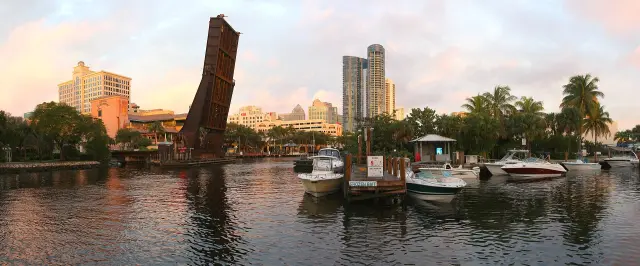
Fort Lauderdale boats must move early, because bridges lock down and close to boat traffic approximately 3.5 hours after an evacuation order or when winds reach 40 mph, whichever is earlier (City of Fort Lauderdale boat guidance).
The city adds that the Fort Lauderdale bridge lockdown may come as much as, or more than, 23 hours before the time a hurricane makes landfall (City of Fort Lauderdale).
Broward County runs a Hurricane Flotilla Plan to move boats out in order before the bridges lock for road evacuation. In Phase I the Broward County Sheriff Marine Patrol puts the plan in effect, patrols survey the waterways for hazards such as barges, and owners fuel up and store deck equipment. In Phase II the Sheriff Marine Patrol tells participants that flotilla movement will cease 3.5 hours after the Evacuation Order; the Fort Lauderdale Police Department Marine Patrol supervises and assists the forming of flotillas north of the New River in the Bahia Mar area and south of it in the Pier 66 area, and is deployed in the I-95 overpass and New River area to help them move west. At the end, the County Emergency Management Division asks the U.S. Coast Guard to have all drawbridges positioned down and locked for vehicle traffic (City of Fort Lauderdale). Small boats that need no bridge opening do not wait for a flotilla, and the timing and gathering harbors are announced at the time of the emergency.
The city boat guidance is blunt: never stay aboard. Owners strip anything that can tear loose, unstep sailboat masts, and take documents, radios and valuables ashore (City of Fort Lauderdale). An easily trailerable boat goes ashore, far from high water, in a garage if possible or secured to strong trees or a deadman anchor. A boat that stays in the water needs a sturdy dock with doubled mooring lines, slack to rise with the higher tides, chafe protectors and extra fenders, or a protected harbor with heavy and extra anchors and a scope of at least 10:1 for each; the city calls hurricane holes, deep narrow coves ringed by sturdy trees, ideal places to moor.
Questions about city emergency planning go to the Fort Lauderdale Domestic Preparedness and Emergency Management Bureau, 2200 Executive Airport Way, phone 954-828-6700 (City of Fort Lauderdale). Last verified: October 18, 2026, against the City of Fort Lauderdale hurricane preparedness pages, the National Hurricane Center, the NOAA seasonal outlook, the Florida Department of Revenue and the Florida Division of Emergency Management.
Frequently asked questions
When does hurricane season end in Fort Lauderdale?
The Atlantic hurricane season that covers Fort Lauderdale ends on November 30. The National Hurricane Center puts the peak on September 10, and NWS Miami calls September and October the most hurricane prone months for South Florida.
Are hurricane supplies tax free in Florida?
Yes, all year since August 1, 2025. The Florida Department of Revenue lists portable generators of 10,000 running watts or less, fuel cans of 5 gallons or less, AA to D, 6-volt and 9-volt batteries, tarps up to 1,000 square feet and tie-down kits.
How many days of hurricane supplies does a Fort Lauderdale household need?
The City of Fort Lauderdale sets a minimum of three days, or 72 hours, with at least one gallon of water per person per day. The Florida Division of Emergency Management encourages at least 7 days of supplies.
When do Fort Lauderdale bridges close to boats before a hurricane?
Bridges lock down and close to boat traffic approximately 3.5 hours after an evacuation order or when winds reach 40 mph, whichever comes first, according to the City of Fort Lauderdale. That may be as much as, or more than, 23 hours before landfall.
Does Fort Lauderdale collect trash during a hurricane warning?
No. The City of Fort Lauderdale suspends all sanitation services once a hurricane warning is issued, and bulk trash or yard waste must not go out during a watch or warning. Household waste stays in sealed bags until service resumes.
Sources
- National Hurricane Center, Tropical Cyclone Climatology https://www.nhc.noaa.gov/climo/ Used for: season dates, September 10 peak, 1991-2020 average and benchmark dates
- NOAA Climate Prediction Center, 2026 Atlantic Hurricane Season Outlook (updated August 6, 2026) https://www.cpc.ncep.noaa.gov/products/outlooks/hurricane.shtml Used for: 2026 season ranges and probabilities, May outlook ranges, El Nino reasoning
- NWS Miami Summer 2026 Weather Summary https://www.weather.gov/media/mfl/news/Summer2026Summary.pdf Used for: September and October as South Florida's most hurricane prone months, plans through November
- City of Fort Lauderdale, Hurricane Preparedness https://www.fortlauderdale.gov/government/departments-a-h/fire-rescue/emergency-services/hurricane-preparedness Used for: disaster supply kit list, 72 hours, tax exemption link
- City of Fort Lauderdale, Before a Storm https://www.fortlauderdale.gov/Government/Departments/Fire-Rescue/Services-Resources/Community-Programs/Hurricane-Preparedness/Before-a-Storm Used for: pre-season household checklist, safe room
- City of Fort Lauderdale, During a Hurricane Watch https://www.fortlauderdale.gov/Government/Departments/Fire-Rescue/Services-Resources/Community-Programs/Hurricane-Preparedness/During-a-Hurricane-Watch Used for: watch checklist, shutters, bulk trash rule
- City of Fort Lauderdale, During a Hurricane Warning https://www.fortlauderdale.gov/Government/Departments/Fire-Rescue/Services-Resources/Community-Programs/Hurricane-Preparedness/During-a-Hurricane-Warning Used for: warning actions, eye of the storm
- City of Fort Lauderdale, Hurricane Terminology https://www.fortlauderdale.gov/Government/Departments/Fire-Rescue/Services-Resources/Community-Programs/Hurricane-Preparedness/Hurricane-Terminology Used for: watch and warning definitions, emergency management bureau contact
- City of Fort Lauderdale, Sanitation Service Tips https://www.fortlauderdale.gov/Government/Departments/Fire-Rescue/Services-Resources/Community-Programs/Hurricane-Preparedness/Sanitation-Service-Tips Used for: sanitation suspension, pre-season yard debris, hotline and Neighbor Service Center
- City of Fort Lauderdale, Generator Safety https://www.fortlauderdale.gov/Government/Departments/Fire-Rescue/Services-Resources/Community-Programs/Hurricane-Preparedness/Generator-Safety Used for: generator placement and maintenance
- City of Fort Lauderdale, Protecting your Boat https://www.fortlauderdale.gov/Government/Departments/Fire-Rescue/Services-Resources/Community-Programs/Hurricane-Preparedness/Protecting-your-Boat Used for: bridge lockdown, Broward Hurricane Flotilla Plan, mooring and trailer guidance
- Florida Department of Revenue, TIP 25A01-05, New Sales Tax Exemptions Beginning August 1, 2025 https://floridarevenue.com/taxes/tips/Documents/TIP_25A01-05.pdf Used for: permanent sales tax exemptions for storm supplies
- Florida Division of Emergency Management, Preparing for the Hurricane Season https://www.floridadisaster.org/planprepare/preparing-for-hurricane-season Used for: 7 days of supplies
How this page was made
Digital Towns uses AI assistance to research and write its guides, and every page is only as good as the sources it cites. Our goal is the most accurate, useful local information possible.
This page was fact-checked twice before publishing.
If you see an error, or anything you can show is false, tell us right away and we will take a third look.
Report an error
Thank you. We'll take a third look and correct the page if it's wrong.