Short answer: The botanical garden on the Florida Tech campus in Melbourne is the 15-acre Joy and Gordon Patterson Botanical Garden, a hardwood hammock along Crane Creek. Founding president Jerome Keuper began planting palms there in the 1960s with help from palm collector Dent Smith, whose name is on the main trail. Florida Tech describes it as a public garden open sunrise to sunset.
Last verified: October 18, 2026, against the sources listed at the end of this page.
What is the botanical garden on the Florida Tech campus?
The Joy and Gordon Patterson Botanical Garden is a 15-acre palm hammock that runs through the middle of the Florida Institute of Technology campus in Melbourne.
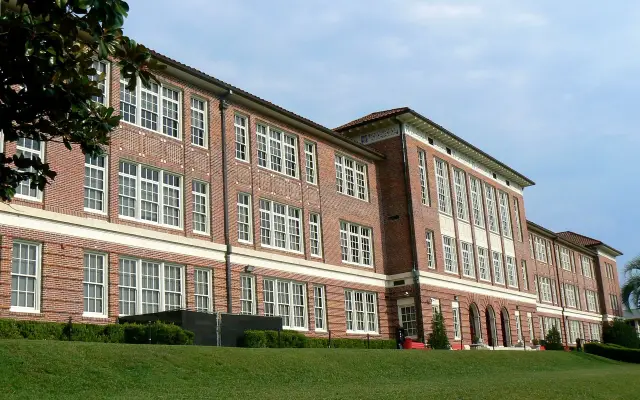
Florida Tech's garden page describes a stream bordered by a shady hammock abounding in palm trees and other tropical growth that winds through the heart of the campus and is the setting for the 15-acre garden. Its main path is the Dent Smith Trail, named for the founder of the Palm Society, and the university calls the site a public garden, open Monday through Sunday from sunrise to sunset. The same page credits Founding President Emeritus Jerome P. Keuper and Dent Smith, working in the 1960s, with making it one of the most unique campus botanical gardens of its kind in the continental United States, and lists the campus address as 150 W. University Blvd., Melbourne, FL 32901, with the university phone (321) 674-8000.
The garden's stated mission is to preserve and maintain the beauty of the natural garden hammock as a peaceful place for wellness and inspiration for the campus community and its visitors, and its vision begins with keeping the founder's pledge to protect the hammock. To protect plants, wildlife and visitors, the university asks that bicycles, skateboards and dogs stay out of the garden, and it treats removing, cutting or tampering with plants as a serious offense. The garden page also points visitors to Melbourne's Little Red Schoolhouse, which stands inside the garden. Drivers park in the red-striped spaces of the lot along the wood line off Babcock Street, across from the Southgate intersection, as the garden map page explains; that page also offers a downloadable garden map and a walking tour pamphlet.
Why is the garden in a Crane Creek hammock?
The garden sits in a Crane Creek hammock because Florida Tech's founding president pledged to protect that hammock when the college received its first campus land.
Gordon Patterson's 2022 Secret History of the garden, published by Florida Tech News, explains that on January 10, 1961, the regents of the University of Melbourne announced an agreement giving Brevard Engineering College a 99-year lease on a 40-acre campus on Country Club Road for a token $1 a year. Most of the site was yellow pine and saw palmetto, but the northeast corner sloped toward Crane Creek and held a lowland hammock of oak, maple and elm hardwoods and cabbage palms. Founding president Jerome P. Keuper believed his pledge to maintain that hammock and not disturb its trees unnecessarily was the critical factor that won the land for the college.
Florida Tech's garden history page, Keuper's own account of the garden's origins, describes the setting in botanical terms. The palm garden is a native hardwood hammock in the floodplain of Crane Creek, with a canopy of live and laurel oaks, red maple and cabbage palms adapted to having their feet wet when the creek floods. The dense canopy provides a greenhouse effect so that cold-sensitive plants might better survive periods of cold weather, and the fertile, wet soil supports abundant jungle-like growth. The university's campus wildlife site adds that the Florida Tech campus lies at the boundary between the subtropics and temperate zones, with acres of ponds, woodlands, wetlands and streambank that serve resident and migrating species.
Who was Dent Smith, and why is the trail named for him?
Dent Smith was a Daytona Beach palm collector and palm society founder, and the Melbourne trail carries his name because he guided and supplied the garden's first plantings.
Keuper's first attempt at tropical landscaping on the Melbourne campus failed. He lined Country Club Road with royal palms, and a freeze turned most of them, in his words, into skinny haystacks; the two Florida Tech accounts date that freeze differently, the history page to January 1961 and Patterson to December 1961. Keuper then learned that Dent Smith, who lived in Daytona Beach, grew an extensive palm collection. Patterson reports that Smith, who retired from investing at age 42 in 1939 and in 1955 founded what became the International Palm Society, promised a truckload of palms and a man to show the college how to plant them, and the truck arrived a few days later.
The Florida Tech profile of Dent Smith, reprinted from the Halifax Herald of the Halifax Historical Society in Daytona Beach, says Smith was born in Staunton, Virginia, in 1897, moved to Daytona Beach from Ridgewood, New Jersey, in 1949, and built his palm collection on four acres running to the Halifax River. By 1956 he had started a journal for the society, later printed and illustrated as Principes, and in December 1983 he received an honorary degree from the Florida Institute of Technology in Melbourne for his work establishing the palm garden. Patterson records that within five years Keuper had more than 150 species of palms for the garden, and that in 1967 Keuper named the nature path passing through the garden Dent Smith Trail in recognition of Smith's generosity and guidance.
Part of that trail began as a utility line. When Florida Power and Light needed to trench through the Crane Creek hammock to power the new dormitory quad, which Patterson lists as Shaw, Grissom, Campbell and Evans halls, Keuper had the company snake the cable around existing trees and palms. According to the history page, students began using the filled trench as a shortcut, a curving concrete bridge was built over the stream, and Keuper and Smith planted Chinese fan palms along the way to complement the natural stand of Sabal palmettos.
How has the garden changed since the 1970s?
The Florida Tech garden grew through the 1970s, declined after Keuper's retirement in 1986 and lost many palms to freezes and invasive vines before a recovery began in 2002.
The Florida Tech history page records that in 1972 the Board of Trustees formally dedicated the jungle, as students called it, as a botanical garden. At one time the collection held approximately 400 species of palms, but later freezes reduced that number to about 60, many of them marked with silver identification tags. Patterson gives a different count, writing that by 2003 cold snaps had killed many of the 200 species of tropical palms. Patterson also writes that in 1969 the Melbourne Garden Club announced plans for a Garden for the Blind, a circular garden with small metal signs identifying the plants in Braille, which Keuper placed between the Homer R. Denius Student Center and what is now the Jerome P. Keuper Administration Building.
Patterson traces a long middle period of strain. Keuper stepped down as president in 1986 and became the garden's unofficial curator, and in 1988 he helped organize the Friends of the Botanical Garden, which ran plant rambles and plant sales in the late 1980s and 1990s. In 1995 Melbourne city workers cut a 15-foot-wide strip along Crane Creek through the garden with no advance warning, drawing criticism from a student group and a Florida Department of Environmental Protection specialist. Keuper died in 2003, and air potato vines, placed on Florida's Noxious Weed List in 1999, threatened the hammock by the early 2000s.
Who supports the Florida Tech garden today?
The garden is supported today by an endowment from Joy and Gordon Patterson, whose names it carries, along with volunteers, donors and Florida Tech.
Patterson writes that in 2002 Florida Tech's fourth president, Anthony Catanese, rallied trustee support for the garden and enlisted University of Florida colleagues against the air potato, and that the development office hosted a series of Botanical Fests between 2005 and 2016. In 2019, Joy and Gordon Patterson established an endowment to preserve and maintain the garden, and the Molly Butterfly Garden and a fountain at the entrance to the Dent Smith Trail were added in 2022.
| Year | Milestone | Source |
|---|---|---|
| 1961 | 99-year, $1 a year lease on the 40-acre Country Club Road campus | Patterson |
| 1967 | Nature path named Dent Smith Trail | Patterson |
| 1972 | Trustees dedicate the hammock as a botanical garden | History page |
| 1988 | Friends of the Botanical Garden organized | Patterson |
| 2019 | Patterson endowment established | Patterson |
| 2022 | Molly Butterfly Garden and fountain added | Patterson |
The garden page posts a fall 2026 calendar: volunteer Clean-up Saturdays from 9 to 11 a.m. on September 19, October 17 and November 14, 2026, and Botanical Garden Tours on Sundays from 2 to 3 p.m. on September 20, October 18 and November 21, 2026. The page also takes tax-deductible donations for the garden, links a Plantsoon page on the garden's plant varieties and keeps a guest book. Because the garden has natural water features and specimen, delicate or possibly poisonous plants, the university asks visitors to stay on the trails or within walled patio areas and asks parents to keep control of their children.
Last verified: October 18, 2026, against the Florida Tech garden home, history, map and Dent Smith pages, Gordon Patterson's 2022 Florida Tech News history and the campus wildlife site, each re-read that day.
Frequently asked questions
Is the Florida Tech botanical garden open to the public?
Yes. Florida Tech describes the Joy and Gordon Patterson Botanical Garden as a public garden open Monday through Sunday from sunrise to sunset. Bicycles, skateboards and dogs are not allowed, and visitors are asked to stay on the trails or within walled patio areas.
Where do visitors park for the Florida Tech botanical garden?
Florida Tech directs garden visitors to the red-striped spaces in the lot along the wood line off Babcock Street, across from the Southgate intersection. A downloadable garden map and a walking tour pamphlet are posted on the garden's map page.
How big is the Florida Tech botanical garden?
Florida Tech gives the garden's size as 15 acres. It follows a stream and a native hardwood hammock in the floodplain of Crane Creek through the middle of the Melbourne campus, with the Dent Smith Trail as its main path.
How many palm species grow in the garden?
Florida Tech's history page says the garden once held approximately 400 palm species, but freezes reduced the collection to about 60. Patterson's history, which says Keuper had more than 150 species within five years, gives a different figure of 200 tropical palm species by 2003.
Does the garden offer tours?
Yes. Florida Tech lists Botanical Garden Tours on Sundays from 2 to 3 p.m. on September 20, October 18 and November 21, 2026, along with volunteer Clean-up Saturdays from 9 to 11 a.m. on September 19, October 17 and November 14, 2026.
Sources
- Joy and Gordon Patterson Botanical Garden, Florida Tech https://garden.fit.edu/ Used for: 15 acres, Dent Smith Trail, public garden, hours, rules, mission, fall 2026 events, Little Red Schoolhouse
- Origins of the Botanical Garden at F.I.T., Florida Tech https://www.fit.edu/garden/history/ Used for: Crane Creek floodplain hammock, canopy, 1972 dedication, 400 to 60 palm species, FP&L trench, Keuper pledge
- About Dent Smith, The Palm Man, Florida Tech https://www.fit.edu/garden/about-dent-smith/ Used for: Dent Smith biography, palm society, 1983 honorary degree
- Botanical Garden Map and Parking, Florida Tech https://www.fit.edu/garden/map/ Used for: parking off Babcock Street
- Secret History: The Origins of Florida Tech's Botanical Garden, Gordon Patterson, Florida Tech News, July 26, 2022 https://news.fit.edu/campus/secret-history-the-origins-of-florida-techs-botanical-garden/ Used for: 1961 lease, freeze, Dent Smith palms, 150 species, 1967 trail name, Garden for the Blind, 1986, 1988, 1995, 2002, Botanical Fests, 2019 endowment, 2022 Molly Butterfly Garden
- Florida Tech Campus Wildlife https://research.fit.edu/florida-tech-campus-wildlife/ Used for: campus habitats and subtropical-temperate boundary
How this page was made
Digital Towns uses AI assistance to research and write its guides, and every page is only as good as the sources it cites. Our goal is the most accurate, useful local information possible.
This page was fact-checked twice before publishing.
If you see an error, or anything you can show is false, tell us right away and we will take a third look.
Report an error
Thank you. We'll take a third look and correct the page if it's wrong.