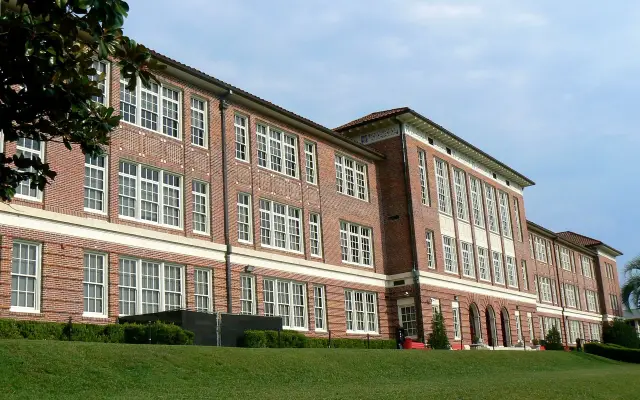
Short answer: WFIT started as a student-run Florida Tech station in Melbourne. A 1968 campaign by the campus ham radio club led to FCC approval in 1973 of a 10-watt station on 91.5, which first broadcast from Roberts Hall on April 4, 1975. It moved to 89.5 in 1979, became an NPR affiliate in 1995 and moved into a new campus building in 2012.
Last verified: October 18, 2026, against the sources listed at the end of this page.
How did WFIT public radio start at Florida Tech?
WFIT 89.5 FM began as a student project at the Florida Institute of Technology in Melbourne, after the Florida Tech Ham Radio Club started campaigning for a campus radio station in 1968, according to Gordon Patterson's Secret History: Radio Free Melbourne.
Patterson's account, published by Florida Tech in August 2022, says that four years later the university applied to the Federal Communications Commission, and on September 29, 1973, the FCC approved a 10-watt educational, noncommercial station on 91.5. The FCC assigned the call sign WFIT the following February, and construction began in fall 1974.
The station was to be housed in dorm rooms on the first floor of Roberts Hall, a Florida Tech residence hall. Firefighters from the Melbourne Fire Department raised the station's antenna onto the roof, a Fort Lauderdale company supplied four turntables, and a Satellite Beach resident donated a transmitter and another turntable. The WFIT About page summarizes the result: in April of 1975, the Florida Institute of Technology began its noncommercial educational radio station as WFIT, a student-run college station.
When did WFIT first go on the air in Melbourne?
WFIT first went on the air at 7 p.m. on Friday, April 4, 1975, three days after its scheduled start, according to the Secret History.
The first broadcast was set for April 1, 1975, but a clerk in Washington mistakenly did not forward the license. On April 4 the FCC sent a telegram approving the sign-on, and at 7 p.m. a student DJ announced the station as WFIT 91.5 in Melbourne, Florida. The first song was Cat Stevens' Hard Headed Woman. In those first months the station was on the air from 7 p.m. to 1 a.m., opening each evening with classical music before turning to progressive rock.
The early station mattered on campus beyond its music. In May 1975, a protest by 300 Florida Tech students in front of the president's office listed censorship of WFIT among its complaints, and university president Jerome P. Keuper acknowledged that he had failed in his communications with students. Patterson's account describes the gathering as good-natured. With only 10 watts, the Melbourne station reached only a few listeners in its first years.
How did WFIT move to 89.5 and grow its signal?
WFIT moved to 89.5 in 1979, when the FCC authorized a power increase to 3,000 watts, according to the Secret History.
The FCC also assigned the station a new frequency, 89.5 megacycles, to prevent interference with nearby stations. By 1980 the 89.5 signal was on the air around the clock, and the new transmitter meant that the station reached an audience in a 35-mile radius from Roberts Hall, the Florida Tech dormitory in Melbourne.
WFIT then became known as a college music station. In 1981 a Florida Tech vice president announced that students would no longer elect WFIT's general manager and that the station was no longer classified as a student organization. Even so, student programmers kept building a national reputation: in 1989 the trade publication The Gavin Report named WFIT a finalist for Best College Radio Station in its annual awards, and Billboard chose the Melbourne station as one of 10 college stations it surveyed for its alternative record chart. The WFIT About page says that in the late 1980s WFIT was regarded as one of the country's top alternative music college radio stations.
Power rose again in 1998. The Secret History reports that the station received permission that October to raise its antenna 20 feet and double the transmitter output from 2.3 to 4.6 kilowatts, with the general manager saying the station would be heard clearly in Sebastian and Vero Beach. The station's About page describes the 1998 change differently, as an FCC approved power increase to 8,000 kilowatts that extended the signal north to Cocoa and Cocoa Beach and south to Vero Beach, so the two Florida Tech sources disagree on the figure. A 2025 Florida Tech feature gives the current figure as 4,700 watts, with a signal across most of Brevard County and into parts of Indian River County.
| Year | Signal change | Source |
|---|---|---|
| 1973 | FCC approves a 10 watt station on 91.5 | Secret History |
| 1979 | 3,000 watts; frequency moves to 89.5 | Secret History |
| 1998 | Antenna raised 20 feet; 2.3 to 4.6 kilowatts | Secret History |
| 1998 | Power increase to 8,000 kilowatts, as the station states it | WFIT About page |
| 2004 | Transmitter upgrade; first HD radio station in Brevard County | WFIT About page |
| 2025 | 4,700 watts across most of Brevard County | Florida Tech, 2025 |
When did WFIT become an NPR station?
WFIT became an NPR affiliate in 1995, after a $29,600 Corporation for Public Broadcasting grant in January 1994, according to the Secret History.
The shift from college station to public radio station began in 1990, when the station's students and volunteers were told the student-run college station was ending under a nonstudent operational manager. The changes set off a protest campaign called Keep the Freedom, including a 1993 gathering of more than 100 people at Melbourne's Lazy Bean Coffee House. Meanwhile the station manager applied to the Corporation for Public Broadcasting. In January 1994 the CPB awarded WFIT a grant of $29,600 to support new programming drawn from National Public Radio, and in 1995 WFIT became an NPR affiliate, adding Morning Edition and All Things Considered.
The station's About page dates its connection to the public radio satellite system to 1993 and says that, in response to changing demographics, WFIT changed its format to jazz and began broadcasting public radio news. WFIT upgraded its transmitter in 2004 and, according to its own history, became the first radio station in Brevard County to broadcast in HD radio. In January 2006 WFIT changed its daytime programming from smooth jazz to Triple A, or Adult Album Alternative, the music format it still uses in Melbourne.
Locally produced shows grew alongside NPR. Fred Migliore's An Unconventional Sunday Morning began on WFIT in 1991 and, renamed FM Odyssey, gained national syndication in 1998. The About page names Coastal Connection and Keller Radio among its arts segments and two local classical programs, Mozart's Attic and Classics for a Sunday Evening, with 23 local volunteer show hosts; the station site also lists features such as Inside Florida Tech, Lagoon Minute and the Psychology Science Minute.
Where is the WFIT broadcast center on the Florida Tech campus?
WFIT broadcasts from a building beside the Gleason Performing Arts Center on the Florida Tech campus, which opened with a celebration on October 11, 2012, according to the university's announcement.
For decades WFIT worked out of Roberts Hall, first from dorm rooms and later from the basement, which Florida Tech's 2025 feature says frequently flooded. Patterson credits Thad Altman, a member of the Florida Senate for District 16, which included Melbourne, as instrumental in getting state funding for the building, and president Anthony Catanese presided over its dedication on October 11, 2012. The station's About page dates the move into the facility to December 2012.
The September 24, 2012 announcement describes the new broadcast center as located adjacent to the Gleason Performing Arts Center on campus. The $1.8 million facility comprises 6,500 square feet, which quadruples the station's former space in the basement of Roberts Residence Hall. It was designed to withstand 130 mph hurricane force winds and has 100 percent generator backup to keep the Melbourne station on the air through power outages. Because it was built connecting to the Gleason Performing Arts Center, it facilitates live broadcasts from the hall. Square footage figures for the building differ among sources: the station's About page gives 5,000 and the 2025 feature gives 4,100, against the 6,500 in the 2012 announcement.
What is WFIT like at 50?
WFIT marked its 50th anniversary in 2025 with the free Sonic Waves Music Festival on Saturday, April 12, 2025.
The festival ran from 5 p.m. to 10 p.m. at Intracoastal Brewing Company in the EGAD district of Eau Gallie, with four bands and free admission for all ages. A September 15, 2025 Florida Tech feature, WFIT at 50: The Soundtrack of the Space Coast, describes a mixed format of locally produced shows, NPR news including Morning Edition and All Things Considered, and volunteer hosts, with segments such as Lagoon Minute on the Indian River Lagoon.
The same feature reports financial strain. General Manager Stephen Yasko wrote there that federal and state funding for public radio and television stations had been eliminated, producing an extensive budget reduction, and that WFIT had eliminated three staff positions while remaining committed to Brevard County and the Space Coast. The Florida Institute of Technology Trustees hold the FCC license, according to the About page, and the station broadcasts at 89.5 FM from its building beside the Gleason Performing Arts Center in Melbourne.
Last verified: October 18, 2026, against the WFIT About page and festival notice and four Florida Tech publications, including Gordon Patterson's 2022 Secret History of the station.
Frequently asked questions
Who owns WFIT 89.5 FM?
WFIT is a noncommercial public radio station licensed by the Federal Communications Commission to the Florida Institute of Technology Trustees. It broadcasts from a building on the Florida Tech campus in Melbourne beside the Gleason Performing Arts Center.
Why is WFIT on 89.5 instead of 91.5?
The FCC first approved WFIT in 1973 as a 10-watt station on 91.5. In 1979 it authorized an increase to 3,000 watts and moved the station to 89.5 to prevent interference with nearby stations, and the Melbourne station has stayed on that frequency since.
Is WFIT still a student radio station?
No. In 1981 Florida Tech said WFIT was no longer classified as a student organization, and in 1990 the student-run college station gave way to a nonstudent operational manager. It became an NPR affiliate in 1995. Florida Tech students still gain broadcasting experience there as volunteers.
How far does the WFIT signal reach from Melbourne?
Florida Tech reported in 2025 that WFIT runs at 4,700 watts, with a signal across most of Brevard County and into parts of Indian River County. The station's About page says a 1998 power increase extended the signal north to Cocoa and Cocoa Beach and south to Vero Beach.
When did WFIT celebrate its 50th anniversary?
WFIT marked 50 years in 2025. It held the free Sonic Waves Music Festival on April 12, 2025, at Intracoastal Brewing Company in the EGAD district of Eau Gallie, and Florida Tech published a WFIT at 50 feature on September 15, 2025.
Sources
- Secret History: Radio Free Melbourne, Gordon Patterson, Florida Tech News, August 18, 2022 https://news.fit.edu/campus/secret-history-radio-free-melbourne/ Used for: 1968 campaign, 1973 FCC approval, Roberts Hall, Melbourne Fire Department antenna, April 4, 1975 first broadcast, 1979 89.5 and 3,000 watts, 35-mile radius, 1981, 1989 Gavin finalist, 1994 CPB grant, 1995 NPR, 1998 power boost, 2012 building
- About WFIT 89.5 FM https://www.wfit.org/about-wfit-89-5-fm Used for: license holder, April 1975 start, 1993 interconnection, 2004 HD radio first in Brevard, January 2006 Triple A, programs
- WFIT at 50: The Soundtrack of the Space Coast, Florida Tech News, September 15, 2025 https://news.fit.edu/?p=82833 Used for: 4,700 watts, coverage, 50th anniversary, funding cuts
- Dedication of New WFIT Studios, Florida Tech News, September 24, 2012 https://news.fit.edu/?p=2082 Used for: $1.8 million, 6,500 sq ft, next to Gleason Performing Arts Center, hurricane design
- Sonic Waves Music Fest 2025, WFIT, April 2, 2025 https://www.wfit.org/2025-04-02/sonic-waves-music-fest-2025 Used for: 50th anniversary festival April 12, 2025
How this page was made
Digital Towns uses AI assistance to research and write its guides, and every page is only as good as the sources it cites. Our goal is the most accurate, useful local information possible.
This page was fact-checked twice before publishing.
If you see an error, or anything you can show is false, tell us right away and we will take a third look.
Report an error
Thank you. We'll take a third look and correct the page if it's wrong.