Short answer: Sebastian's native plants grow in four settings: oak scrub and pine flatwoods on the mainland sand, coastal hammock and mangrove along the lagoon, and sea oats and sea grapes on the Orchid Island dunes. The best public places to see them are Indian River County's 407-acre North Sebastian Conservation Area on Main Street and the Hammock Trail at Sebastian Inlet State Park. Florida law bans removing sea oats or sea grapes from public land, and saw palmetto berries need a permit.
Last verified: October 15, 2026, against the sources listed at the end of this page.
Which native plant communities grow around Sebastian?
Sebastian has four main native plant settings: oak scrub and pine flatwoods on the mainland sand, coastal hammock and mangrove on the lagoon and barrier island, and dune grasses on the Orchid Island beaches.
The mainland communities are best documented by Indian River County. Its North Sebastian Conservation Area lists mesic pine flatwoods, scrubby flatwoods, hydric flatwoods, oak scrub, sand pine scrub, freshwater marshes and wet prairies on one tract (Indian River County). The Sebastian scrub habitat guide covers the scrub oaks and sand pine in more depth, and the Sebastian saw palmetto guide covers the palm that fills much of the flatwoods understory.
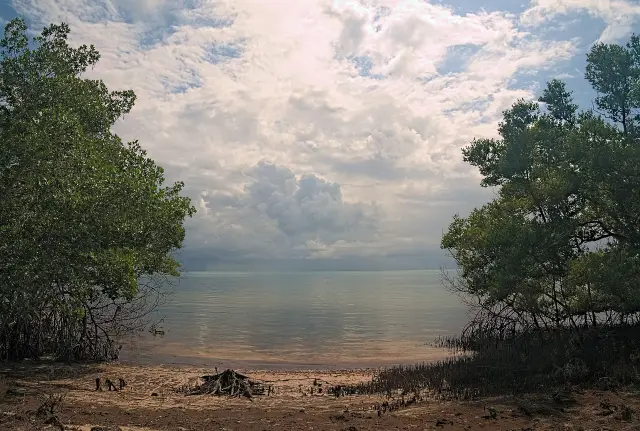
Across the Indian River Lagoon the plants change. Sebastian Inlet State Park describes its Hammock Trail as a mile-long walk under a coastal, subtropical palm and oak hammock along the fringe of the mangroves, with plant identification signs (Florida State Parks). The Florida Native Plant Society defines a maritime hammock as forest on raised coastal ground with a canopy often dominated by live oak (Florida Native Plant Society), and the coastal hammock guide for Sebastian follows that forest from the inlet to Wabasso. On the lagoon, the U.S. Fish and Wildlife Service lists mangroves, live oaks and gumbo limbo among the plants at Pelican Island National Wildlife Refuge (U.S. Fish and Wildlife Service).
The beach is the fourth setting. UF/IFAS Extension Indian River County names railroad vine, beach sunflower, sea oats, spider lily and sea grape as five salt-tolerant natives for the coast, and notes that at least two of them grow only on the beach dune (UF/IFAS Extension Indian River County). The beach dune plants guide and the sea grapes guide take those plants one at a time, from Sebastian Inlet south to Wabasso Beach.
| Question | Key fact | Guide |
|---|---|---|
| What grows in Sebastian scrub? | Oak scrub, sand pine scrub and scrubby flatwoods on county preserves | Scrub habitat guide |
| Can saw palmetto berries be picked? | Only with landowner written permission and a state permit (F.S. 581.189) | Saw palmetto guide |
| What forest grows behind the dunes? | Palm and oak coastal hammock; mile-long Hammock Trail at Sebastian Inlet State Park | Coastal hammock guide |
| Which plants hold the dunes? | Sea oats, railroad vine, beach sunflower and others; sea oats protected by F.S. 161.242 | Beach dune plants guide |
| Can sea grapes be trimmed or removed? | Not from public land, or private land without the owner's consent (F.S. 161.242) | Sea grapes guide |
Where can native plants be seen on public land near Sebastian?
The largest county native plant preserve in and near Sebastian is the 407-acre North Sebastian Conservation Area at 1295 Main St, with about 10 miles of trails, open 7:30 a.m. to sunset year-round.
Indian River County lists 15 parking spaces and 1 handicap space at the North Sebastian Conservation Area, restrooms at Friendship Park, benches, boardwalks and educational signage; dogs must be leashed and fires are not allowed (North Sebastian Conservation Area). Over 10 miles of trails cross the site, with boardwalks over many of its wetlands, and the county says it is the only conservation tract it manages that allows equestrian use.
| Preserve | Address | Size | Main plant communities | Pets |
|---|---|---|---|---|
| North Sebastian Conservation Area | 1295 Main St | 407 acres | Pine flatwoods, oak scrub, sand pine scrub, marsh, wet prairie | Leashed dogs |
| Sebastian Harbor Preserve | 184 Englar Drive | 163 acres | Scrubby and mesic flatwoods, freshwater marsh, wet prairie | No pets |
| Wabasso Scrub Conservation Area | 8900 64th Ave | 111 acres | Sand pine and scrub oak, scrubby flatwoods, pine flatwoods, wet prairie | Leashed dogs |
| Sebastian Scrub Conservation Area | 1258 Schumann Drive | 10 acres | Oak scrub and scrubby flatwoods | Leashed dogs |
The Wabasso Scrub Conservation Area breaks its 111 acres into 53 acres of sand pine, scrub oak and scrubby flatwoods, 15 acres of wet prairies, 41 acres of pine flatwoods and about 2 acres of other land, with parking at Wabasso Park (Wabasso Scrub Conservation Area). Sebastian Harbor Preserve lists zero parking spaces on its county page and bans pets, alcohol, glass containers and feeding wildlife (Sebastian Harbor Preserve). It shares its southern edge with the 166-acre Sebastian Stormwater Park, which connects to the Sebastian Scrub Conservation Area on Schumann Drive, so the three form one green corridor through the Sebastian Highlands.
The small Schumann Drive tract has a practical catch. The Indian River County page for the Sebastian Scrub Conservation Area, checked October 14, 2026, still lists its walking trails as under development, while noting that the county has cleared trails and firebreaks and installed an informational kiosk (Sebastian Scrub Conservation Area). A short walk there is possible, but the North Sebastian Conservation Area off Main Street is the better choice for a long native plant walk with parking.
Which native plants does Florida law protect around Sebastian?
Around Sebastian, state law bars cutting or removing sea oats and sea grapes without the landowner's consent, requires written permission and a state permit to harvest saw palmetto berries, and lists other protected plants in Chapter 5B-40.
Florida Statutes 161.242 makes it unlawful for any purpose to cut, harvest, remove or eradicate sea oats or sea grapes from any public land, or from private land without the owner's consent (Florida Statutes 161.242). The statute's stated purpose is to protect beaches and shores from erosion by preserving the vegetation that binds the sand. UF/IFAS Extension Indian River County repeats the point for homeowners: it is illegal to pick sea oats (UF/IFAS Indian River County).
Work near the dune is a separate permit. The Florida Department of Environmental Protection says its Coastal Construction Control Line program regulates structures and activities that can destabilize dunes, and that CCCL permits also protect sea turtles and dune plants; the program answers questions at 850-245-8570 (Florida DEP CCCL program). Beachfront owners near Wabasso Beach planning a walkover or dune planting start there.
Saw palmetto berries carry their own rule. Florida Statutes 581.189 makes it unlawful to destroy, harvest or sell the berries on another person's private land or on any public land without written permission from the landowner and a permit from the department (Florida Statutes 581.189). The Florida Department of Agriculture and Consumer Services says some native plants are protected under Chapter 5B-40 of the Florida Administrative Code in three categories, threatened, endangered and commercially exploited, and takes permit questions at 1-888-397-1517 (FDACS native plant harvesting permit). The county page for Sebastian Harbor Preserve adds a simpler request: leave only footprints.
Why are Sebastian scrub preserves burned and cleared of melaleuca?
Sebastian's scrub preserves are burned, chopped and weeded because the county manages them as Florida scrub-jay habitat under the Sebastian Area-Wide Florida Scrub-Jay Habitat Conservation Plan finalized in March 2000.
Indian River County says the primary purpose of buying the North Sebastian Conservation Area, between 1996 and 1999 with three Florida Communities Trust cost-share grants, was to preserve and restore scrub and wetland habitats for rare and endangered species, and that the tract is a key property under that plan (Indian River County).
The Wabasso Scrub Conservation Area, bought in 1995, has a direct link to Sebastian home building: the county says its management in part mitigates the incidental take of Florida scrub-jays within platted lots in the Sebastian Highlands, and that it has served as a recipient site for relocated gopher tortoises, a state Threatened species (Indian River County). In other words, scrub cleared for houses on the Highlands grid is offset by scrub kept open on 64th Avenue.
Invasive plants are the other target. At Sebastian Harbor Preserve, county management began in 2007 with roller chopping and burning in the scrubby and mesic flatwoods, and a melaleuca removal project treated and harvested the trees in the wetlands, then introduced melaleuca weevils that cut seed production and seedling establishment (Indian River County). The City of Sebastian Natural Resources Board points residents to the UF/IFAS assessment of non-native plants because invasive plant species can have detrimental impacts on local ecosystems (City of Sebastian).
Where can Sebastian residents get native plants for a yard?
Sebastian residents can buy discounted native plants or sign up for free live oak trees through the Pelican Island Audubon Society, a program the City of Sebastian Natural Resources Board promotes.
The city's Florida Landscaping page ties native planting to its Sustainable Sebastian Initiative and lists nine Florida-Friendly principles, from Right Plant, Right Place to Protect the Waterfront, alongside links to the city fertilizer ordinance and tree ordinance (City of Sebastian Natural Resources Board). It says local residents are eligible to buy discounted native plants or register to receive free live oak trees from Pelican Island Audubon.
The Audubon program, called Trees for Life and Plants for Birds, reports 36,929 native plants distributed as of October 9, 2026, toward a goal of planting 100,000 native trees (Pelican Island Audubon Society). The society's physical address is Audubon House, 195 9th Street SE (Oslo Road) in Vero Beach, south of Sebastian. The same Audubon page lists the nursery's Saturday hours two ways, 9 a.m. to noon in one place and 9 to 11 a.m. in another, with Monday and Wednesday at 9 to 11 a.m.. The society asks visitors to call 772-567-3520 to confirm its office is open before going to Audubon House, and the same call settles the nursery time before a Saturday drive from Sebastian.
For a salt-sprayed coastal lot on Orchid Island, UF/IFAS Extension Indian River County recommends its five salt-tolerant natives as easy to establish and low maintenance once watered in, and says they can be seen growing on the island side of Jaycee Park in Vero Beach (UF/IFAS Extension Indian River County). Sea grape needs at least one male and one female plant to fruit, which matters for anyone in Sebastian planting one for wildlife.
Frequently asked questions
Is it illegal to pick sea oats on Sebastian area beaches?
Yes. Florida Statutes 161.242 makes it unlawful to cut, harvest or remove sea oats or sea grapes from public land, or from private land without the owner's consent. The statute applies statewide, including the dunes from Sebastian Inlet to Wabasso Beach, and exists to keep the vegetation that binds the sand.
Can saw palmetto berries be picked near Sebastian?
Only with written permission from the landowner and a state permit. Florida Statutes 581.189 makes harvesting or selling the berries on public land, or another person's land, without both unlawful. That covers county preserves such as the North Sebastian Conservation Area.
Which Sebastian preserve has the most native plant trails?
The North Sebastian Conservation Area at 1295 Main St is the largest of the four county preserves listed here, at about 407 acres, with roughly 10 miles of trails through pine flatwoods, oak scrub and wet prairie. It opens 7:30 a.m. to sunset year-round, with 15 parking spaces.
Where can Sebastian residents get free native trees?
Pelican Island Audubon Society's Trees for Life program offers free live oak trees and discounted native plants to local residents, as the City of Sebastian Natural Resources Board notes. The society is at 195 9th Street SE in Vero Beach; phone 772-567-3520.
Are dogs allowed in Sebastian's native plant preserves?
Leashed dogs are allowed at the North Sebastian, Sebastian Scrub and Wabasso Scrub conservation areas, according to Indian River County. Sebastian Harbor Preserve on Englar Drive allows no pets and has no parking spaces listed.
Sources
- North Sebastian Conservation Area (Indian River County) https://indianriver.gov/business_detail_T21_R52.php Used for: address, acreage, hours, trails, plant communities, scrub-jay HCP, purchase years
- Sebastian Scrub Conservation Area (Indian River County) https://indianriver.gov/business_detail_T21_R60.php Used for: address, 10 acres, trails under development, oak scrub, wildlife corridor
- Wabasso Scrub Conservation Area (Indian River County) https://indianriver.gov/business_detail_T21_R63.php Used for: address, 111 acres, acreage by community, 1995 purchase, Sebastian Highlands mitigation, tortoise recipient site
- Sebastian Harbor Preserve (Indian River County) https://indianriver.gov/business_detail_T21_R59.php Used for: address, 163 acres, no pets, flatwoods, management since 2007, melaleuca removal and weevils
- Florida Statutes 161.242, harvesting of sea oats and sea grapes prohibited http://www.leg.state.fl.us/statutes/index.cfm?App_mode=Display_Statute&URL=0100-0199/0161/Sections/0161.242.html Used for: sea oats and sea grape protection
- Florida Statutes 581.189, saw palmetto berries http://www.leg.state.fl.us/statutes/index.cfm?App_mode=Display_Statute&URL=0500-0599/0581/Sections/0581.189.html Used for: written permission and permit rule for saw palmetto berries
- Sebastian Inlet State Park experiences and amenities (Florida State Parks) https://www.floridastateparks.org/parks-and-trails/sebastian-inlet-state-park/experiences-amenities Used for: Hammock Trail length and plant identification signs
- Florida Landscaping, Natural Resources Board (City of Sebastian) https://www.cityofsebastian.org/408/Florida-Landscaping Used for: Sustainable Sebastian Initiative, Florida-Friendly principles, Audubon programs, invasive plant reference
- 5 Salt Tolerant Native Plants for Coastal Florida (UF/IFAS Extension Indian River County) https://blogs.ifas.ufl.edu/indianriverco/2021/10/26/5-salt-tolerant-native-plants-for-coastal-florida/ Used for: five coastal natives, Jaycee Park display, sea oats note
- Native Plant Harvesting Permit (Florida Department of Agriculture and Consumer Services) https://www.fdacs.gov/Agriculture-Industry/Plant-Industry-Permits/Native-Plant-Harvesting-Permit Used for: Chapter 5B-40 protected plant categories, permit helpline
- Coastal Construction Control Line Program (Florida DEP) https://floridadep.gov/rcp/coastal-construction-control-line Used for: CCCL permits protect dune plants, phone
- Trees for Life / Plants for Birds (Pelican Island Audubon Society) https://pelicanislandaudubon.org/home-page/trees-for-life-plants-for-birds/ Used for: nursery hours, address, native plants distributed, 100,000 tree goal
- About Us, Pelican Island National Wildlife Refuge (U.S. Fish and Wildlife Service) https://www.fws.gov/refuge/pelican-island/about-us Used for: refuge upland and shoreline plants
- Maritime Hammock (Florida Native Plant Society) https://www.fnps.org/native-plant-community-details/maritime-hammock Used for: maritime hammock definition, live oak canopy
How this page was made
Digital Towns uses AI assistance to research and write its guides, and every page is only as good as the sources it cites. Our goal is the most accurate, useful local information possible.
This page was fact-checked twice before publishing.
If you see an error, or anything you can show is false, tell us right away and we will take a third look.
Report an error
Thank you. We'll take a third look and correct the page if it's wrong.