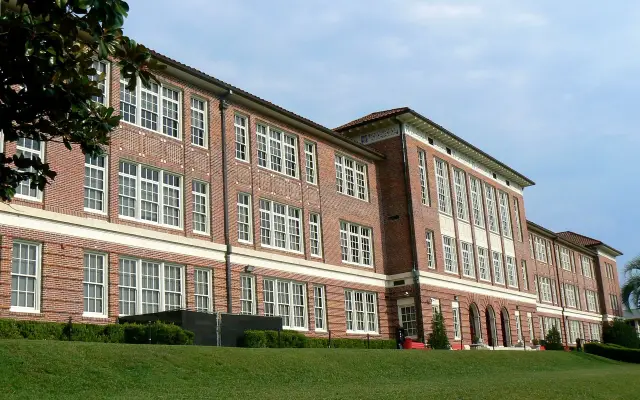
Short answer: It was a six-week course for young women planned for June 1968 by the Aerospace Technical Institute, an affiliate of Florida Institute of Technology (formerly Brevard Engineering College) in Melbourne. Meant to bring women to a campus that had six women among 154 students in 1958, it cost $405 and allowed glasses. Florida Today reported only two registrants, and the program never ran.
Last verified: October 16, 2026, against the sources listed at the end of this page.
What was the pre-stewardess training program at Brevard Engineering College?
It was a six-week airline career course for young women that the Melbourne college planned for June 1968 and never ran.
Florida Tech historian Gordon Patterson tells the story in a September 2023 Secret History article. By then Brevard Engineering College had become Florida Institute of Technology, and the course belonged to its new affiliate, the Aerospace Technical Institute, known as ATI, which was set up to train pilots, engineering technicians and mechanics at Cape Kennedy Regional Airport, today's Melbourne Orlando International Airport.
The pre-stewardess course was meant to solve a problem the article traces to the first night of classes in 1958: the Melbourne campus had almost no women. A brochure printed in the spring of 1968 invited applicants to study beside future airline pilots and space engineers, live in Brownlie Hall and prepare for airline careers. According to Patterson, Florida Today reported that only two local high school graduates registered, and the Melbourne course was dropped before it began.
Why did the Melbourne college want women on campus?
The numbers were stark from the first night of classes.
The Secret History of Launching Florida Tech records that by early September 1958, 154 students had registered at the new Melbourne-area college, and that six women were among the first students. The state's Florida Institute of Technology marker, placed in 2007 on South Country Club Road in Melbourne, says Keuper founded the school in 1958 to meet a critical need for scientists and engineers in America's race for space. Those first classes met in three classrooms that Brevard County Schools agreed to rent to the new college at Eau Gallie Junior High School, and the applicants' average age was 33.
The ratio did not improve with growth. Patterson reports that seven years after opening, Brevard Engineering College had only one full-time female student, a math major. In April 1966 Keuper boasted of a 1,000 percent improvement, claiming 10 full-time women in a student body of 1,100, though an oceanography student at the Melbourne school estimated the ratio in her classes at about 150 to one. Orlando Evening Star columnist George Tomlinson counted 42 female full- and part-time students around the same time, most of them math majors, with a few in space technology and physics.
Those women were not the audience the stewardess plan imagined. Patterson stresses that Countdown College, as the Melbourne school was nicknamed, had always drawn women aiming at science and engineering careers, and that the first woman to earn a Brevard Engineering College degree completed a master's in space technology in 1962. Tomlinson described the physics and space technology students as members of a rare but growing breed. The ATI course, by contrast, was pitched at young women seeking airline work, and the two people who registered were local high school graduates.
Who was behind the Aerospace Technical Institute?
Keuper recruited Jerry Lauderbaugh, a retired U.S. Air Force pilot with degrees from the University of Illinois and the University of Chicago, to lead ATI, the Melbourne college's new aviation affiliate.
Keuper said its attention would be focused on commercial aviation and the air transportation industry. The institute was to operate from Cape Kennedy Regional Airport in Melbourne, with classes starting in September 1968.
Patterson writes that Keuper and Lauderbaugh hatched the idea of using ATI to bring women to the Melbourne campus, and suggests that Coffee, Tea or Me?, a ghostwritten bestseller presented as the memoir of two Eastern Airlines stewardesses, may have been a catalyst. The article itself dates the book both ways, calling it a 1966 bestseller in the text and giving 1967 as its publication year in a caption. ATI outlived the stewardess plan. In 1971 the institute ceased to be an affiliate and became Florida Tech's School of Aeronautics. Its successor, the College of Aeronautics, starts aspiring pilots' flight training in the first semester at the Emil Buehler Center for Aviation Training and Research, and Florida Tech's Facts and Figures page places the campus about 2 miles from Melbourne Orlando International Airport.
What did the 1968 brochure promise and require?
The ATI brochure sold the course as glamour.
It described the program as a concentrated course to acquaint and prepare young women for airline careers, pictured a constantly moving job, and promised tastefully appointed rooms in Brownlie Hall beside a refreshing swimming pool on the Melbourne campus. Students would join what the brochure called the exclusive club of jet-set career girls.
The price was itemized. Patterson lists a total of $405, made up of $150 tuition, a $95 flight lab fee and $160 for room and board. The physical requirements followed airline rules: a height between 5 feet 2 inches and 5 feet 9 inches and a weight between 95 and 140 pounds. In one respect the Melbourne program broke with the industry: ATI applicants were allowed to wear glasses.
Patterson calls the Melbourne glasses rule a bold move that broke with the industry standard, noting that in 1968 United Airlines required stewardesses to have vision of 20/40 or better without glasses.
| Item | ATI plan |
|---|---|
| Length and start | Six weeks, June 1968 |
| Tuition | $150 |
| Flight lab fee | $95 |
| Room and board in Brownlie Hall | $160 |
| Total cost | $405 |
| Height range | 5 feet 2 inches to 5 feet 9 inches |
| Weight range | 95 to 140 pounds |
| Glasses | Allowed |
| Registrants, per Florida Today | Two local high school graduates |
Why did the program fail, and what changed at Florida Tech afterward?
With two registrants, the Melbourne course could not run.
Patterson places the Melbourne failure in its moment, writing that in 1968 young women were joining the women's liberation movement and that times were changing.
What changed the gender balance at Florida Tech was curriculum and sport, not airline glamour. In 1969 the student newspaper The Crimson surveyed 100 students about the campus social problem, and an editorial urged a broader liberal arts curriculum. The 1970s brought a School of Psychology and more humanities and communication courses, and Title IX led the Melbourne university to add women's crew in 1972, volleyball in 1978, softball in 1980, cross country in 1982 and basketball in 1986.
Patterson's article closes with a figure the ATI planners could not have imagined: as of Aug. 1, 2023, women made up 32.5 percent of Florida Tech's incoming first-year class. The university's Facts and Figures page now lists among its alumni the first female four-star general in U.S. military history and a 1984 Olympic gold medalist in rowing.
Last verified: October 15, 2026, by re-reading Gordon Patterson's Florida Tech News articles on the pre-stewardess program and on launching the college, and Florida Tech's Facts and Figures and College of Aeronautics pages, plus the state's Florida Institute of Technology marker record.
Frequently asked questions
Did the pre-stewardess program ever hold classes in Melbourne?
No. According to Florida Tech historian Gordon Patterson, Florida Today reported that only two local high school graduates registered for the June 1968 course, and the program never materialized.
How much did the ATI pre-stewardess course cost?
The brochure listed a total of $405 for the six weeks: $150 tuition, a $95 flight lab fee and $160 for room and board in Brownlie Hall on the Florida Tech campus in Melbourne.
What was the Aerospace Technical Institute?
ATI was a Florida Institute of Technology affiliate led by retired Air Force pilot Jerry Lauderbaugh to train pilots, technicians and mechanics at the Melbourne airport. In 1971 it became Florida Tech's School of Aeronautics.
How many women attended Brevard Engineering College at first?
Six. The Secret History of Launching Florida Tech records 154 students registered in September 1958, with six women among them, at the first classes held at Eau Gallie Junior High School.
How did the Melbourne course differ from airline rules of 1968?
It allowed applicants to wear glasses, which Patterson says broke with the industry standard; in 1968 United Airlines required vision of 20/40 or better without glasses. Its height and weight limits, 5 feet 2 inches to 5 feet 9 inches and 95 to 140 pounds, followed airline guidelines.
Sources
- Secret History: The Pre-Stewardess Training Program (Florida Tech News, 2023) https://news.fit.edu/campus/secret-history-the-pre-stewardess-training-program/ Used for: program plan, ATI, brochure terms, enrollment of women, outcome, later changes
- The Secret History of Launching Florida Tech https://news.fit.edu/archive/the-secret-history-of-launching-florida-tech/ Used for: first registration, 154 students, six women
- Florida Tech Facts and Figures https://www.fit.edu/about/facts-and-figures/ Used for: campus location, airport distance, notable alumni
- Florida Tech College of Aeronautics https://www.fit.edu/aeronautics/ Used for: present-day College of Aeronautics and flight training center
- Florida Institute of Technology, Florida Historical Marker (Florida Department of State, 2007) https://markers.flheritage.com/home/details/78 Used for: 1958 founding by Jerome P. Keuper to meet the need for scientists and engineers
How this page was made
Digital Towns uses AI assistance to research and write its guides, and every page is only as good as the sources it cites. Our goal is the most accurate, useful local information possible.
This page was fact-checked twice before publishing.
If you see an error, or anything you can show is false, tell us right away and we will take a third look.
Report an error
Thank you. We'll take a third look and correct the page if it's wrong.