Short answer: The Indian River Lagoon is the 156-mile estuary between the mainland and the barrier islands that forms Sebastian's eastern waterfront. Off Sebastian it mixes ocean water from Sebastian Inlet, one of only five navigable inlets, with fresh water from the St. Sebastian River. More than 4,300 species depend on it, and the Marine Resources Council's 2025 report rated the central lagoon from Rockledge to Sebastian as okay, up from poor.
Last verified: October 11, 2026, against the sources listed at the end of this page.
What is the Indian River Lagoon at Sebastian?
The Indian River Lagoon is the 156-mile estuary between the Florida mainland and the barrier islands, and Sebastian sits on its west shore where the St. Sebastian River enters, facing Pelican Island and Orchid Island across the water.
Indian River County describes the lagoon as a 156-mile-long bar-built estuary that makes up 40% of Florida's east coast, located between the mainland and the barrier island (Indian River County Lagoon Division). The county stretch is the central portion of the lagoon, with the Sebastian Inlet to the north and the Fort Pierce Inlet to the south, which puts Sebastian, Roseland and Wabasso at the northern end of the Indian River County shoreline.
Despite the name, it is not a river. The Indian River Lagoon National Estuary Program explains that the system is three connected water bodies, the Mosquito Lagoon, the Banana River and the Indian River Lagoon, and that all three are estuaries where fresh water mixes with ocean water. It spans seven counties: Volusia, Brevard, Indian River, St. Lucie, Martin, Okeechobee and Palm Beach (One Lagoon). The water off Sebastian's Indian River Drive is the Indian River segment of that system.
Where does the lagoon water at Sebastian come from?
Lagoon water off Sebastian is a mix of ocean water that enters through Sebastian Inlet and fresh water that drains in from the St. Sebastian River and the city's canals and ditches.
On the ocean side, Indian River County notes that the lagoon is connected to the Atlantic Ocean via 5 inlets, and the Sebastian Inlet District describes Sebastian Inlet as one of only five navigable channels that connect the Indian River Lagoon to the Atlantic (Sebastian Inlet District). The IRLNEP describes lagoons as shallow estuaries with limited exchange with the ocean, so the inlets matter for how quickly water in the lagoon near Sebastian is flushed.
On the land side, the St. Sebastian River is the big input. The City of Sebastian calls it a major tributary of the Indian River Lagoon and states that the city lies along nearly 9 miles of the lower eastern and southern banks of the St. Sebastian River and occupies approximately 9,000 acres of the 100,000 acres overall Sebastian River Watershed (City of Sebastian drainage history). Most city runoff travels through canals, ditches and swales to the river and then to the lagoon, and the city notes that farmland west of Sebastian supplies much of the watershed runoff.
Too much fresh water is its own problem. The St. Johns River and South Florida water management districts identified heavy freshwater inputs from the St. Sebastian River watershed, and their effect on salinity, as the principal concern for the basin, since salinity swings can disrupt nursery areas, according to the same city page.
What lives in the lagoon near Sebastian?
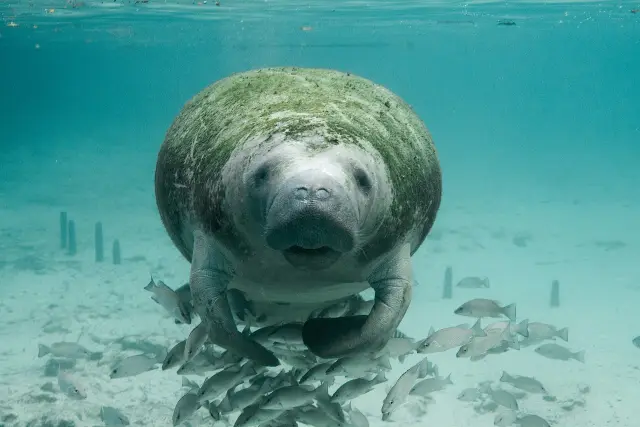
More than 4,300 species depend on the Indian River Lagoon for part of their lives, including the manatees, green sea turtles and wood storks protected around Pelican Island off Sebastian.
Indian River County counts more than 4,300 species dependent upon its ecosystem for some period of their lifecycle, of which 50 are listed as endangered or threatened. The IRLNEP explains part of the reason: the lagoon straddles the transition zone between cold temperate and warm subtropical provinces, so temperate, subtropical and tropical species overlap along the Treasure Coast.
At Pelican Island, the U.S. Fish and Wildlife Service lists the federally protected green sea turtle, Florida manatee and wood stork in the lagoon around the refuge, along with state-listed reddish egrets and tricolored herons, and notes that during spring and fall migration birds rest and refuel there as they follow the Indian River Lagoon south to the Everglades or to the Caribbean (U.S. Fish and Wildlife Service). Florida State Parks notes that canoes and kayaks can be paddled to islands and along the mangrove-fringed shoreline of the lagoon from Sebastian Inlet State Park (Florida State Parks).
How healthy is the lagoon near Sebastian now?
The 2025 Marine Resources Council report rated the Central Indian River Lagoon, from Rockledge to Sebastian, as improved from poor to okay, though that stretch still had the lowest water quality in the lagoon.
WQCS reported in November 2025 that the Central Indian River Lagoon, from Rockledge to Sebastian, improved from poor to okay due to lower algae concentrations and increased seagrass coverage (WQCS, Nov. 11, 2025). The council's director said the central basin still has the lowest water quality of everything in the lagoon, and the report drew on data from August 2024 to August 2025 collected by eight organizations. The detailed scores, the St. Sebastian River readings and the septic and stormwater programs are covered on the lagoon water quality page.
Seagrass is being replanted near Sebastian. In 2025, Indian River County Natural Resources staff and partners planted about 13 acres of seagrass at Big Slough near Sebastian Inlet and another 10 acres at Preacher's Hole near the Wabasso Causeway, sites chosen because they historically supported seagrass and are more sheltered than other parts of the lagoon (NOAA Fisheries). Crews put steel cages over the plantings to keep boats and grazing animals off the young grass.
Who manages and protects the lagoon around Sebastian?
No single agency runs the Indian River Lagoon at Sebastian; Indian River County's Lagoon Division, the Indian River Lagoon National Estuary Program, the U.S. Fish and Wildlife Service and the Sebastian Inlet District each handle a part.
The lagoon is part of the National Estuary Program and was designated an estuary of national significance in 1990, according to Indian River County. The county's Lagoon Division carries out its Lagoon Management Plan, adopted Sept. 26, 2023, which identifies 17 key factors impacting the health of the Indian River Lagoon and sets goals and projects for each (Indian River County). The county calls the plan a living document, with project updates made every year.
The division's recent work in the waters off Sebastian and Wabasso includes oyster restoration, muck mapping and removal, seagrass restoration and anchoring limits. Its highlights page notes that 2 derelict vessels were removed from the lagoon in winter 2026, that the county is launching a pump-out vessel program in 2026, and that the Living Docks program with Florida Tech has installed 21 docks. Federal stewardship centers on Pelican Island National Wildlife Refuge, and the Sebastian Inlet District maintains the inlet and monitors seagrass on its flood shoal; the legal aquatic preserve designation is covered on its own page.
What is the Indian River Lagoon worth to the region?
A 2025 study for the Indian River Lagoon National Estuary Program valued the lagoon at $28.3 billion a year in local economic impacts across the seven counties that include Indian River County and Sebastian.
| Measure | Figure | Source |
|---|---|---|
| Length | 156 miles | Indian River County |
| Share of Florida's east coast | 40 percent | Indian River County |
| Ocean inlets | 5 | Indian River County |
| Species dependent on the lagoon | More than 4,300; 50 listed | Indian River County |
| Annual local economic impact | $28.3 billion | IRLNEP, 2025 valuation |
| Jobs supported | 128,400 | IRLNEP, 2025 valuation |
The IRLNEP retained The Balmoral Group in 2025 to value the lagoon. It found that recreational fishing, boating, tourism, commercial fishing, boat-building and other lagoon uses generate $28.3 billion annually in local economic impacts, add $14 billion to gross domestic product, support 128,400 jobs and $8.3 billion in wages, and that the lagoon's ecosystem services provide more than $10 billion in annual benefits (One Lagoon). Sebastian's share shows up in the fishing, boating and waterfront businesses along Indian River Drive and at Sebastian Inlet.
Frequently asked questions
Is the Indian River at Sebastian a river or a lagoon?
A lagoon. The Indian River Lagoon National Estuary Program says the Indian River, Banana River and Mosquito Lagoon are estuaries, not rivers. The water along Indian River Drive in Sebastian is a shallow, brackish estuary behind the barrier islands.
How long is the Indian River Lagoon?
Indian River County gives the length as 156 miles, making up 40 percent of the Florida east coast. Sebastian sits near the north end of the Indian River County stretch, which runs from Sebastian Inlet south to the Fort Pierce Inlet.
What river flows into the lagoon at Sebastian?
The St. Sebastian River. The City of Sebastian calls it a major tributary of the Indian River Lagoon and says the city covers about 9,000 acres of the 100,000-acre Sebastian River watershed, along nearly 9 miles of its banks.
Is the lagoon near Sebastian getting healthier?
The Marine Resources Council 2025 report found the Central Indian River Lagoon, from Rockledge to Sebastian, improved from poor to okay with lower algae and more seagrass, though it still had the lowest water quality of the five basins.
Who is in charge of the Indian River Lagoon?
Responsibility is shared. Indian River County runs a Lagoon Division and a Lagoon Management Plan adopted in 2023, the Indian River Lagoon National Estuary Program coordinates seven counties, and federal and special-district agencies manage Pelican Island and Sebastian Inlet.
Sources
- Indian River Lagoon (Indian River County Lagoon Division) https://indianriver.gov/services/natural_resources/indian_river_lagoon/ Used for: lagoon length, share of east coast, five inlets, county position, estuary of national significance 1990, 4,300 species and 50 listed, division highlights
- Lagoon Management Plan (Indian River County) https://indianriver.gov/services/natural_resources/indian_river_lagoon/lagoon_management_plan.php Used for: 17 key factors, living document updated yearly
- About the Indian River Lagoon (Indian River Lagoon National Estuary Program, One Lagoon) https://onelagoon.org/about-the-lagoon/ Used for: seven counties, three water bodies, 4,000+ species, transition zone, 2025 economic valuation
- About Us, Pelican Island National Wildlife Refuge (U.S. Fish and Wildlife Service) https://www.fws.gov/refuge/pelican-island/about-us Used for: protected species in the lagoon at Pelican Island, migration route
- About Sebastian Inlet District https://www.sitd.us/about-sebastian-inlet-district Used for: Sebastian Inlet as one of five navigable channels
- The History of Sebastian Drainage System (City of Sebastian) https://cityofsebastian.org/434/The-History-of-Sebastian-Drainage-System Used for: St. Sebastian River as major tributary, city along nearly 9 miles of the river, 9,000 of 100,000 watershed acres, freshwater and seagrass concerns
- Indian River Lagoon shows stability in annual health report (WQCS, Nov. 11, 2025) https://www.wqcs.org/wqcs-news/2025-11-11/indian-river-lagoon-shows-stability-in-annual-health-report Used for: 2025 Marine Resources Council report: Central IRL from Rockledge to Sebastian improved from poor to okay
- Restoring the Indian River Lagoon's Seagrass Meadows and Wetlands (NOAA Fisheries) https://www.fisheries.noaa.gov/feature-story/restoring-indian-river-lagoons-seagrass-meadows-and-wetlands Used for: 2025 seagrass plantings at Big Slough and Preacher's Hole
- Experiences & Amenities, Sebastian Inlet State Park (Florida State Parks) https://www.floridastateparks.org/parks-and-trails/sebastian-inlet-state-park/experiences-amenities Used for: boat access from the inlet to the lagoon, Intracoastal Waterway and Sebastian River; paddling along mangrove shoreline
How this page was made
Digital Towns uses AI assistance to research and write its guides, and every page is only as good as the sources it cites. Our goal is the most accurate, useful local information possible.
This page was fact-checked twice before publishing.
If you see an error, or anything you can show is false, tell us right away and we will take a third look.
Report an error
Thank you. We'll take a third look and correct the page if it's wrong.