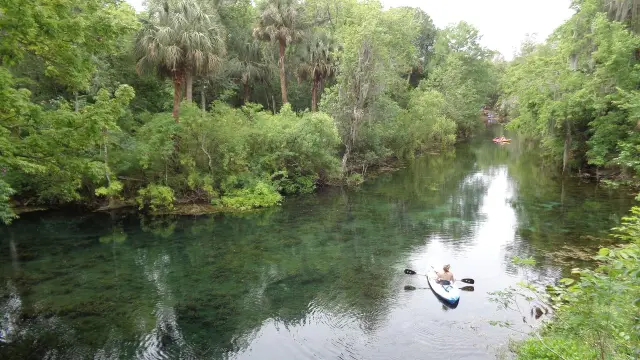
Short answer: Oyster reefs near Sebastian are mostly restored ones. Indian River County ringed Lauren's Island, just south of the Merrill Barber Bridge, with almost 500 concrete reef balls, and the Sebastian Inlet District installed 22 reef arches as a living shoreline at Coconut Point in Sebastian Inlet State Park. Wild oyster harvest in the lagoon is closed July 1 to September 30 and allowed only in open FDACS areas.
Last verified: October 15, 2026, against the sources listed at the end of this page.
Where are the oyster reefs near Sebastian?
The best documented restored oyster reef near Sebastian is the Indian River County Lagoon Division's double ring of reef balls around Lauren's Island, just south of the Merrill Barber Bridge.
County staff and volunteers placed concrete reef modules, which the county calls oyster balls, in a double ring around the spoil island to promote oyster growth in the Indian River Lagoon (Indian River County). Each ball weighed about 50 pounds, and almost 500 were installed.
Closer to Sebastian, the newest habitat work is at the inlet. On September 10, 22 reef arch structures were installed along about 200 feet of eroded shoreline at Coconut Point, a finger of land on the south side of Sebastian Inlet State Park (Sebastian Inlet District).
From the Sebastian riverfront, the City of Sebastian Yacht Club ramp at 820 Indian River Drive, just north of Riverview Park, is a dual concrete ramp into the Indian River, with a fishing pier, boat dock areas and a restroom, and trailer parking across the street in the city's Riverview Park lot (City of Sebastian). The city describes quick access across the waterway to Sebastian Inlet.
Why did the Indian River Lagoon lose its oyster reefs?
The Indian River Lagoon lost oyster reefs to pollution, coastal construction, boat strikes and sea level rise, and none of the sources checked gives a reef count for the Sebastian shoreline itself.
The lagoon off Sebastian is part of an estuary that runs 156 miles from Ponce de Leon Inlet in Volusia County to Jupiter Inlet in Palm Beach County, and over the years pollution and coastal construction wiped out huge numbers of its oyster beds (Florida Tech). Those beds work as natural breakwaters that blunt wave energy, and oysters act as living filters that remove impurities from the water.
The best documented losses are north of Sebastian, in Mosquito Lagoon. The University of Central Florida Coastal and Estuarine Ecology Lab says its reefs need restoring after significant boat strike damage that dislodges and fragments oyster mats, combined with sea level rise that increases boring sponge activity and leaves shells brittle (UCF Coastal and Estuarine Ecology Lab). The lab began restoring reefs there in 2007 and counts 97 reefs restored on a footprint of about 4 acres. In its 2022 to 2023 funding period it restored 5 reefs with Indian River Lagoon National Estuary Program funding plus 7 with the Florida Fish and Wildlife Conservation Commission, using only biodegradable materials, and recruitment on its 2007 mats remains high at 896.44 live oysters per square meter. None of the sources checked gives a comparable count for the Indian River County shoreline between Sebastian and Vero Beach.
What living shoreline is being built at Sebastian Inlet?
At Coconut Point in Sebastian Inlet State Park, 22 reef arch structures were installed on September 10 along about 200 feet of eroded shoreline as a living shoreline meant to cut erosion and add marine habitat.
Reef arches are prefabricated, honeycomb-shaped modular units used for coastal protection and habitat restoration, and Reef Arches, LLC, installed all of them in one day (Sebastian Inlet District, updated September 18, 2026). Up to 90 mangrove plants were to follow in the weeks after. The Ocean Research and Conservation Association (ORCA), a Vero Beach nonprofit, is using volunteer citizen scientists to monitor the site for at least three years.
The project is a partnership of the Florida Department of Environmental Protection, ORCA and Sebastian Inlet State Park, funded by a $95,000 state cost-share grant with in-kind matches from the District, Reef Arches and MANG, a mangrove awareness foundation. The District says living shorelines absorb wave energy, filter pollutants and adapt naturally to sea level rise, the same breakwater and filter roles Florida Tech describes for natural oyster beds. The District's post does not yet report oyster growth on the arches.
How was the Lauren's Island oyster reef built?
Indian River County Lagoon Division staff and volunteers built the Lauren's Island reef by setting concrete reef modules in a double ring around the spoil island just south of the Merrill Barber Bridge.
The county gives three reasons for the work: oysters filter water to improve water clarity, provide habitat, and act as breakwaters that stabilize shorelines and reduce erosion (Indian River County). Each oyster ball weighed approximately 50 pounds, and almost 500 were installed at the restoration site. The county page gives no installation date or reef length, so it is not possible to say from it how long the reef has had to grow.
| Project | Location | Built | Size | Lead |
|---|---|---|---|---|
| Lauren's Island oyster reef | Spoil island south of Merrill Barber Bridge | Not dated on county page | Almost 500 balls of about 50 pounds | Indian River County Lagoon Division |
| Coconut Point living shoreline | South side of Sebastian Inlet State Park | September 10 (post updated September 18, 2026) | 22 reef arches along about 200 feet | Sebastian Inlet District with FDEP, ORCA and the park |
| Indian River Lagoon Habitat Restoration | 10 sites lagoon-wide | FY2024 award | 6.5 acres of oyster habitat | Indian River Lagoon Council |
| Mosquito Lagoon reefs | North of Sebastian | Since 2007 | 97 reefs, about 4 acres | UCF |
Can oysters be harvested in the Indian River Lagoon near Sebastian?
Oysters near Sebastian can be taken only from FDACS shellfish areas classified approved or conditionally approved and in open status, outside the FWC closed season of July 1 to September 30.
For the Indian River Lagoon at Sebastian, the Florida Fish and Wildlife Conservation Commission applies its statewide recreational rules, which cover everywhere outside Apalachicola Bay: a recreational saltwater fishing license unless exempt, two bags per person or vessel per day, with one bag equal to two 5-gallon buckets, one 10-gallon bucket or 60 pounds, a 3-inch minimum size, and harvest by hand or tong only (FWC). The Florida Department of Agriculture and Consumer Services Division of Aquaculture manages the harvesting areas.
Status changes with rain. On October 14, 2026, the FDACS Atlantic coast page listed area 7202 North Indian River as Conditionally Approved with a rainfall closure at sunset on October 8, 2026, and a re-open water sample scheduled for October 13 with results due October 15 (FDACS). Area 7001 Indian River/St. Lucie showed Approved and open with a status date of October 31, 2024, and area 7005 was Restricted and closed year round. The page does not say which area covers the Sebastian shoreline, so the area map on FDACS is the check to make before harvesting near Sebastian. Closures take effect at sunset and re-openings at sunrise, and daily status is also available from the FDACS Atlantic Coast field office in Melbourne at 321-984-4890 (FDACS). FWC adds that FDACS may close areas during the open season for rainfall, higher river levels or harmful algal blooms, that all harvest is prohibited in closed areas, and that oysters must be culled over the bar they came from (FWC).
| Area | Name | Classification | Status shown |
|---|---|---|---|
| 7001 | Indian River/St. Lucie | Approved | Open since October 31, 2024 |
| 7005 | Indian River/St. Lucie | Restricted | Closed year round |
| 7202 | North Indian River | Conditionally Approved | Rainfall closure at sunset October 8, 2026 |
Which agencies protect oyster habitat off Sebastian?
Oyster habitat off Sebastian lies inside the Indian River-Malabar to Vero Beach Aquatic Preserve, run by the Florida Department of Environmental Protection, which lists oyster reef restoration and oyster research among its work.
The preserve was established in 1970, covers about 28,000 acres in Brevard and Indian River counties, and lists oysters among its animals (Florida Department of Environmental Protection). Its access points include the Main Street Boat Ramp, the Wabasso Causeway Boat Ramp, Dale Wimbrow Park and Sebastian Inlet State Park.
Federal money reaches the same lagoon. The NOAA Restoration Center lists an Indian River Lagoon Council project of 10 sites and 15 individual projects that together restore or enhance 6.5 acres of oyster habitat, 46 acres of seagrass and 6,045 linear feet of living shoreline (NOAA Restoration Center). Its Indian River County site at Big Slough and Preacher's Hole is a seagrass planting that drew $1,073,506 in FY2024 funding, with construction listed to start April 1, 2025.
Last verified: October 14, 2026, on the FDACS, FWC, Florida DEP, NOAA, Indian River County, Sebastian Inlet District and City of Sebastian websites.
Frequently asked questions
Where can restored oyster reefs near Sebastian be seen?
Indian River County's Lauren's Island reef rings a spoil island just south of the Merrill Barber Bridge, and the Sebastian Inlet District's reef arch living shoreline sits at Coconut Point on the south side of Sebastian Inlet State Park. From Sebastian, the city Yacht Club ramp at 820 Indian River Drive launches into the lagoon.
How many reef balls ring Lauren's Island?
Almost 500. Indian River County staff and volunteers set concrete oyster balls of about 50 pounds each in a double ring around the spoil island, just south of the Merrill Barber Bridge, to promote oyster growth in the Indian River Lagoon.
When is oyster season in the lagoon near Sebastian?
FWC closes wild oyster harvest statewide, outside Dixie, Levy, Wakulla and Apalachicola Bay, from July 1 through September 30. Even in season, harvest is legal only in FDACS areas that are approved or conditionally approved and open, which rain can close.
How many oysters can be taken per day?
FWC allows two bags per person or vessel per day, whichever is less, with one bag equal to two 5-gallon buckets, one 10-gallon bucket or 60 pounds. Oysters must be at least 3 inches and harvested by hand or tong in the Indian River Lagoon.
How much oyster reef has been restored in the lagoon?
UCF's Coastal and Estuarine Ecology Lab counts 97 reefs restored on about 4 acres in Mosquito Lagoon since 2007, and the NOAA-funded Indian River Lagoon Council program covers 6.5 acres of oyster habitat across 10 sites. None of the sources checked gives a reef count for the Sebastian shoreline.
Sources
- Oyster Restoration, Lagoon Division Projects (Indian River County) https://www.indianriver.gov/services/natural_resources/indian_river_lagoon/lagoon_division_projects/oyster_restoration.php Used for: Lauren's Island reef south of Merrill Barber Bridge, double ring, about 50-pound balls, almost 500 installed
- Indian River-Malabar to Vero Beach Aquatic Preserve (Florida Department of Environmental Protection) https://floridadep.gov/rcp/aquatic-preserve/locations/indian-river-malabar-vero-beach-aquatic-preserve Used for: established 1970, 28,000 acres, oysters listed, oyster reef restoration and oyster research, access points
- Indian River Lagoon Habitat Restoration, Big Slough and Preacher's Hole (NOAA Restoration Center project 5809) https://www.habitat.noaa.gov/apps/rcdb_services/rcdb/project/5809 Used for: 10 sites, 15 projects, 6.5 acres oyster, FY2024 $1,073,506, construction start April 1, 2025
- Shellfish Harvesting Area Status, Atlantic Coast (Florida Department of Agriculture and Consumer Services) https://shellfish.fdacs.gov/seas/seas_atlantic.htm Used for: areas 7001, 7005, 7202 status on October 14, 2026, wild oyster closure July 1 to September 30
- Oysters and clams, recreational regulations (Florida Fish and Wildlife Conservation Commission) https://myfwc.com/fishing/saltwater/recreational/shellfish/ Used for: bag limit, 3-inch minimum, hand or tong only, license, approved or conditionally approved open areas only
- Yacht Club boat ramp (City of Sebastian) https://www.cityofsebastian.org/facilities/facility/details/Yacht-Club-21 Used for: 820 Indian River Drive just north of Riverview Park, trailer parking in Riverview Park
- Restoration, Coastal and Estuarine Ecology Lab (University of Central Florida) https://sciences.ucf.edu/biology/ceelab/restoration/ Used for: Mosquito Lagoon oyster restoration since 2007, 97 reefs, about 4 acres
- Living Shoreline Project Installed on the Indian River Lagoon (Florida Tech, May 25, 2017) https://news.fit.edu/blog/irl/oyster-reefs-in-indian-river-lagoon/ Used for: 156-mile lagoon, pollution and coastal construction wiped out oyster beds
- Oyster reef balls at Sebastian's Riverview Park show early success after one year (WQCS via WUSF, December 21, 2025) https://www.wusf.org/environment/2025-12-21/oyster-reef-balls-at-sebastians-riverview-park-show-early-success-after-one-year Used for: November 2024 install, second phase native plants, accretion in six months, quarterly monitoring two to three years, Riverside Park living shoreline, Sebastian Inlet District plan
- Oyster reef balls in Sebastian show early success after one year (Sebastian Daily) https://www.sebastiandaily.com/business/oyster-reef-balls-in-sebastian-show-early-success-after-one-year-88550 Used for: 265 linear feet, November 2024
- Indian River County expands oyster reef restoration with Lauren's Island project (WQCS, July 16, 2026) https://www.wqcs.org/wqcs-news/2026-07-16/indian-river-county-expands-oyster-reef-restoration-with-laurens-island-project Used for: 350 linear feet, two rows, openings every 55 feet, signage, crushed shell concrete, 50 gallons a day, multi-year monitoring
- Oyster reefs are growing again in the Indian River Lagoon (FOX 35 Orlando, January 2026) https://www.fox35orlando.com/news/oyster-reefs-growing-again-indian-river-lagoon Used for: 63 percent loss since 1943 in the Mosquito Lagoon area, 20 gallons a day, pink barnacle
- Coconut Point living shoreline: 22 reef arches, ORCA monitoring (Sebastian Inlet District) https://sitd.us/new-living-shoreline-to-stem-erosion-improve-navigation-at-sebastian-inlet-s-coconut-point Used for: Coconut Point living shoreline: 22 reef arches, ORCA monitoring (Sebastian Inlet District)
How this page was made
Digital Towns uses AI assistance to research and write its guides, and every page is only as good as the sources it cites. Our goal is the most accurate, useful local information possible.
This page was fact-checked twice before publishing.
If you see an error, or anything you can show is false, tell us right away and we will take a third look.
Report an error
Thank you. We'll take a third look and correct the page if it's wrong.