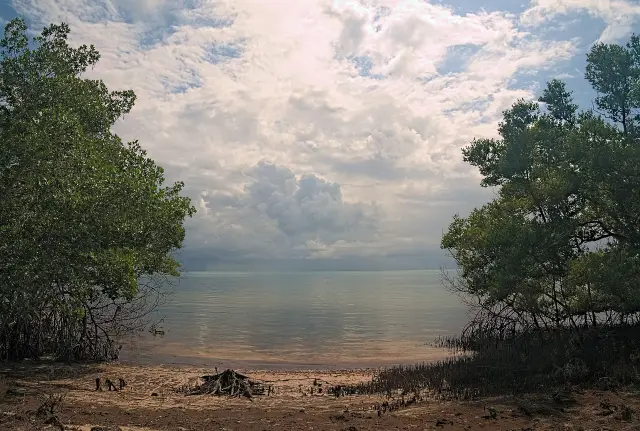
Short answer: On March 14, 1903, President Theodore Roosevelt reserved Pelican Island, a 5.5 acre mangrove island in the Indian River Lagoon off Sebastian, as a preserve and breeding ground for native birds. It was the first federal bird reservation and the first unit of today's National Wildlife Refuge System, created after plume hunting had driven Florida's nesting birds into decline.
Last verified: October 11, 2026, against the sources listed at the end of this page.
What did the March 14, 1903 order do for Pelican Island?
The March 14, 1903 executive order set aside Pelican Island in the Indian River Lagoon off Sebastian as a federal preserve and breeding ground for native birds, the first such reservation in the United States.
The Indian River Lagoon Encyclopedia quotes the operative words of President Theodore Roosevelt's order: Pelican Island in Indian River is hereby reserved and set apart for the use of the Department of Agriculture as a preserve and breeding ground for native birds. There was no appropriation, no staff and no boundary survey, only a short directive covering one small mangrove island across the lagoon from the Sebastian shore.
The U.S. Fish and Wildlife Service describes Pelican Island as the first federal bird reservation and says the order gave birth to the National Wildlife Refuge System. In 1903 the island measured 5.5 acres, according to the same Service page. The National Wildlife Refuge System uses the date as its own starting point, stating that Roosevelt established Pelican Island along Florida's Atlantic coast as the first unit of what would become the system.
Historian Evan B. Jaynes, writing in the Florida Historical Quarterly in 2020, explains why the order mattered beyond Sebastian. Land had already been set aside in the United States for national parks and other purposes, he notes, but never before had American land been reserved specifically for its wild fauna.
Why did the Pelican Island birds need protection by 1903?
Pelican Island needed protection because plume hunters and gunners were cutting down Florida's nesting birds, and the island was one of the last brown pelican rookeries left on the east coast.
The Florida Historical Society states that by the late 1800s Florida's bird populations were dwindling because of hunting for plumes, which supplied the hat trade. It describes Pelican Island as a small mangrove island that hosted thousands of brown pelicans, spoonbills and other birds raising their young. The encyclopedia goes further, calling the island the last rookery for brown pelicans on the east coast of Florida.
The threat was close to home for the Sebastian settlement. Market hunters worked the Indian River Lagoon from fast boats, and sportsmen on passing yachts fired at birds as they rose from the water. Florida passed a law protecting non-game birds in 1901, but a state statute did not put anyone on the water around Pelican Island full time, and the colony remained exposed until the federal order of 1903.
Who pushed Roosevelt to protect Pelican Island?
A Sebastian homesteader, Paul Kroegel, and national bird advocates led by ornithologist Frank Chapman, the Florida Audubon Society and the American Ornithologists' Union pressed for federal protection of Pelican Island.
The Service credits the encouragement of Frank Chapman and the Florida Audubon Society. The Pelican Island Conservation Society lists the same coalition with one more name at the front: at the urging of Mr. Kroegel, the Florida Audubon Society and the American Ornithologists' Union, Roosevelt signed the executive order that made Pelican Island the first national wildlife refuge.
The Florida Historical Society adds that naturalists including Chapman visited Kroegel on the Indian River and appealed to Roosevelt on his behalf. Jaynes records the story that Roosevelt, told early in 1903 that no law prevented him from making Pelican Island a federal reserve, answered Very well then, I so declare it. The Quarterly presents that line as what the president supposedly said, and it is best read that way, as tradition rather than transcript.
The story of Kroegel himself, from his homestead on Barker's Bluff to his years as warden, is told on its own page in this Sebastian history series.
Pelican Island milestones after 1903
Each of the federal and international designations below was layered onto the 1903 reservation off Sebastian, as recorded by the U.S. Fish and Wildlife Service.
| Year | Milestone | Source |
|---|---|---|
| 1903 | Executive order of March 14 reserves the 5.5 acre island for native birds | U.S. Fish and Wildlife Service |
| by 1909 | Roosevelt adds nine more Florida reservations and 55 in all | U.S. Fish and Wildlife Service |
| 1963 | Named a National Historic Landmark; Service recommends a 4,740 acre boundary | U.S. Fish and Wildlife Service; Pelican Island Conservation Society |
| 1970 | Designated wilderness by Congress | U.S. Fish and Wildlife Service |
| 1993 | Recognized as a Ramsar Wetland of International Importance | U.S. Fish and Wildlife Service |
| 2000 | Listed as a candidate Marine Protected Area | U.S. Fish and Wildlife Service |
| 2001 | Shoreline project builds a 165 foot oyster shell wave break | U.S. Fish and Wildlife Service |
The Service notes that Pelican Island was named a National Historic Landmark because it was the first federal area set aside specifically to protect wildlife, and that the Ramsar listing thirty years later recognized its support of endangered species and large gatherings of migratory birds in the Indian River Lagoon.
What grew out of the Pelican Island reservation?
The Pelican Island order became the template for a national network: Roosevelt created 55 bird reservations and game preserves, and the refuge system that traces its start to Sebastian now counts more than 570 refuges.
According to the Service, by the end of his presidency Roosevelt had named nine more reservations in Florida and a total of 55 bird reservations and national game preserves, which it calls the forerunner of the National Wildlife Refuge System. The pattern set at Pelican Island, an executive reservation for wildlife with a local warden, was repeated across the country.
The refuge system's own page gives its size today as more than 570 national wildlife refuges and 96 million land acres, with 760 million marine acres, across all 50 states and five territories. All of it is counted from the 1903 reservation in the Indian River Lagoon.
The connection is built into the refuge itself. The Service trails page describes the Centennial Trail boardwalk on the Orchid Island side of the lagoon, where more than 569 engraved planks each carry the name of a refuge established since 1903, ending at the observation tower that looks across to Pelican Island.
How has Pelican Island changed since 1903?
Pelican Island has lost close to half its 1903 area to erosion, while the protected refuge around it near Sebastian has grown from a few islands to more than 5,400 acres.
The Service reports that the island measured 5.5 acres in 1903, began to shrink around 1943 from natural and human-induced wave action, and was less than half its original size by 2000. Its wilderness description gives the current size as roughly 3 acres, blaming boat wakes and sea-level rise, and calls the Pelican Island Wilderness the smallest unit of the National Wilderness Preservation System.
To slow the loss at Pelican Island, the Service and partners completed a shoreline project in 2001 that placed a 165 foot oyster shell wave break and planted smooth cordgrass and mangroves along the shore. A helicopter carried in the shell to keep disturbance to nesting birds low.
The refuge grew outward even as the island shrank. The Pelican Island Conservation Society records that in 1963 the Service recommended expanding the boundary to 4,740 acres of lagoon bottom and wetland, and that the state's refusal to sell those bottomlands marked the first time in Florida that state-owned bottomlands were protected for conservation. Stanbridge, the Indian River County Historian, writes that the Trustees leased the river bottom to the refuge in 1963 instead of selling it to developers. The Service states the refuge eventually expanded to over 5,400 acres of wetlands and upland habitat.
Where can the 1903 refuge be seen from Sebastian today?
The 1903 island is closed wilderness, but the U.S. Fish and Wildlife Service opens viewing trails on Historic Jungle Trail, 3.3 miles south of Sebastian Inlet, daily from 7:30 a.m. to sunset.
The Service visitor page places the public use areas on the Historic Jungle Trail in Indian River County, off A1A, 3.7 miles north of Wabasso Beach Road (CR 510). From Interstate 95 it routes drivers through exit 156 to County Road 512, Sebastian Boulevard, which crosses the city and the Indian River Lagoon on the way to the barrier island. The Centennial Trail is a three-quarter-mile accessible path that ends at the tower facing the island.
| Place | What is there | Source |
|---|---|---|
| Centennial Trail, Historic Jungle Trail | Boardwalk with 569 plus engraved refuge planks and a tower facing Pelican Island | U.S. Fish and Wildlife Service |
| Refuge public use areas | Open daily, 7:30 a.m. to sunset; 3.3 miles south of Sebastian Inlet | U.S. Fish and Wildlife Service |
| Riverview Park, Sebastian | Statue of warden Paul Kroegel looking out toward Pelican Island | Indian River Lagoon Encyclopedia |
| Sebastian Area Historical Museum, Main Street | Exhibits on the Ais Indians and Pelican Island; free admission | Sebastian Area Historical Society |
On the mainland, the Indian River Lagoon Encyclopedia records that the 2003 statue of the first warden at Riverview Park in Sebastian looks out at Pelican Island. The Sebastian Area Historical Society keeps exhibits on the Ais Indians and Pelican Island in its museum in the 1927 Historic Sebastian Public School on Main Street, open Tuesdays, Thursdays and Saturdays.
Frequently asked questions
Why is Pelican Island called the first national wildlife refuge?
On March 14, 1903, Theodore Roosevelt reserved the island in the Indian River Lagoon off Sebastian as a preserve and breeding ground for native birds. The U.S. Fish and Wildlife Service counts it as the first unit of the National Wildlife Refuge System.
How big was Pelican Island in 1903?
The U.S. Fish and Wildlife Service reports that the island measured 5.5 acres in 1903. Erosion from about 1943 onward reduced it to less than half that size by 2000, and the Service now gives roughly 3 acres.
Did Roosevelt really say Very well then, I so declare it?
The Florida Historical Quarterly repeats the line as what Roosevelt supposedly said when told no law prevented him from protecting Pelican Island. It is a long-told tradition, not a documented quotation, and is best treated that way.
Who asked Roosevelt to protect Pelican Island?
The U.S. Fish and Wildlife Service credits Frank Chapman and the Florida Audubon Society. The Pelican Island Conservation Society adds Sebastian homesteader Paul Kroegel and the American Ornithologists' Union, and the Florida Historical Society says naturalists appealed to Roosevelt on Kroegel's behalf.
How many refuges have grown from the Pelican Island order?
Roosevelt himself created 55 bird reservations and game preserves, nine more of them in Florida. The National Wildlife Refuge System now lists more than 570 national wildlife refuges, all counted from the 1903 Pelican Island reservation.
Sources
- Pelican Island National Wildlife Refuge, About Us, U.S. Fish and Wildlife Service https://www.fws.gov/refuge/pelican-island/about-us Used for: 1903 order and its sponsors, 5.5 acre island in 1903, erosion from about 1943, 2001 shoreline project, nine more Florida reservations and 55 in all under Roosevelt, 1963 landmark, 1970 wilderness, 1993 Ramsar, 2000 marine protected area candidate, expansion past 5,400 acres
- About Wildlife Refuges, National Wildlife Refuge System, U.S. Fish and Wildlife Service https://www.fws.gov/program/national-wildlife-refuge-system/about-us Used for: Pelican Island as the first unit of the refuge system; current system size
- A Movement for the Birds: Pelican Island and the Origins of the First American Wildlife Refuge, Evan B. Jaynes, Florida Historical Quarterly vol. 99 no. 1 (2020), UCF STARS https://stars.library.ucf.edu/fhq/vol99/iss1/4 Used for: wording of the order; first land reserved for wild fauna; the reported Roosevelt remark
- March 14, 1903: Pelican Island became the first national refuge, Florida Historical Society https://myfloridahistory.org/date-in-history/march-14-1903/pelican-island-national-wildlife-became-first-national-refuge Used for: plume hunting decline of bird populations; brown pelicans and spoonbills on the island; Kroegel and Chapman appeal
- History of Pelican Island NWR, Pelican Island Conservation Society http://www.firstrefuge.org/history-of-pelican-island-nwr Used for: Kroegel, Florida Audubon Society and American Ornithologists' Union urging the order; 1963 boundary recommendation of 4,740 acres; first protection of state bottomlands in Florida
- Paul Kroegel and the Story of Pelican Island, Ruth Stanbridge, Indian River County Historian (Pelican Island Conservation Society reprint) http://www.firstrefuge.org/paul-kroegel-and-the-story-of-pelican-island Used for: 1963 lease of river bottom to the refuge instead of sale to developers; 1963 National Historic Landmark
- Paul Kroegel, Indian River Lagoon Encyclopedia https://indianriverlagoonnews.org/guide/index.php/Paul_Kroegel Used for: text of the executive order; last brown pelican rookery on Florida's east coast
- Pelican Island NWR trails, U.S. Fish and Wildlife Service https://www.fws.gov/refuge/pelican-island/visit-us/trails Used for: Centennial Trail boardwalk planks, one per refuge established since 1903
- Pelican Island NWR, Visit Us, U.S. Fish and Wildlife Service https://www.fws.gov/refuge/pelican-island/visit-us Used for: public use areas on Historic Jungle Trail, 3.3 miles south of Sebastian Inlet and 3.7 miles north of Wabasso Beach Road (CR 510); open daily 7:30 a.m. to sunset; I-95 exit 156 to County Road 512, Sebastian Boulevard
- Sebastian Area Historical Museum, Sebastian Area Historical Society https://www.sebastianareahistoricalmuseum.com Used for: museum exhibits on Pelican Island in the 1927 Historic Sebastian Public School at 1235 Main Street
How this page was made
Digital Towns uses AI assistance to research and write its guides, and every page is only as good as the sources it cites. Our goal is the most accurate, useful local information possible.
This page was fact-checked twice before publishing.
If you see an error, or anything you can show is false, tell us right away and we will take a third look.
Report an error
Thank you. We'll take a third look and correct the page if it's wrong.