Short answer: The median owner-occupied home in the City of Miami was valued at $518,100 and median rent was $1,758 a month (ACS 2020-2024 5-year), and 69.2 percent of occupied homes are rented. Owners file for the Miami-Dade homestead exemption by March 1, save 4 percent paying taxes in November, and buildings recertify at 30 years, or 25 for coastal condo buildings built in 1998 or later. Zoning follows the Miami 21 code.
Last verified: October 15, 2026, against the sources listed at the end of this page.
What does a home cost in Miami?
The median owner-occupied home in the City of Miami was valued at $518,100 and the median gross rent was $1,758 a month in the ACS 2020-2024 5-year estimates (ACS DP04 for Miami).
Most Miami households rent. Owner-occupied homes made up 30.8 percent of occupied units and renter-occupied homes 69.2 percent in the same ACS 2020-2024 release (ACS DP04). For owners, median monthly costs were $2,863 with a mortgage and $858 without one.
These Census figures are five-year estimates for 2020 through 2024, not current sale prices or asking rents. The Miami market trends guide and the Miami luxury condos guide cover recent sale activity.
What kind of housing does Miami have?
Nearly half of Miami housing, 48.8 percent of units, sits in buildings with 20 or more units (ACS DP04).
The ACS 2020-2024 estimates count 223,826 housing units in Miami city, of which 194,821 were occupied and 29,005 vacant (ACS DP04). The homeowner vacancy rate was 1.4 percent and the rental vacancy rate 6.5 percent.
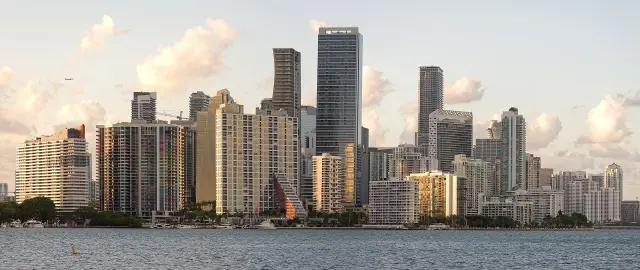
Much of the stock is recent. In the same table, 17.2 percent of Miami units were built from 2000 to 2009, 16.1 percent from 2010 to 2019 and 3.2 percent in 2020 or later (ACS DP04), so more than a third of the city's homes were built in 2000 or later. The Brickell condo guide, the Miami new construction 2026 guide and the Miami neighborhoods guide go deeper on where those towers stand.
How does the homestead exemption work for a Miami home?
A Miami owner who lives in the home as a primary residence can apply to the Miami-Dade Property Appraiser for a homestead exemption worth up to $50,000 of taxable value, by March 1 (Miami-Dade Property Appraiser).
The first $25,000 applies to all taxing authorities. The second $25,000 excludes School Board taxes and applies only to assessed values above $50,000 (Miami-Dade Property Appraiser). Florida voters approved Amendment 5 on November 5, 2024, which adjusts that second exemption each year by the Consumer Price Index, so the Miami-Dade exemption came to $50,722 for tax year 2025.
The Property Appraiser accepts timely applications through March 1 and takes calls at 305-375-4712. Late filings may still be accepted up to the deadline printed on the TRIM notice. An assessment reduction on homesteads caps annual property value increases, and portability lets a homeowner transfer savings to a new homesteaded property (Miami-Dade Property Appraiser). Renting the home out can put the exemption at risk.
Timing matters for a Miami buyer. To qualify, an owner must hold legal or equitable title and have permanent residence on the property as of January 1, and the Property Appraiser lets applicants track application status online after submitting (Miami-Dade Property Appraiser). The exemption covers the owner's permanent residence, so a Miami condo that is not the owner's permanent residence does not qualify.
When are Miami property taxes cheapest to pay?
Miami property taxes are cheapest in November, when the Miami-Dade Tax Collector applies a 4 percent early payment discount (Miami-Dade Tax Collector).
| Month paid | Discount |
|---|---|
| November | 4 percent |
| December | 3 percent |
| January | 2 percent |
| February | 1 percent |
| March | None, gross tax |
The discount counts from the date a payment is submitted online or in person, and from the postmark date when mailed (Miami-Dade Tax Collector). When a discount period ends on a Saturday, Sunday or legal holiday, the due date moves to the following business day for payments made online or in person, and Florida Statute 197.122 requires taxes to be paid before April 1 of the year after they are assessed. Miami-Dade County, the School Board, municipalities and other agencies all levy taxes on the Property Appraiser's taxable value, and the TRIM notice shows what the November bill is likely to be (Miami-Dade Property Appraiser).
A practical reading of the schedule for Miami owners: on a bill of $10,000, the November discount is worth $400 and the February discount $100, while a payment made in March pays the full gross amount (Miami-Dade Tax Collector).
What inspections do older Miami condo buildings need?
Miami-Dade buildings must be recertified at 30 years and every 10 years after, and condominium and cooperative buildings three stories or taller within three miles of the coastline, built on or after 1998, reach that point at 25 years (Miami-Dade Building).
The schedule changed after a state law took effect on May 26, 2022, creating milestone inspections for condominium and cooperative buildings three stories and taller; Miami-Dade amended its own program, which dates to 1975, on June 1, 2022 (Miami-Dade Building). Coastal condominium and cooperative buildings three stories or taller built between 1983 and 1997 within three miles of the coastline had to be inspected by December 31, 2024. Once an owner gets the Notice of Required Recertification, the report is due within 90 days. Single-family homes, duplexes and buildings with an occupant load of 10 or less do not go through recertification.
Who enforces it depends on the address. Miami-Dade County has 35 municipalities, and each municipal building official holds jurisdiction over permitting, inspections and recertifications (Miami-Dade Building), so a building inside the City of Miami recertifies through the city's building official. The City of Miami Office of Capital Improvements runs a program to recertify City-owned municipal, public safety and parks buildings under the same 30 year rule, 25 years by the water (City of Miami Office of Capital Improvements).
Tall Miami towers get a more technical inspection. The county says any building four stories or taller, and any other threshold building, must be inspected separately by a Florida licensed structural engineer and a Florida licensed electrical engineer (Miami-Dade Building). The county also notes that owners and condominium associations with doubts about a high-rise structure can commission a structural engineer on their own, even before their municipality requires a recertification.
How is a Miami property's zoning or flood status checked?
Zoning inside the City of Miami follows the Miami 21 code, and a property whose folio number does not begin with 01 is not within the City of Miami (City of Miami Zoning FAQs).
The city zoning FAQ says to search the GIS site by address or folio and open the Zoning tab; a folio that does not start with 01 is outside the City of Miami and the city GIS shows nothing for it (City of Miami Zoning FAQs). Allowed uses by transect zone are in Miami 21 Article 4 Table 3. A short-term rental of less than 30 days counts as a lodging use, allowed only where lodging is permitted and only with a Building Certificate for the structure.
For flood insurance, the City of Miami holds Community Rating System class 6, effective October 1, 2022, worth a 20 percent premium discount inside special flood hazard areas and 10 percent outside them (FEMA NFIP community status book). The FEMA record lists the currently effective map date as 02/19/27, a date still ahead as of October 15, 2026. FEMA gives September 29, 1972 as the date of the city's initial flood hazard boundary map and initial flood insurance rate map. Last verified: October 15, 2026, on the FEMA, Miami-Dade Property Appraiser and City of Miami websites.
Which Miami real estate guide answers which question?
Six Miami real estate guides sit under this hub: Brickell condos, Coconut Grove, luxury condos 2026, market trends, neighborhoods and new construction 2026.
| Question | Guide |
|---|---|
| What is the Brickell condo market like? | Brickell condo market guide |
| What sets Coconut Grove apart as a Miami submarket? | Coconut Grove real estate guide |
| Where are Miami luxury condos and how are they selling? | Miami luxury condos 2026 guide |
| Is the Miami market rising or cooling? | Miami market trends guide |
| How do Miami neighborhoods differ? | Miami neighborhoods guide |
| What towers and projects are being built? | Miami new construction 2026 guide |
| What do homes cost and who owns them? | This hub: $518,100 median value, 30.8 percent owner occupied (ACS 2020-2024) |
Digital Towns does not list properties or name agents or brokerages; the Miami guides explain the market and the public rules that govern buying, owning and renting in the city.
Frequently asked questions
What is the median home value in Miami, Florida?
The ACS 2020-2024 5-year estimates put the median owner-occupied home value in the City of Miami at $518,100, with a median gross rent of $1,758 a month. These are five-year Census estimates, not current sale prices.
Do most people in Miami rent or own?
Most rent. In the ACS 2020-2024 5-year estimates, 69.2 percent of occupied housing units in the City of Miami were renter occupied and 30.8 percent owner occupied, with a rental vacancy rate of 6.5 percent.
When is the homestead exemption deadline in Miami-Dade?
Timely homestead exemption applications are due to the Miami-Dade Property Appraiser by March 1; late applications may still be accepted up to the deadline on the TRIM notice. The exemption is worth up to $50,000 of taxable value, adjusted by CPI to $50,722 for 2025. Questions go to 305-375-4712.
How much is the discount for paying Miami-Dade property taxes early?
The Miami-Dade Tax Collector applies 4 percent in November, 3 percent in December, 2 percent in January and 1 percent in February. Taxes paid in March carry no discount. Mailed payments count by postmark.
When does a Miami condo building need recertification?
Miami-Dade buildings recertify at 30 years and every 10 years after. Condominium and cooperative buildings three stories or taller within three miles of the coast, built in 1998 or later, recertify at 25 years. In the City of Miami the city building official handles it.
Sources
- U.S. Census Bureau, ACS 2020-2024 5-year DP04, Miami city https://data.census.gov/api/access/data/table?id=ACSDP5Y2024.DP04&g=160XX00US1245000 Used for: housing units, tenure, home value, rent, owner costs, units in structure, year built, vacancy
- Miami-Dade Property Appraiser, Homestead Exemption https://www.miamidadepa.gov/pa/exemptions_homestead.asp Used for: exemption amounts, 2025 CPI amount, March 1 deadline, phone, Save Our Homes
- Miami-Dade Tax Collector, Discounts for Early Payment https://mdctaxcollector.gov/discounts-for-early-payment Used for: 4 to 1 percent discount schedule, postmark rule
- Miami-Dade County Building Recertification https://www.miamidade.gov/global/economy/building/recertification.page Used for: 30 and 25 year schedules, 2022 state law, 90 day report, 35 municipalities
- City of Miami, 40-50 Year Building Recertification Program https://www.miami.gov/My-Government/Departments/Office-of-Capital-Improvements/Capital-Improvements-Projects-Construction-Notices-Per-District/City-Wide-Projects/40-50-Year-Building-Recertification-Program Used for: 30 years, 25 by the water, City-owned buildings
- City of Miami Zoning FAQs https://www.miami.gov/Planning-Zoning-Land-Use/Zoning-FAQs Used for: folio 01 rule, Miami 21 Article 4 Table 3, short term rentals as lodging
- FEMA NFIP Community Status Book, City of Miami 120650 https://www.fema.gov/api/open/v1/NfipCommunityStatusBook?$filter=communityIdNumber%20eq%20%27120650%27 Used for: CRS class 6, discounts, map dates
How this page was made
Digital Towns uses AI assistance to research and write its guides, and every page is only as good as the sources it cites. Our goal is the most accurate, useful local information possible.
This page was fact-checked twice before publishing.
If you see an error, or anything you can show is false, tell us right away and we will take a third look.
Report an error
Thank you. We'll take a third look and correct the page if it's wrong.