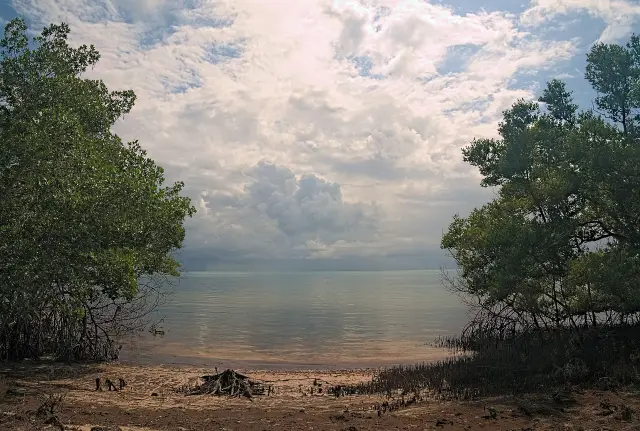
Short answer: Brown pelicans nest on Pelican Island in the Indian River Lagoon off Sebastian, and the U.S. Fish and Wildlife Service says fall through spring is the best time to see the nesting birds. The island, now roughly 3 acres, is closed to landing but visible from the Centennial Trail tower on Jungle Trail. Florida's brown pelicans left the federal endangered list in 1985, and the species was fully delisted in 2009.
Last verified: October 11, 2026, against the sources listed at the end of this page.
Where are brown pelicans seen around Sebastian?
Around Sebastian, brown pelicans nest on Pelican Island in the Indian River Lagoon and rest and feed around Sebastian Inlet, where the Sebastian Inlet District has photographed them gathered on an oyster reef on the flood shoal.
Pelican Island is the core site. The U.S. Fish and Wildlife Service says at least 16 bird species have been documented nesting on Pelican Island proper, with the brown pelican first on its list, followed by the great egret, roseate spoonbill and wood stork (USFWS). The island sits inside Pelican Island National Wildlife Refuge, whose more than 5,400 acres of protected waters and lands lie near the coastal community of Sebastian (USFWS).
At the inlet, the Sebastian Inlet District wildlife page shows pelicans gathered on an oyster reef on the flood shoal side of Sebastian Inlet, one of the photographs the district keeps of the marine life and birds around the inlet it maintains.
The rocks are the other meeting point. Florida State Parks says impressive catches are often made from the two jetties that extend into the Atlantic at Sebastian Inlet State Park, and lists more than 180 bird species that visitors can see at the park over a year (Florida State Parks). Where pelicans and fishing lines meet on those jetties, the FWC hooked-bird guidance further down this page applies.
When do brown pelicans nest at Pelican Island near Sebastian?
The U.S. Fish and Wildlife Service says fall through spring is the best time to see nesting brown pelicans at Pelican Island, the island in the Indian River Lagoon off Sebastian.
The refuge's main page pairs those nesting brown pelicans with migratory white pelicans in the same fall to spring window, and its species page says spring brings migration and mating, with the nesting colony on Pelican Island proper. Summer is the least active season for wildlife at the refuge, according to the same page.
A nest is a short project. The Audubon field guide gives 3 eggs, sometimes 2 to 4, incubated by both parents for roughly 28 to 30 days, with young first flying at a reported 9 to 12 weeks or more. It says brown pelicans nest on islands, bare and rocky or covered with mangroves or other trees, the description that fits the mangrove island in the Indian River Lagoon east of Sebastian.
The island is smaller than it was. The refuge says Pelican Island proper covered 5.5 acres when it became a wilderness area in 1970 and is now roughly 3 acres because of boat-induced wave action and sea-level rise, making the Pelican Island Wilderness the smallest unit of the National Wilderness Preservation System (USFWS).
The colony is watched from shore. The Great Florida Birding and Wildlife Trail says the island is off limits to visitors but viewable from a boat kept outside the closed area, or from land via the Centennial Trail on Jungle Trail, which ends at an elevated observation tower with two fixed viewing scopes (FWC birding trail). The refuge's public use areas on the Historic Jungle Trail are 3.3 miles south of Sebastian Inlet and open daily from 7:30 am until sunset (USFWS).
How is a brown pelican told apart from a white pelican at Sebastian?
At Sebastian the brown pelican is the dark, year-round bird that plunges headfirst for fish, while the American white pelican is a white winter visitor to Pelican Island that does not dive from the air.
The U.S. Fish and Wildlife Service species profile describes the adult brown pelican as a large dark gray-brown water bird with white about the head and neck, with immatures gray-brown above and white underneath. Adults can reach up to 8 pounds, and larger individuals have wing spreads of over 7 feet, the bird seen over Sebastian Inlet State Park and the lagoon.
Feeding style settles it. The Audubon field guide says brown pelicans forage by diving from as high as 60 feet, plunging into the water headfirst and surfacing with fish in the bill, then tilting the bill to drain the pouch. Audubon also notes the species can scavenge and become tame, even approaching fishermen for handouts, behavior that brings pelicans close to the anglers on Sebastian Inlet's jetties.
White pelicans follow a calendar instead. The FWC's birding trail says American white pelicans overwinter at Pelican Island National Wildlife Refuge, and the refuge describes them migrating south to spend a warm winter there (USFWS). Both species can be on the lagoon off Sebastian in the same winter months.
Are brown pelicans still endangered?
No: brown pelicans in Florida, the birds that nest at Pelican Island off Sebastian, came off the federal endangered list in 1985, and the U.S. Fish and Wildlife Service removed the species' remaining populations in 2009.
The federal account of that recovery is the November 2009 U.S. Fish and Wildlife Service delisting story. It says the brown pelican was first declared endangered in 1970 under the Endangered Species Preservation Act and credits the federal ban on general use of the pesticide DDT in 1972. By 2009 there were more than 650,000 brown pelicans across Florida, the Gulf and Pacific coasts, the Caribbean and Latin America. The same story ties the bird back to Sebastian, saying past efforts to protect the brown pelican led to the birth of the National Wildlife Refuge System in central Florida.
Florida birds also helped other states. The story says 1,276 young pelicans were captured in Florida and released at three sites in southeastern Louisiana over the 13 years of a restoration project run with the Florida Game and Fresh Water Fish Commission. Protection did not end with delisting: the Migratory Bird Treaty Act and the Lacey Act still protect the brown pelican, its nests and its eggs, including the colony in the Indian River Lagoon.
| Year | Event | Source |
|---|---|---|
| 1903 | Executive order makes Pelican Island the nation's first national wildlife refuge for nesting birds | USFWS |
| 1970 | Brown pelican declared endangered; Pelican Island designated wilderness at 5.5 acres | USFWS |
| 1972 | Federal ban on general use of DDT | USFWS |
| 1985 | Florida and Atlantic coast population removed from the endangered list | USFWS |
| 2009 | Remaining populations removed; more than 650,000 birds | USFWS |
| Today | Pelican Island proper about 3 acres; at least 16 species nest there | USFWS |
What is the FWC guidance for a pelican hooked at Sebastian Inlet?
For a pelican hooked by mistake at Sebastian Inlet or on the lagoon, the FWC's advice is to keep the line, reel the bird in slowly, remove the hook and release it, or call the Wildlife Alert Hotline at 888-404-3922.
In an August 15, 2016 report by WFSU, the FWC's avian conservation coordinator said anglers should not cut the line, because a bird trailing line can fly off, become entangled and entangle other birds, which can lead to death or injury. Pelicans, the report says, are typically the birds caught on these hooks, which makes the advice relevant on the jetties at Sebastian Inlet.
The steps described are to use a net to lift the bird from the water, grasp it with one hand behind the eyes, fold the wings and hold it against the body, then push the hook through, cut off the barb and back the hook out, releasing the bird if it shows no sign of distress. Anyone in Sebastian not equipped to do that can take the bird to a local rehabilitator or contact the FWC hotline at 888-404-FWCC.
Frequently asked questions
When is the best time to see brown pelicans nesting near Sebastian?
The U.S. Fish and Wildlife Service says fall through spring is the best time to see nesting brown pelicans at Pelican Island National Wildlife Refuge, east of Sebastian in the Indian River Lagoon. Summer is the least active season for wildlife there.
Can people land on Pelican Island to see the pelicans?
No. The FWC birding trail says the island is off limits to visitors. It can be viewed from a boat kept outside the closed area, or from the observation tower at the end of the Centennial Trail off Jungle Trail, which has two fixed scopes.
How big is Pelican Island today?
The U.S. Fish and Wildlife Service says Pelican Island proper covered 5.5 acres in 1970 and is now roughly 3 acres, worn down by boat wakes and sea-level rise. It is the smallest unit of the National Wilderness Preservation System.
Are the white pelicans on the Indian River Lagoon at Sebastian a different species?
Yes. American white pelicans are winter visitors that overwinter at Pelican Island National Wildlife Refuge, according to the FWC birding trail, while brown pelicans are the darker birds that nest there and dive headfirst for fish.
Which laws protect brown pelicans at Sebastian after delisting?
The U.S. Fish and Wildlife Service says the Migratory Bird Treaty Act and the Lacey Act continue to protect the brown pelican, its nests and its eggs, even though the species left the endangered list in Florida in 1985 and everywhere in 2009.
Sources
- Pelican Island National Wildlife Refuge (USFWS) https://www.fws.gov/refuge/pelican-island Used for: 5,400+ acres; Centennial trail and tower; fall through spring nesting brown pelicans
- Pelican Island NWR About Us (USFWS) https://www.fws.gov/refuge/pelican-island/about-us Used for: 1903 order; wilderness 1970; island shrank from 5.5 to about 3 acres
- Pelican Island NWR Species (USFWS) https://www.fws.gov/refuge/pelican-island/species Used for: 16 nesting species; white pelicans in winter
- Pelican Island NWR Visit Us (USFWS) https://www.fws.gov/refuge/pelican-island/visit-us Used for: Jungle Trail location, hours
- Pelican Island NWR, Great Florida Birding and Wildlife Trail (FWC) https://floridabirdingtrail.com/site/pelican-island-national-wildlife-refuge/ Used for: island off limits, view by boat or land, scopes, white pelicans overwinter
- Brown Pelican species profile (USFWS) https://www.fws.gov/species/brown-pelican-pelecanus-occidentalis Used for: size, wingspan, plumage
- Brown Pelican Populations Recovered, Removed from Endangered Species List (USFWS, Nov. 2009) https://www.fws.gov/story/2009-11/brown-pelican-populations-recovered-removed-endangered-species-list-0 Used for: 1970 listing, 1972 DDT ban, 1985 and 2009 delisting, 650,000, MBTA
- Brown Pelican, Audubon Field Guide https://www.audubon.org/field-guide/bird/brown-pelican Used for: plunge diving, eggs, incubation, nesting habitat, movements
- Wildlife Sanctuary (Sebastian Inlet District) https://www.sitd.us/wildlife-sanctuary-af8b156 Used for: pelicans on oyster reef, flood shoal
- Sebastian Inlet State Park Experiences and Amenities (Florida State Parks) https://www.floridastateparks.org/parks-and-trails/sebastian-inlet-state-park/experiences-amenities Used for: two jetties, 180 bird species
- FWC To Anglers Who Accidentally Hook Seabirds: Don't Cut The Fishing Line (WFSU, Aug. 15, 2016) https://news.wfsu.org/post/fwc-anglers-who-accidentally-hook-seabirds-don-t-cut-fishing-line Used for: hooked pelican guidance and hotline
How this page was made
Digital Towns uses AI assistance to research and write its guides, and every page is only as good as the sources it cites. Our goal is the most accurate, useful local information possible.
This page was fact-checked twice before publishing.
If you see an error, or anything you can show is false, tell us right away and we will take a third look.
Report an error
Thank you. We'll take a third look and correct the page if it's wrong.